The laughter was quiet enough to deny — but loud enough to cut through every inch of that auditorium.
A young SEAL lieutenant leaned back in his chair, Trident gleaming, watching a woman cross the room with a crutch and a limp she couldn’t fully hide. He didn’t know her story. He didn’t know anyone’s story but his own. And that was about to destroy him.
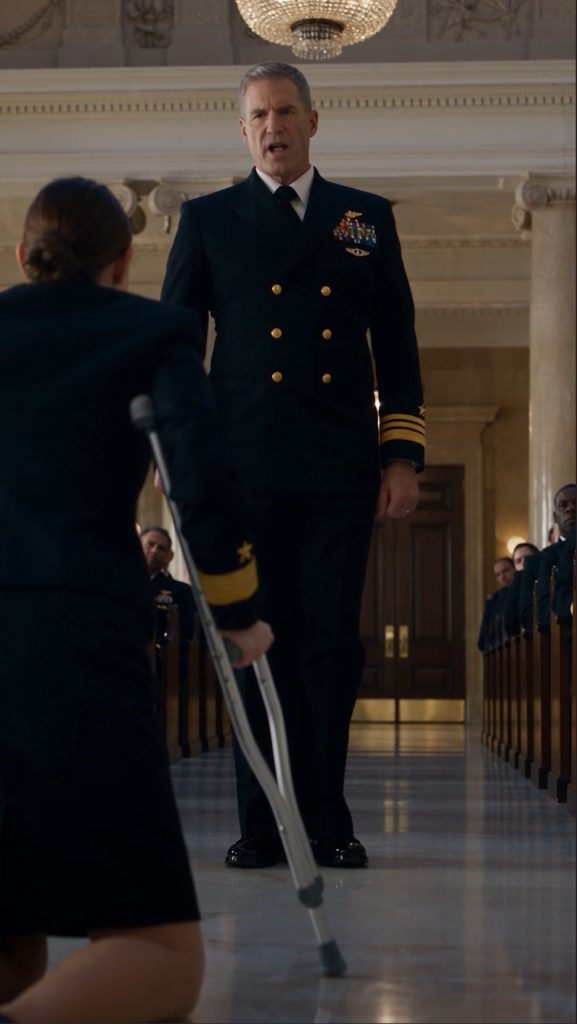
She moved slowly down the center aisle. Click. Step. Pause. Click. Her left hand gripped the aluminum so tightly the metal pressed white lines into her palm. Beneath the dark fabric of her Navy dress uniform, her right leg ended in carbon fiber and titanium — a prosthetic she’d earned in fire and blood.
Nobody in those seats knew how many times she’d fallen learning to walk again. How many nights she’d torn open a healing wound because she refused to wait for the doctors’ permission. How she’d gripped parallel bars until her palms split and bled, then gripped them again the next morning.
“Easy there, Captain,” the lieutenant murmured as she passed his row. “Wouldn’t want you tripping over that thing.”
A few men laughed behind their hands. One pretended to cough.
She didn’t look back.
He took her silence as surrender.
“Seriously, Captain — watch yourself.” His voice rose now, no longer hiding. His friends watched him with half-grins, waiting for the next line. He gave it to them without hesitation.
“If you need a crutch just to cross the room, maybe this isn’t exactly the place for you.”
The words landed like a grenade with the pin already pulled.
Heads turned. A commander near the stage went rigid. Two junior officers exchanged uneasy glances. A woman in the second row dropped her eyes to her lap. No one said a word — and that silence gave the cruelty all the room it needed.
Captain Claire Bennett stopped walking.
For a moment, she wasn’t in that auditorium anymore. She was inside a burning aircraft. Smoke filled her throat. Aviation fuel scorched the air. Someone was screaming through the flames. Another voice begged her not to leave him behind.
She remembered crawling toward the first wounded man. Dragging him out. Going back. Finding another. Going back again. The heat was unbearable by then. Someone ordered her to stop.
She didn’t.
Then came the blast. White light. Pressure. Nothing. And later — a hospital ceiling, a surgeon’s careful voice, and the quiet devastation of learning what the explosion had taken from her body.
She blinked. The auditorium returned. The lieutenant was still watching her. Still amused.
Slowly, she turned toward him. Sunlight caught the ribbons above her heart. Her voice never rose.
“Tell me, Lieutenant — what exactly do you think this crutch means?”
His smile cracked. He glanced sideways. None of his friends were laughing anymore.
“It means you were injured, Captain.”
Before she could respond, the admiral at the lectern stepped forward. His jaw was set like stone.
“No, Lieutenant.”
The word echoed off every wall.
“It means Captain Bennett went back into a burning aircraft three times after losing half her team.”
The lieutenant’s face drained of color. His chest stopped moving.
The admiral opened the citation folder. His eyes dropped to the first line.
“And you will remain standing while I read the names of the seven men Captain Bennett carried out before the blast took her leg.”
He looked directly at the young SEAL.
Then spoke the first name on that list — the name that would shatter everything Lieutenant Mercer thought he knew about his own father, the war, and the woman he had just humiliated in front of every officer in that room.
“Chief Petty Officer Michael Mercer.”
The sound that left Evan Mercer’s throat wasn’t a word. It was something older than language — the airless, gutted noise of a man watching the floor beneath his entire identity crack open.
His knees didn’t buckle. They simply stopped working.
He caught himself on the chair in front of him, fingers gripping the wooden back so hard his knuckles turned the color of bone. The officer sitting there flinched but didn’t turn around. No one turned around. Every pair of eyes in that auditorium had found somewhere else to look — the ceiling, the program, the floor — because what was happening to Lieutenant Mercer’s face was too private and too devastating to witness directly.
The admiral continued reading.
“Petty Officer First Class David Gutierrez.”
Claire stood motionless in the aisle. She hadn’t known Mercer’s last name when she’d heard his voice behind her. She hadn’t connected it. Not until this moment, when the admiral spoke the name she had whispered into a dying man’s ear while dragging him through smoke — and the young lieutenant in the third row stopped breathing entirely.
“Hospital Corpsman Second Class James Aldridge.”
Each name fell into the silence like a stone into still water.
“Aviation Ordnanceman Third Class Robert Nakamura.”
Evan’s lips were moving now. Not speaking. Counting. His father had told him the story a hundred times — the crash, the fire, the officer who kept coming back. But his father had never said it was a woman. Had never said her name. Had only ever said, “Someone came for me when no one else would.”
“Petty Officer Second Class Andre Williams.”
Claire’s crutch trembled against the polished floor. Not from weakness. From memory. Andre had been pinned beneath a section of fuselage, screaming her name as the heat peeled paint from the metal above them. She’d burned both hands pulling him free. The scars still mapped her palms like pale rivers.
“Aviation Electrician’s Mate Third Class Thomas Hargrove.”
Six names. Six men breathing air today because a woman smaller than most of them had refused a direct order to stop.
“Airman Kyle Pruitt.”
Seven.
The admiral closed the folder. The sound was sharp and final — a single clap of paper against leather that seemed louder than any voice in the room.
“Captain Bennett received the Navy Cross for extraordinary heroism,” the admiral said, his voice lower now, weighted with something that went beyond protocol. “She sustained the injuries that cost her left leg during her third reentry into the aircraft. She was still carrying Airman Pruitt when the secondary explosion occurred.”
He paused.
“She shielded his body with her own.”
Two hundred people in that auditorium. Not one of them moved. Not one of them breathed loudly enough to hear.
Evan Mercer stood in the third row with tears running silently down both cheeks. His Trident — the golden insignia he’d earned through the most punishing selection process in the military — caught the same afternoon light that touched Claire’s ribbons. But it looked different now. Smaller. Like a child’s trophy placed beside something immeasurably larger.
Claire finally turned away from him. She took another step toward the stage. Click. Step. Pause. The sound filled the auditorium differently now — not awkward, not pitiful, but measured. Deliberate. The rhythm of a woman who had learned to walk again because stopping was never something her body understood.
The admiral descended the three steps from the stage and met her at the bottom.
He didn’t wait for her to climb.
He came to her.
In his hands was a small blue case. He opened it without ceremony, and inside lay the Navy Cross — a bronze cross suspended from a dark blue ribbon with a single white center stripe. It was smaller than most people expected. Every decoration that mattered always was.
Claire lowered her head.
The admiral pinned it above her heart, beside the other ribbons she never spoke about. His fingers were steady, but when he stepped back, Claire saw that his eyes were not.
“On behalf of a grateful nation,” he said quietly, and the rest of the words disappeared beneath the sound of every person in that auditorium rising to their feet.
Every person except one.
Evan Mercer had not sat back down since the admiral ordered him to remain standing. But he wasn’t standing at attention anymore. He was standing the way a man stands when the ground he built his whole life on has just been pulled away — unsteady, hollowed, stripped of every assumption he had carried into that room.
The applause lasted a long time. Claire stood at the base of the stage, one hand on her crutch, the other at her side, her chin raised, her eyes fixed on a point beyond the back wall of the auditorium — beyond the room, beyond the ceremony, somewhere only she could see.
When the applause finally faded, the officers began to settle back into their seats. Programs rustled. Throats cleared. The ceremony would continue — other awards, other names, other stories — but the air had changed. Something permanent had entered that room, and it would never fully leave.
Claire turned to walk toward her seat.
She passed the third row.
And Evan Mercer stepped into the aisle.
He didn’t speak immediately. He stood in front of her — this woman he had mocked, this woman who had crawled through fire to carry his father out of hell — and his mouth opened, closed, opened again.
“Captain.” His voice broke on the second syllable. “I didn’t — I didn’t know.”
Claire studied him for a long moment. Her face revealed nothing. Then something shifted behind her eyes — something that looked less like anger and more like exhaustion. The exhaustion of someone who had spent years surviving rooms full of people who didn’t know.
“Your father,” she said softly, “talked about you while I was dragging him out. He told me his son wanted to be a SEAL.”
Evan’s face shattered completely.
“He was on fire, Lieutenant. Half his uniform had melted into his skin. And the only thing he could talk about was how proud he was of his boy.”
Evan’s hand came up to his face. Not to wipe the tears — they were beyond wiping now — but to cover his mouth, because the sound trying to escape from inside him was not something he wanted two hundred people to hear.
Claire watched him. Then she did something no one in that auditorium expected.
She shifted her crutch to her right hand. And with her left — the hand still scarred from the fire that had almost killed her — she reached out and gripped Evan Mercer’s shoulder.
Not hard. Not soft. The way a commanding officer steadies a sailor who has lost his footing.
“You didn’t know,” she said. “Now you do.”
She held his shoulder for three full seconds. Then she released him, repositioned her crutch, and walked the rest of the way to her seat.
Click. Step. Pause. Click.
The auditorium was so quiet that every person in it could hear the rhythm of her walking — that steady, unbreakable cadence that had carried seven men out of fire and carried her through every room built for judgment since.
Evan Mercer remained standing in the aisle long after she passed. His friends in the third row sat motionless, eyes down, hands folded over their programs like men sitting in church after hearing something they would never be able to unhear.
The ceremony continued. Other names were called. Other awards were given. But no one in that auditorium was truly listening anymore. They were all still inside the same moment — the moment a young man with a golden Trident on his chest learned that the woman he’d ridiculed for needing a crutch was the reason he still had a father.
Three weeks later, a letter arrived at Claire Bennett’s apartment. No return address. She opened it at her kitchen table, morning light filling the small room, a cup of coffee growing cold beside her hand.
Inside was a single photograph — old, creased, taken in a military hospital. In it, a younger Claire lay unconscious in a bed, her left leg wrapped in heavy bandages, both hands cocooned in gauze. And sitting beside her, hunched forward in a plastic chair with an IV still in his arm, was Chief Michael Mercer. His head was bowed. His burned hands were folded together. He was praying.
On the back of the photograph, in shaky handwriting she didn’t recognize, someone had written five words:
He sat there for three days.
Beneath that, in different ink, a second line — steadier, newer, written by a hand she somehow knew belonged to a lieutenant who had finally understood what courage looked like:
Thank you for giving him back to us.
Claire set the photograph against the windowsill where the morning sun could reach it.
Then she picked up her crutch, rose from the table, and walked into the light.