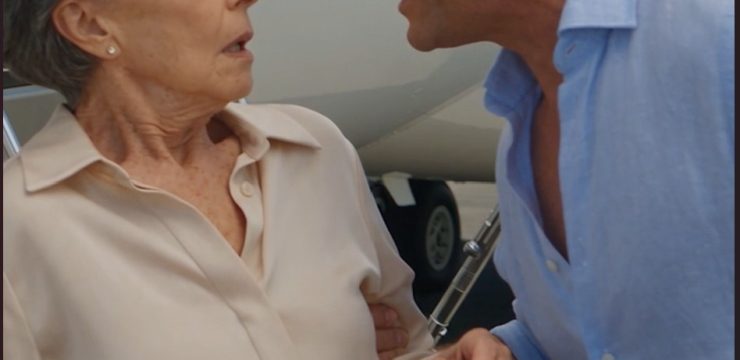
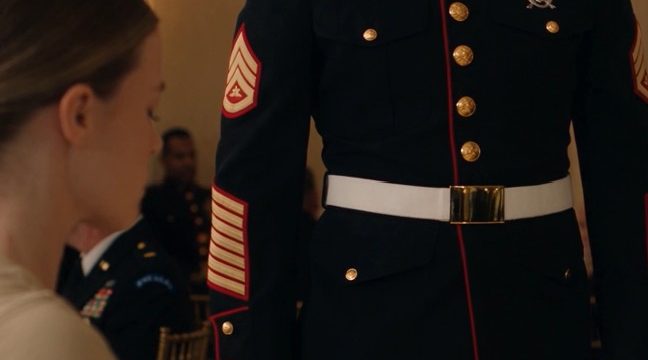
The laughter died before anyone understood why.
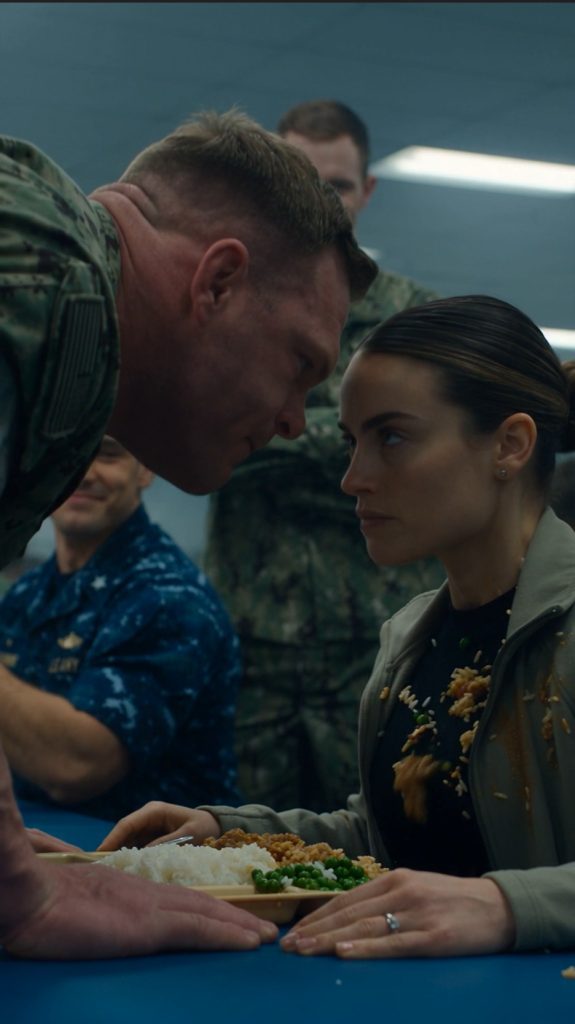
A lunch tray balanced dangerously at the edge of the table, one careless shove away from crashing to the floor. Across from it, a woman sat perfectly still while six mud-soaked men surrounded her—and somewhere behind them, a young sailor had just noticed something on her hand that made his blood run cold.
“Get up,” Sergeant Mason Reed said.
He had already shoved her tray aside. The fork rolled once, struck a paper cup, and stopped with a hollow click.
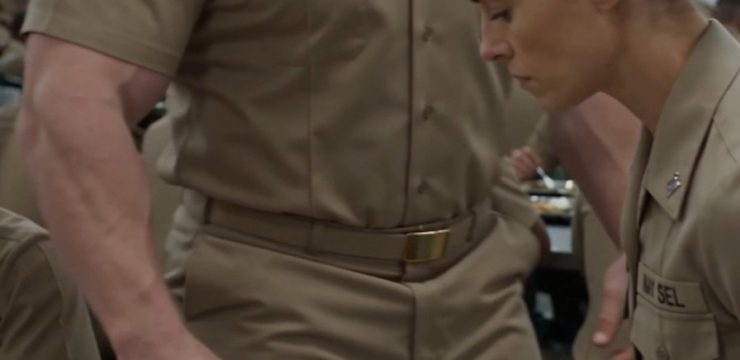
Around them, the SEAL cafeteria at Naval Amphibious Base Coronado seemed to tighten into silence.
“This section is for operators.”
The woman looked at Mason’s fist planted on the table, then slowly raised her eyes to his face.
She appeared around forty, perhaps older. Dark hair tied low. Gray field jacket over a black T-shirt. No rank. No unit patch.
Only a long, pale scar crossing the back of her right hand.
Before Mason arrived, she had been quietly eating turkey, rice, green beans, and drinking black coffee. Now six men fresh from training boxed her in, water dripping from their boots, mud drying across their uniforms.
“Maybe she didn’t hear you,” Corporal Tyler Boone said, grinning.
Mason never looked away from her.
“She heard me.”
The woman calmly wiped one fingertip with her napkin.
“You sure you want to start here?”
Nearby conversations weakened.
Mason smiled. “Start what?”
Her eyes flicked toward the clock.
11:42 a.m.
Then back to him.
“That depends on what you think you’re doing.”
The men laughed.
She didn’t.
“You walk into a SEAL team cafeteria dressed like a civilian,” Mason said. “Take a corner table like you own it. Sit there staring at people who earned this room.”
She glanced around at the plastic trays, framed unit photographs, schedules pinned to a bulletin board. Outside, California sunlight blazed across the training yard, the Pacific shining beyond it.
“You believe the room was earned by volume?”
Mason’s eyes hardened.
“What?”
“You’re loud,” she said. “That seems important to you.”
Someone muttered, “Damn.”
Mason stepped closer and pressed his boot against the leg of her chair.
A small movement.
A deliberate one.
Her gaze dropped to his boot, then returned to his face.
“Careful.”
Tyler pointed toward the scar on her hand. “What happened there? Rough day opening canned soup?”
Laughter exploded behind him.
Her fingers tightened around the napkin.
Nothing else moved.
Mason studied the scar. “Looks painful.”
“It was.”
“Kitchen accident?”
“No.”
The word landed strangely.
For one second, nobody laughed.
Mason broke the silence by lifting her tray. Coffee trembled inside the cup. Rice slid toward the edge as he moved it farther away, then pushed it until it rested against the table’s raised lip.
One more touch would send everything crashing down.
“Stand up.”
Her eyes remained on the tray.
“That meal belongs to me.”
“This seat belongs to people who bled for this country,” Mason said.
He paused.
“Real blood.”
A chair scraped somewhere behind them.
“Mason, chill,” someone whispered.
He ignored it.
The woman finally met his eyes again.
“Are you certain those are the words you want remembered?”
Mason laughed.
“Lady, I’m not repeating myself for someone who doesn’t understand combat.”
She studied him without anger.
Without fear.
It was something colder.
Measurement.
“Combat?”
“The thing you read about,” Mason said.
Tyler laughed again.
Mason pointed toward the exit. “Visitor center’s down the road.”
The woman leaned back slightly, the metal chair creaking beneath her.
At the nearest table, twenty-two-year-old sailor Ethan Cole stopped moving.
He had noticed her before Mason had.
Not because of her face.
Not because of the scar.
Because of the black steel ring on her left hand.
Plain. Dark. Worn along the edges.
A thin engraved line circled the band.
Ethan knew that line.
He had seen it once inside a sealed training file pulled from a restricted archive during an advanced briefing. The image had remained on the projector for barely five seconds before the instructor shut it off.
Someone had asked what the ring meant.
The instructor’s answer had been quiet.
“Pray you never need to know.”
Now Ethan stared at that same ring across the cafeteria while Mason stood over the woman, unaware of what he had just stepped into.
And nobody in that room was prepared for what came next. 👇
Ethan set the bottle down so carefully that the plastic barely clicked against the table.
“Sergeant,” he said, his voice thinner than he wanted. “Step away from her.”
Mason turned, almost amused. “You giving me an order, Cole?”
“No.” Ethan swallowed. His eyes stayed on the ring. “I’m telling you I know what that is.”
The woman’s gaze shifted to him for the first time. Something changed in her face—not fear, but recognition that he had noticed what she had hoped would remain unnoticed.
Tyler’s grin faded. “Know what?”
“Black steel. Single cut around the band.” Ethan rose. “It was in the Nightglass file.”
The room seemed to lose its air.
Mason looked back at the woman. “That file’s restricted.”
“So is the name attached to it,” Ethan said.
The woman stood.
She was not tall enough to make Mason step back. He stepped back anyway.
“My name is Commander Lena Vale,” she said. “Retired.”
No one laughed.
“I came here at Rear Admiral Mercer’s request,” Lena continued. “Not to inspect this cafeteria. I came to speak to one sailor before I left Coronado.”
Her eyes moved to Ethan.
Mason seized on the hesitation. “Then this is some kind of setup.”
“No,” Lena said. “What you did happened because you believed no one important was watching.”
A door opened near the serving line.
Captain Daniel Hargrove entered with two senior chiefs. His eyes moved from Lena’s displaced tray to Mason.
“Don’t touch anything,” Hargrove said. “Security has the last twelve minutes.”
Mason’s face drained.
“I don’t want theater,” Lena said.
“You won’t get it,” Hargrove replied. “You’ll get procedure.”
Mason’s jaw tightened. “Sir, she provoked us. She disrespected the team.”
“By eating lunch?”
Silence.
Then Mason pointed at Lena’s scar.
“We bleed for this place. People like her don’t know what that costs.”
Ethan closed his eyes.
Lena did not.
“Nightglass cost me eleven people,” she said.
Mason’s hand dropped.
“We were pinned inside a burned-out clinic outside Mosul. No clean extraction. No air support. Two men were already dead. Three more were bleeding out.”
Her thumb moved over the pale scar.
“The ring belonged to a small joint recovery cell. We went where ordinary extraction was no longer considered possible.”
Mason stared at the black band.
“Your instructor told you to pray you never needed to know what it meant because if you saw one of us coming for you, everyone else had already failed to get you home.”
No one in the cafeteria moved.
Then Lena looked at Ethan.
“Your father was there.”
The words struck him like a physical blow.
“My father?”
“Chief Aaron Cole.”
Ethan gripped the table.
For twelve years, he had known only the official version: helicopter crash, hostile territory, remains recovered later.
Lena stepped closer.
“He didn’t die in the crash.”
Ethan’s lips parted.
“He survived the impact,” Lena said. “He got two injured men out before the fuel caught. Then he came back for me.”
Her hand trembled for the first time.
“This scar happened when a roof panel collapsed. I was trapped underneath it. Your father could have made the extraction window.”
Ethan whispered, “But he didn’t.”
“No.”
Lena’s breath broke.
“He stayed.”
Ethan pressed a fist against his mouth.
“He lifted enough of the panel for me to pull free,” Lena continued. “Then the second collapse came down.”
For several seconds she could not speak.
“What did he say?” Ethan asked.
Lena reached inside her jacket.
Mason suddenly moved.
It was only one step, but Hargrove’s chiefs closed the distance immediately.
“Sergeant Reed,” Hargrove said, “you are relieved of duty pending formal investigation. Surrender your access badge.”
Mason stared at him. “Over lunch?”
“No. Over a pattern.”
Tyler looked up.
“Three complaints,” Hargrove said. “Two trainees who withdrew statements after pressure from senior men. One medical incident reported as accidental. Security was already reviewing you.”
Mason looked around for someone to stand beside him.
Nobody did.
“You told me they were handled,” Mason snapped at Tyler.
Every head turned.
Tyler flinched.
Hargrove’s voice became very quiet. “Thank you, Sergeant.”
Mason realized too late what he had admitted.
A senior chief held out his hand.
For one second Mason clamped his fingers around the badge as though that small piece of plastic still contained the authority he had mistaken for character.
Then he let go.
The click of it landing in the chief’s palm sounded enormous.
As Mason was escorted out, he looked once at Lena.
She gave him no triumph.
Tyler remained by the table, staring at the wet boot prints.
“I laughed,” he said. “I knew it was wrong, and I laughed anyway.”
Lena held his gaze. “Then remember how easy that was.”
Tyler nodded, eyes burning, and reported to Hargrove without protest.
Only when the door closed did the cafeteria breathe again.
Lena reached into her jacket and removed a small envelope, yellowed at the corners.
Ethan stared at his name across the front.
“That’s his handwriting,” Lena said.
His fingers shook as he took it.
“He wrote it before Nightglass. Letters for family were held with mission effects. Because the operation stayed classified, yours stayed sealed.”
“For twelve years?”
“I fought for seven to get it released.”
“Why today?”
Lena glanced at the clock.
12:03 p.m.
“Today would have been his fiftieth birthday.”
Ethan sat down.
He opened the envelope and read in silence.
Halfway through the first page, his eyes closed and a small, broken sound escaped him.
When he finished, he flattened the paper against the table.
“He knew I wanted to join.”
A faint smile touched Lena’s mouth. “He talked about you constantly.”
“My mom said he hated the idea.”
“He did.”
A surprised laugh broke through Ethan’s tears.
“He said you were stubborn, reckless, and incapable of finding matching socks,” Lena said. “Then he said if you ever came here, he hoped somebody would teach you that being hard and being cruel were not the same thing.”
Ethan looked toward the door Mason had disappeared through.
Then Lena slid the black steel ring from her finger.
“I thought that was yours,” he said.
“It was his.”
She placed it beside the letter.
“He gave it to me before he went back under that roof.”
Ethan stared at the thin engraved line.
“He said, ‘If I don’t walk out, don’t let my boy grow up thinking the loudest man in the room is the strongest.’”
Ethan bent forward.
His shoulders shook once.
Lena reached across the table and laid her scarred hand over his wrist.
No speech.
Just contact.
The investigation widened exactly where Mason’s own words had pointed it. Old complaints were reopened, pressured trainees spoke again, and the medical incident stopped being treated as an accident.
Formal proceedings substantiated abuse of authority, retaliation, and misconduct. Mason was removed from operational status and separated from the unit; the influence he had used to silence younger men was gone for good.
Tyler was disciplined for his part. He also cooperated, named what he had seen, and apologized directly to the trainees he had helped intimidate.
Months passed.
The cafeteria changed in small ways.
Men interrupted jokes that crossed the line. Junior sailors stopped lowering their eyes when senior ones entered.
And beneath the unit photographs appeared a simple framed sentence:
Being hard and being cruel are not the same thing.
On a cool evening the following spring, Ethan stood with his mother beside a quiet stretch of beach north of Coronado.
Lena waited a few feet away, shoes in one hand, the tide washing over her bare feet.
Ethan’s mother cried when she saw the ring.
Then, unexpectedly, she laughed.
“He wore that ugly thing everywhere.”
Ethan smiled. “Apparently it saved lives.”
“No,” Lena said softly. “He did.”
She held the ring toward Ethan.
This time he took it.
He turned it once between his fingers, watching the last light catch the engraved line.
Then he shook his head.
“I think you should keep it.”
Lena stared at him.
“He gave it to you for a reason,” Ethan said. “And you spent twelve years carrying him home.”
His mother reached for Lena’s hand.
There was no ceremony in it.
Just two women standing in cold water, fingers closing around the same old grief until it no longer belonged to either of them alone.
For years, the ring had felt to Lena like a debt.
That evening, for the first time, it felt like permission.
She slid it back onto her finger.
The sun lowered over the Pacific, turning the water copper and gold.
Ethan’s mother tucked her arm through his.
Lena stood on his other side.
Three shadows stretched behind them across the wet sand, long enough to touch.
And when the next wave came in, none of them stepped away.