She stared at the cracked screen of her daughter’s phone, and her breath caught somewhere deep in her chest — the kind of catch that happens when your mind recognizes something before your heart is ready to accept it.
She told herself she was wrong.
She looked again.
She wasn’t wrong.
Dark silver band. Black crest. The old wolf insignia that only twelve men in the entire country still wore — the men who had graduated together, who had bled together, who had sworn oaths together in a time when honor still meant something.
Her husband had worn that ring. She had held his hand the day they placed it there. She had kissed his fingers the night before he deployed for the last time. She knew every curve of that crest the way a mother knows the sound of her own child’s cry — instinctively, unmistakably, without a single shadow of doubt.
And now that same ring was on the hand of the man who had stood at the edge of her daughter’s attack.
Twelve men still wore it. Only one of them had access to the private federal estate where her daughter had been cornered, beaten, and left to pull herself off the ground alone.
Colonel Mercer.
The name landed in her chest like a stone dropped into still water.
Colonel Mercer, who had stood at her husband’s coffin with tears in his eyes and his hand on her shoulder. Who had told her, quietly and firmly, that he would look after her family. Who had come to her daughter’s graduation. Who had sat at their Thanksgiving table. Who had once, with patient and steady hands, taught her daughter how to shoot — how to stand her ground, how to stay calm when everything around her was falling apart.
He had spent years learning exactly how to earn their trust.
Her daughter was watching her face, and her voice came out barely above a whisper.
“You know him, don’t you?”
The mother’s jaw tightened. She didn’t answer right away, because the answer was cracking something open inside her that she wasn’t ready to name yet.
Too much was suddenly making sense. Every strange silence. Every moment when the investigation had stalled. Every closed door and unanswered call.
Dustin — the young man whose family money had always bought him out of consequences — had never been bold enough to act alone. Someone older had been running interference. Someone with rank. Someone with access codes and gate privileges and the kind of influence that makes problems disappear before they’re ever officially filed.
She scrolled through the rest of the footage. The audio had degraded, but the images needed no explanation.
Dustin laughing in the passenger seat. A security gate swinging open before the car had even come to a full stop. A uniformed arm waving them through without hesitation. And then, in the final frame before the phone hit the ground and the screen went dark — a face turning toward the camera.
Colonel Mercer’s face.
The mother went completely cold.
Not because she was surprised anymore. The shock had already passed. What replaced it was something harder and quieter — the slow, absolute clarity that comes when every piece finally falls into place.
Her daughter had begun to cry.
“I told them I was going to tell you,” she whispered. “That’s when everything changed. That’s when they stopped warning me and started panicking.”
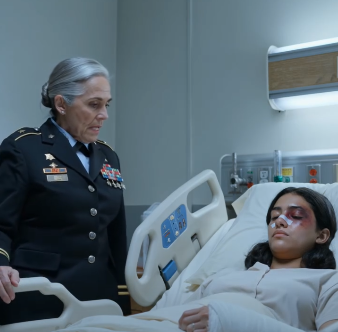
The mother leaned down and pressed her lips gently to her daughter’s forehead. Her voice, when she spoke, was the calmest it had been all night.
“No, sweetheart,” she said softly. “That’s when they buried themselves.”
She straightened up. Every medal pinned to her chest caught the harsh fluorescent light of the hospital room like shards of steel catching sunfire. She had earned each one. She had paid for each one with years of service, sacrifice, and an unshakable belief that the institution she served was worth protecting.
She picked up her phone.
She did not call the police. She did not call a lawyer. She made one call — direct and deliberate — to military intelligence.
Her daughter looked up from the pillow.
“Why them?”
The mother’s eyes never moved from the shattered screen still glowing in her other hand.
Because this was no longer a story about a violent young man from a wealthy family who had never been told no. Not if Mercer was involved. Not if the attack had taken place on secured federal property. Not if the same network of men now quietly connected to her daughter’s assault were already being watched — cautiously, carefully, in the slow way these investigations always begin — for moving prohibited materials through academy grounds.
This had never been about Dustin’s wounded pride.
She looked back at her daughter, and her voice dropped to something low and certain.
“You thought they came after you because you refused Dustin.”
She held up the phone one final time.
“They came after you because of what you saw inside Mercer’s trunk.”
The girl stared at her mother in the silence that followed — the kind of silence that falls when a story you thought you understood reveals its real shape for the first time — and something in her eyes shifted from grief into something that looked almost like resolve.
The mother recognized that look.
She had worn it herself, once, a long time ago.
She pressed dial.
The investigation that had been buried was about to be unearthed.
And this time, there was no one left with enough rank to stop it.