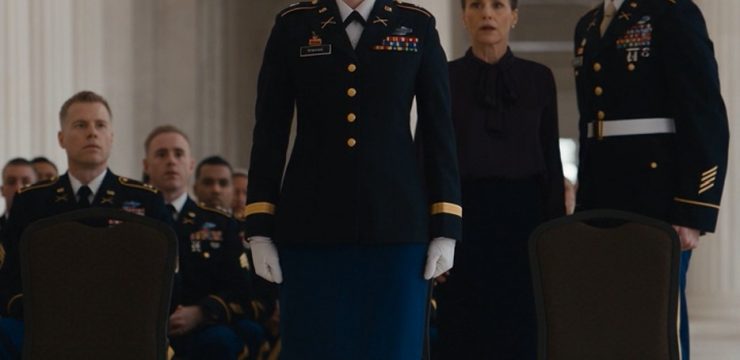
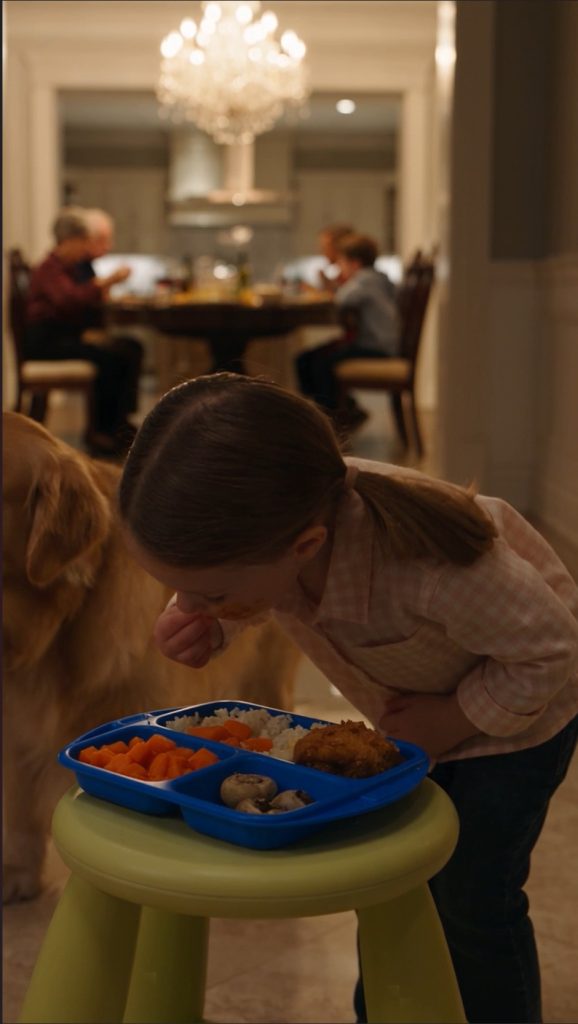
The little girl was eating dinner on the kitchen floor while the rest of her family sat around a table with two empty chairs. When she heard her father’s voice, her face brightened—then she glanced toward the dining room, and the happiness disappeared.
Something was terribly wrong in that house. And Gabriel Hart had come home early enough to see it.
He had flown back from Chicago with a silver music box for his daughter, Amelia. She would turn ten next month, and he had imagined her racing into his arms, Biscuit, their golden retriever, following close behind.
Instead, he found his parents, Marlene and Everett, eating roasted chicken with his nephews, Bryce and Theo.
“Where’s Amelia?” he asked.
“Outside playing,” Marlene replied.
Rain streamed down the windows.
Then a small voice called, “Daddy?”
Gabriel followed it into the kitchen.
Amelia sat beside Biscuit, a plastic tray of chicken, rice, and carrots resting on the floor. Her braids were uneven, and she held herself strangely still.
“Sweetheart, why aren’t you eating with everyone?”
“Grandma says it’s crowded.”
Gabriel looked toward the six-chair dining table.
Two seats were empty.
“She says I spill things,” Amelia whispered. “And children shouldn’t interrupt adults.”
The explanation sounded memorized.
“How long has this been happening?”
Amelia glanced toward the dining room, as though asking permission to answer.
That frightened him more than anything.
“I’m not angry with you,” he said gently.
“Grandma said you might be.”
Marlene appeared behind them.
“Gabriel, don’t make a family crisis out of nothing.”
“Nothing?” His voice tightened. “My daughter is eating on the floor.”
“She needs discipline.”
When Gabriel questioned Everett, his father admitted he hadn’t considered it worth an argument.
Gabriel held out his hand to Amelia.
“You don’t have to earn a place at your own table.”
He moved Marlene’s handbag from a chair and seated his daughter beside him.
“That’s my seat,” Marlene protested.
“Not tonight.”
Then he gave Amelia the music box.
As the tiny ballerina turned, she smiled.
But halfway through dinner, her glass tipped.
Water spread across the tablecloth.
Amelia froze, trembling.
“I’m sorry.”
Gabriel handed her a napkin.
“It’s only water.”
Her eyes immediately searched for her grandmother.
Later, while Gabriel tucked her into bed, he learned that Amelia spent her afternoons doing homework and helping Marlene rather than playing.
Then she asked something that made his stomach sink.
“Daddy, when you go away, can you tell me?”
“I always do.”
“Grandma says sometimes you’re too busy to talk.”
Gabriel went silent.
He had called every evening from Chicago. He had left messages whenever Amelia was unavailable.
“Did Grandma give you my messages?”
Amelia shook her head.
“She said they were grown-up things.”
Gabriel promised he wouldn’t leave the next day. He stayed until she fell asleep.
Downstairs, Marlene was washing dishes.
“You embarrassed me,” she said.
“How many times has Amelia eaten on that floor?”
“Twice.”
Silence.
“A few times,” she corrected.
Gabriel pressed her, but every answer became another excuse.
Then, while throwing away a napkin, he noticed a blue envelope beneath a paper towel.
Westbridge Trust Company.
It administered the trust his late wife, Nora, had established for Amelia’s developmental needs before her death.
The envelope was addressed to Gabriel.
Already opened.
Inside, a letter confirmed an $18,450 payment for home-based developmental and respite services.
Services Amelia had never received.
Services Gabriel had never authorized.
“What’s this?” he asked.
Marlene’s expression collapsed.
“Give me that letter.”
“No.”
Everett appeared in the hallway. When he saw the envelope, his face drained of color.
Gabriel unfolded the second page.
A payment authorization.
His name was printed beneath it.
And below his name was a signature that made his blood run cold.
He slowly raised his eyes toward his parents.
The silence that followed was only the beginning. 👇
Marlene reached for the paper.
Gabriel pulled it away.
“Who signed this?”
His mother stared at him, her fingers suspended between them. Behind her, the kitchen faucet continued dripping into the sink.
“Gabriel, you’re exhausted. You’ve just come back from a business trip.”
“Who signed my name?”
Everett lowered himself into a chair without answering.
Marlene’s eyes flickered toward him.
And suddenly Gabriel understood that whatever had happened, his father knew more than he was saying.
“Dad?”
Everett rubbed both hands over his face.
“Your mother told me the money was necessary.”
Marlene spun toward him.
“Everett.”
“Necessary for what?” Gabriel asked.
Nobody answered.
He placed the letter on the counter, photographed both pages with his phone, and looked at his mother.
“You have one chance to tell me the truth.”
Marlene’s face hardened.
“I have spent three years helping raise your daughter while you fly around the country pretending work is more important than family.”
Gabriel stared at her.
“Don’t use Amelia to explain a forged signature.”
“I kept this household functioning!”
“With her money?”
The words seemed to take the air out of the room.
Everett closed his eyes.
Marlene looked away.
Gabriel picked up his phone.
“I’m calling the trust company tomorrow morning. And until I know exactly what’s happened, neither of you will be responsible for Amelia.”
“You can’t throw us out,” Marlene said.
Gabriel looked toward the staircase.
His daughter was asleep upstairs, trusting that the adults in her life would keep her safe.
“Watch me.”
The next morning, Gabriel took Amelia to school himself.
Before she got out of the car, she hesitated with her backpack on her knees.
“Is Grandma mad at me?”
He turned toward her.
“Why would she be?”
“Because I told you.”
Gabriel felt his throat tighten.
He reached across the console and held her hand.
“You did exactly the right thing. The grown-ups are responsible for what happened. Not you.”
Amelia studied his face for a moment.
“Even if somebody gets in trouble?”
“Even then.”
She nodded, although he could see she was still trying to believe him.
At nine fifteen, Gabriel sat in the office of the trust company’s compliance director, Caroline Reeves.
The authorization lay between them.
Caroline examined the document, then opened a file on her computer.
“There have been six disbursements under this service arrangement,” she said.
Gabriel stared at her.
“Six?”
She turned the screen toward him.
The payments totaled $110,700.
All described as developmental support and respite services provided at home.
All connected to authorizations bearing his signature.
Gabriel gripped the armrests.
“Amelia hasn’t received these services.”
Caroline’s expression became grave.
“Then we need to investigate immediately.”
The money had been transferred to a service provider listed as Hart Family Support Services.
Gabriel had never heard of it.
The registered contact address belonged to a post-office box used by his mother.
Caroline explained that access had been granted using documents presented as his authorizations. How those documents had passed verification would also require investigation.
Gabriel sat perfectly still.
For months, while he believed Amelia was receiving loving care from her grandparents, someone had been drawing money from the trust Nora had created to protect her.
And his mother’s name was attached to it.
By afternoon, the company had frozen further payments and opened a formal fraud investigation.
Gabriel contacted an attorney.
Then he drove home.
Marlene was waiting in the living room with Everett.
Her suitcase stood beside the staircase.
“You’ve made your point,” she said.
Gabriel placed copies of the financial records on the coffee table.
“One hundred and ten thousand, seven hundred dollars.”
Everett stared at the papers.
Marlene remained motionless.
“Where did it go?” Gabriel asked.
“We had expenses.”
“What expenses?”
“The house. Our debts. Things you wouldn’t understand.”
Gabriel shook his head.
“This is Amelia’s money.”
“And we were looking after Amelia!”
“By making her eat on the floor?”
Marlene flinched.
Then Everett spoke.
“She told me you had approved the payments.”
Gabriel turned.
Everett’s voice trembled.
“She said Nora had arranged the trust so we could be compensated for helping. She showed me the forms. I thought—”
“You thought what, Dad?”
Everett looked at the floor.
“I thought it was easier not to question her.”
Marlene gave a bitter laugh.
“Oh, now you’re innocent?”
“No,” Everett whispered.
He looked up at Gabriel.
“I heard Amelia crying one evening because she wanted to speak to you. Your mother told her you didn’t have time.”
Gabriel couldn’t move.
Everett’s eyes filled.
“I knew that wasn’t right. But I said nothing.”
Marlene’s mouth opened, then closed.
For the first time, her husband wasn’t looking to her for permission.
Gabriel moved to the window.
Outside, rainwater still clung to the bare branches.
“Why?” he asked quietly.
Marlene said nothing.
“Why make my daughter believe I didn’t want to talk to her?”
His mother’s voice finally broke through.
“Because whenever you called, she wanted you. She cried for you. She wouldn’t listen to me afterward.”
Gabriel slowly turned.
“So you made her think I wasn’t calling?”
“I needed her to stop depending on someone who was never home!”
Gabriel stared at the woman who had raised him.
“You didn’t want her to miss me,” he said. “You wanted her to stop trusting me.”
Marlene looked away.
That was the moment he stopped hoping for an explanation that would make any of it understandable.
He asked his parents to leave.
Everett took his coat from the hallway.
Marlene remained beside her suitcase.
“After everything I’ve done for this family?”
Gabriel opened the front door.
“You could have asked for help. You could have told me you were overwhelmed. Instead, you hurt my child and took money meant for her.”
She looked toward the staircase.
“Amelia will miss me.”
Gabriel’s answer was quiet.
“That doesn’t mean she was safe with you.”
Marlene left without another word.
The investigation lasted several months.
Records established that Marlene had submitted the false authorizations and directed the payments into accounts she controlled. Additional evidence confirmed that the services described in the invoices had not been provided.
She eventually admitted what she had done.
Her attorney negotiated a guilty plea, and the court imposed a prison sentence, restitution, and financial penalties.
Assets were recovered and returned to Amelia’s trust, though the process took time.
Everett cooperated with investigators. He was not charged, but Gabriel made it clear that cooperation did not erase the harm caused by his silence.
Neither grandparent was permitted unsupervised contact with Amelia.
When Gabriel told his daughter that Grandma would no longer be living with them, Amelia sat quietly on the edge of her bed.
“Is it because I spilled the water?”
He closed his eyes for a second.
Then he sat beside her.
“No, sweetheart.”
“Because I told you about dinner?”
“No.”
She twisted the corner of her blanket.
“Then why?”
Gabriel chose his words carefully.
“Grandma made some serious choices that hurt people. She has to take responsibility for them.”
Amelia looked down.
“Can I still love her?”
The question nearly undid him.
He put his arm around her shoulders.
“Yes. You can love someone and still need to be safe from the things they do.”
Amelia leaned into him.
For a long time, neither spoke.
Gabriel changed his work schedule. He stopped accepting extended trips and arranged to work from home whenever possible.
He also found a child therapist who helped Amelia understand that mistakes, spilled water, and ordinary childhood needs were not reasons to fear punishment.
Healing came slowly.
Some evenings she still apologized for dropping a pencil.
Sometimes she asked permission to take a second helping of dinner.
Once, when Gabriel laughed loudly at something on television, she flinched before realizing he wasn’t angry.
He noticed every time.
And each time, he tried to give her a different memory to put beside the old one.
Everett began writing Amelia letters.
He didn’t ask her to forgive him.
He wrote about Biscuit, the garden, and the birds gathering outside his apartment window.
In one letter, he admitted that being quiet when someone was treated unfairly had been a terrible mistake.
Amelia kept that letter in her desk drawer.
Months later, she agreed to see him with Gabriel present.
Everett arrived carrying a small packet of sunflower seeds.
“I thought we might plant these,” he said.
Amelia considered him carefully.
“Will you tell Daddy if something bad happens?”
Everett swallowed.
“Yes.”
“Even if Grandma doesn’t like it?”
His eyes filled.
“Especially then.”
Amelia took the seeds.
It was not forgiveness.
But it was a beginning.
As her tenth birthday approached, Gabriel found something unexpected while sorting through Nora’s belongings.
Inside an old folder was a handwritten note, folded around a photograph of Amelia at six years old.
Nora had written it during the final months of her illness.
Gabriel recognized her handwriting immediately.
His hands trembled as he unfolded the page.
It wasn’t about money.
It was about the dining table.
Nora had described how Amelia, even as a little girl, loved pulling out chairs for visitors because she never wanted anyone to feel left out.
Then Gabriel reached the last paragraph.
“If I’m not there for her tenth birthday,” Nora had written, “please make sure she knows the table will always have room for her. Even when she makes mistakes. Especially then.”
Gabriel sat on the bedroom floor with the letter against his chest.
For months he had remembered Nora’s insistence on a six-chair table as a simple expression of generosity.
Now he understood something deeper.
She had been leaving Amelia a promise.
And without ever reading those words, he had spoken almost the same promise to their daughter on the kitchen floor.
On her birthday, Gabriel invited Bryce, Theo, and a few of Amelia’s school friends over.
The dining room filled with laughter, paper decorations, and the smell of chocolate cake.
Bryce quietly apologized for never questioning why Amelia ate separately.
Theo admitted he had wanted to sit with her but had been afraid of getting in trouble himself.
Amelia listened.
Then she offered them both a slice of cake.
“I was scared too,” she said.
That evening, after the guests left, Gabriel brought Nora’s letter to the table.
He read it aloud.
Amelia listened without moving.
When he finished, she reached for the photograph.
“Mommy knew?”
Gabriel brushed a tear from his cheek.
“She knew you deserved to belong. Always.”
Amelia looked around the table.
Then she stood, walked to the kitchen, and returned with Biscuit following her.
She placed his food bowl beside her chair.
“Can he eat with us?”
Gabriel smiled.
“As long as he doesn’t steal my dinner.”
Amelia laughed.
A real laugh, loud and unguarded.
Later, when the house had grown quiet, she opened her silver music box.
The ballerina turned beneath the warm dining-room light.
Gabriel sat beside her, watching the small figure spin.
“Daddy?”
“Yes, sweetheart?”
“Next time I spill something, can we just clean it up together?”
He reached for her hand.
“Every single time.”
Amelia rested her head against his shoulder while Biscuit slept at their feet.
Outside, the last light faded beyond the Connecticut trees.
On the table stood six chairs, a half-eaten birthday cake, and Nora’s photograph beside the little silver music box.
For the first time in a long while, Amelia didn’t glance over her shoulder before smiling.
And when the music ended, she stayed exactly where she belonged—safe beside her father, in a home where no one had to earn their place at the table.