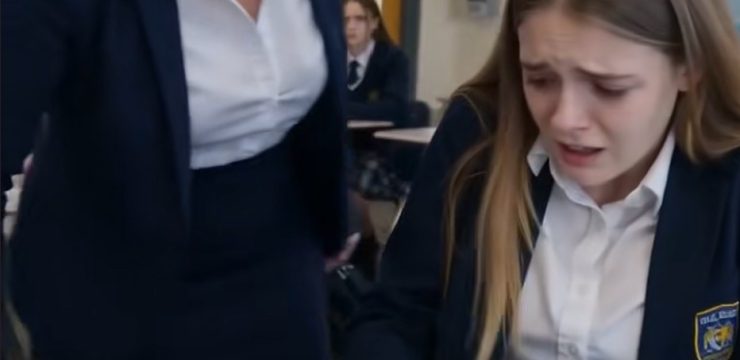
The wooden ruler cracked against his hand, and twenty-three seventh-graders fell into a terrible silence. His fingers curled instinctively as he fought back tears. At the back of the classroom, a hidden phone was recording something no child should ever have to witness.
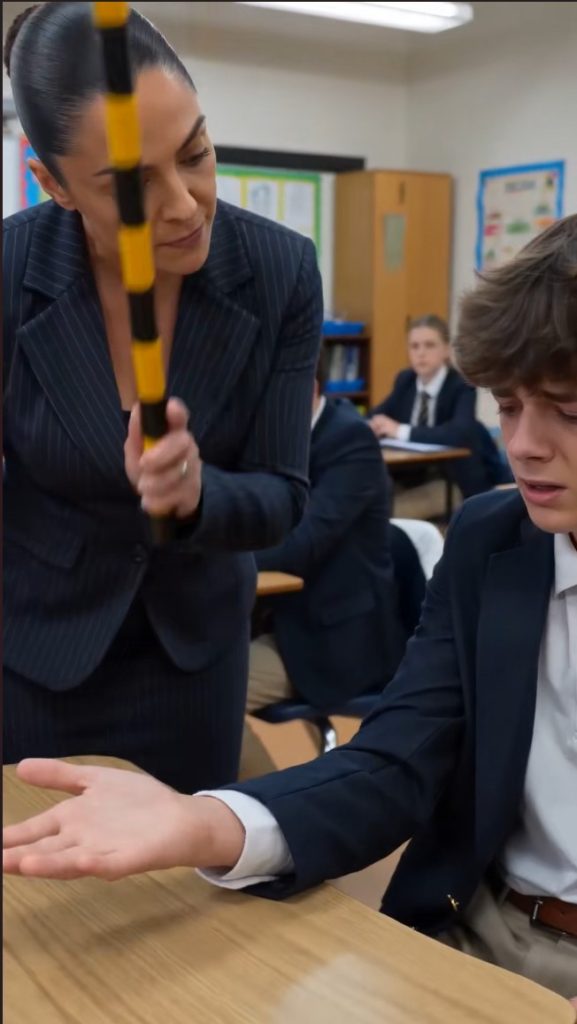
Dylan Parker stood trembling before Mrs. Elaine Carter, his injured left hand pressed against his chest. The forty-five-year-old teacher wore a gray cardigan, dark skirt, and school badge. Her expression remained cold.
“Why are you the only one without a signed camp form?”
“My dad was hurt,” Dylan whispered. “He had an accident at work. I need to stay home with him this summer.”
Seven weeks earlier, Mark Parker had fallen from a maintenance platform, fracturing two ribs and severely injuring his left shoulder. Surgery and physical therapy had helped, but lifting groceries or even a full cooking pan still caused pain.
Dylan had quietly accepted that summer camp would have to wait. His father needed him, and the $650 fee was impossible to justify while Mark received reduced disability pay.
Mrs. Carter knew everything. Dylan had explained twice, and Mark had emailed her personally.
“You still sign,” she said.
A pause followed. “You still pay.”
Dylan stared at her, struggling to understand how someone could hear about his father’s suffering and respond that way.
Behind an upright textbook, Jake Wilson held his smartphone low, its camera aimed toward the teacher’s desk. He had started recording before the first strike.
“Hand out!” Mrs. Carter demanded.
Dylan slowly extended his left hand, palm down. The ruler descended again, sending pain through his wrist.
“Again.”
He barely shook his head. Mrs. Carter stepped closer, repeating the command with frightening calm.
Dylan offered his trembling hand once more. The third strike landed, and he immediately pulled his arm against his chest.
Then came something worse than the pain.
“No signature tomorrow?” Mrs. Carter said quietly. “You won’t pass seventh grade.”
Dylan looked up, stunned. “But my grades are passing.”
“Summer participation is part of our readiness requirements.”
“No, it isn’t.”
The words escaped before he could stop them. Mrs. Carter’s expression hardened, and Dylan immediately lowered his eyes.
Jake stopped recording.
His fingers trembled as he opened Mark Parker’s contact, saved from the days their families coordinated basketball practice rides.
Mr. Parker, this just happened.
He attached the video and pressed send. Moments later, the confirmation appeared.
Across town, Mark was driving home from physical therapy when Jake’s notification appeared. His injured shoulder ached beneath the seat belt.
He pulled into a grocery-store parking area, stopped completely, and opened the video.
There was Dylan.
Then the ruler struck.
Mark leaned closer. “Dylan…”
He heard his son explain the accident, heard Mrs. Carter demand payment, and watched the remaining blows.
Then came the threat about seventh grade.
Mark replayed those final seconds, his jaw tightening. It wasn’t disbelief that made him watch again. It was the unbearable realization that an adult had humiliated and hurt his son in front of an entire classroom.
He placed the phone in the console, checked traffic, and turned toward Westbridge Middle School.
Meanwhile, Jake slipped Dylan a folded note beneath the desk divider.
I sent it to your dad.
Dylan’s breathing caught.
Mrs. Carter was collecting signed forms, warmly thanking Liam, Avery, and Noah. Everyone had complied except Dylan.
Then she opened a blue binder.
Dylan saw his name highlighted in red beside four words:
NO FORM — FINAL HOLDOUT
Beneath them was another handwritten instruction.
Needs consequence before Friday count.
Dylan stared at the classroom calendar.
Today was Thursday.
And whatever Mrs. Carter had planned for Friday, those words suggested his punishment was anything but accidental.
The most frightening question was what that Friday count actually meant… 👇
The binder’s metal rings clicked shut.
Dylan flinched. Mrs. Carter looked up from her desk, followed his gaze to the red marking, and closed one hand over the cover.
“Dylan. Come here.”
He stayed seated. His left hand throbbed beneath the desk, and Jake’s note lay crumpled against his knee. In the hallway, footsteps approached, then stopped outside the door.
Someone knocked.
Mrs. Carter’s expression softened instantly. “Come in.”
The principal, Ms. Alvarez, entered first. Mark followed, pale beneath the fluorescent lights, his injured shoulder held stiffly at his side. He saw Dylan’s face before he saw the ruler.
“Dad?” Dylan’s voice sounded too small for the room.
Mark took one step toward him. Mrs. Carter moved into his path.
“Mr. Parker, we’re in the middle of instruction. Dylan has been refusing a required—”
“Please move,” Mark said.
He didn’t raise his voice. That was what made the room so quiet.
Ms. Alvarez noticed the ruler on the desk. “Elaine, I need you to leave it where it is.”
Mrs. Carter glanced at it, then at the children. “There’s been a misunderstanding.”
Mark crouched beside Dylan’s chair. Bending pulled at his ribs, but he didn’t show it. “Can I see your hand?”
Dylan hesitated. He was still looking over Mark’s shoulder, waiting for the teacher’s permission. Mark saw that too.
“You don’t have to be brave for me,” he whispered.
Dylan slowly opened his fingers. Three raised marks crossed the skin, one near the base of his thumb. Mark drew a shaky breath and let the school nurse, waiting at the door, come closer.
Ms. Alvarez held up Mark’s phone. “I’ve seen the video, Elaine. We are moving this conversation to my office.”
Jake stood before he could change his mind. “I recorded it,” he said. “All three times. And what she said about his grades.”
Mrs. Carter’s eyes fixed on him. Jake’s shoulders tightened, but he didn’t sit down.
“Thank you, Jake,” the principal said. “You won’t be punished for telling us.”
From the front row, Avery spoke so softly they almost missed it. “She told us not to interfere.”
Noah nodded. Other children began looking at one another, recognizing that the silence they’d shared hadn’t protected Dylan at all.
Mrs. Carter reached for the blue binder.
“Leave that too,” Ms. Alvarez said.
In the office, with Dylan’s hand cooled and examined, the principal opened the binder on her conference table. A printed roster listed twenty-three children. Twenty-two names had checkmarks; Dylan’s was circled in red.
Beside the roster sat a payment sheet for the outside camp provider. At the bottom was a line marked COORDINATOR STIPEND — PAID ENROLLMENT TARGET.
“Friday count,” Mark read.
Ms. Alvarez’s face changed. “You told me the entire class had agreed to attend.”
“I expected the last form,” Mrs. Carter answered.
“You reported twenty-three paid registrations on Monday. There are twenty-two.”
Mrs. Carter’s mouth tightened. “If we missed the target, we would lose the coordinator funding. I was trying to keep the program running.”
“By hitting my son?” Mark asked.
She looked at the table rather than at him. “He was being difficult.”
Mark’s right hand closed around the edge of his chair. He remembered Dylan lifting laundry with both arms because Mark couldn’t. Dylan learning where to place a hot pan so his father could slide it instead of carrying it. Difficult. That was the word she had chosen.
Ms. Alvarez turned another page. It contained the email Mark had sent, describing the fall, the surgery, and their reduced income. Across the bottom, in Mrs. Carter’s handwriting, were three words: NO EXEMPTION OFFERED.
The principal pulled up the district policy on her laptop.
“Camp is optional,” she said. “No student’s grade can be affected. Families facing hardship can apply for assistance, and you were instructed to give them that information.”
Mrs. Carter said nothing.
“You knew there was help available?” Mark asked.
“I needed paid confirmations by Friday.”
For a moment, nobody moved. Dylan stared at the email. He hadn’t known his father had written such careful words on his behalf.
“I told you he got hurt,” Dylan said, his voice wavering. “You said it didn’t matter.”
Mrs. Carter finally looked at him. “I shouldn’t have handled it that way.”
“That’s not what he asked,” Mark said.
Dylan looked down at his swollen hand. “I thought if I signed, you’d make Dad find the money. And if I didn’t, I’d have to repeat the grade.”
The principal’s eyes filled, though her voice remained steady. “Neither of those things was ever going to happen, Dylan. I’m sorry we let you believe it could.”
Mrs. Carter was escorted out of the building that afternoon. She did not return to Dylan’s classroom. The district preserved Jake’s recording, the binder, the email, and the children’s witness accounts. Mark filed a police report rather than letting the school quietly handle it.
At the disciplinary hearing weeks later, Mrs. Carter again described the pressure of enrollment numbers. The panel watched the video without interrupting her. Her employment was terminated, the assault was referred through the legal process, and the state later revoked her teaching certificate for misconduct. The camp provider ended its enrollment incentive arrangement with the school.
None of those decisions made the marks on Dylan’s hand vanish immediately. Nor did they erase how he watched every adult’s hands for a while.
The first time his new teacher reached across his desk for a pencil, Dylan jerked backward. She stopped at once.
“I’m reaching for the pencil,” she said gently. “Is that okay?”
Dylan nodded. The teacher waited until he moved it toward her himself.
Jake had troubles of his own. He confessed to Mark that he’d nearly deleted the video because he was afraid Mrs. Carter would take his phone and blame him.
“You sent it anyway,” Mark told him.
Jake looked at Dylan. “I thought you’d be mad I recorded you crying.”
Dylan shook his head. “I thought no one was going to help.”
There was nothing clever to say after that. The boys sat shoulder to shoulder on the school steps until Jake offered him half a packet of crackers.
At home, Mark found Dylan carrying a laundry basket toward the stairs with his uninjured hand.
“Set that down,” Mark said.
Dylan froze.
Mark immediately softened his voice. “Not because you’re in trouble. Because carrying everything isn’t your job.”
“Your shoulder still hurts.”
“It does.” Mark sat beside the basket. “And I need help sometimes. But needing help doesn’t mean I get to take your whole summer.”
Dylan’s eyes reddened. “I was scared if I left, something would happen while I was gone.”
Mark covered his son’s right hand with his own. “I was scared of something too. That you’d start believing loving me meant giving things up.”
The next morning, Mark placed a folded letter on the breakfast table. It was dated before the video, before the confrontation, before anyone at school had admitted what was happening.
Dylan read the first line twice.
He had been accepted into a local summer day program, with the full fee covered by a workplace injury family-support fund. Mark had applied weeks earlier through his rehabilitation counselor and arranged check-ins with a neighbor while Dylan was away.
“You already did this?” Dylan whispered.
Mark smiled, embarrassed. “I was planning to tell you after physical therapy. I wanted to be sure the place was yours before I got your hopes up.”
All those afternoons at therapy, all the careful attempts to drive and cook and manage the house, hadn’t been about learning to live without Dylan. Mark had been practicing so his son could leave for a few hours without carrying the weight of his recovery.
“But you don’t have to go,” Mark said. “It’s your choice. That’s the part that matters.”
Dylan studied the letter, then looked through the window at the basketball resting beside the porch steps.
“Can Jake come over after?”
“Every day, if his family agrees.”
“And you’ll tell me when you actually need help?”
“I promise.”
By late summer, Mark could lift a warm pan from the stove again, carefully, with both hands. One Saturday, Dylan and Jake came home dusty from the court and found pancakes waiting, uneven at the edges and stacked too high.
Dylan reached for the plate. Mark nudged it toward him.
Outside, the last sunlight stretched across the kitchen floor. Dylan rested his left hand on the table, palm open, while his father sat beside him. For the first time in months, neither of them was afraid of what tomorrow would ask.