She walked into that bar carrying something most people never have the courage to hold — the truth about a man the room had spent years trying to forget.
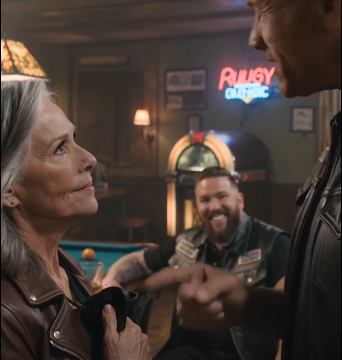
Nobody noticed her at first. The low hum of conversation, the clink of glasses, the familiar smell of leather and old wood — it was just another evening for the men gathered inside. But when she stepped forward and placed that worn, faded patch on the counter, everything stopped.
The bald biker near the door laughed. It was the kind of laugh designed to humiliate, to shrink someone down before they even get a chance to speak. He looked her over with the casual cruelty of a man who had never once been held accountable for anything.
She didn’t flinch.
She stood her ground, fingers trembling slightly, and said the words that cracked the entire room open.
“I’m Dutch’s daughter.”
Three words. That was all it took.
The laughter died so fast it was almost violent. Every man in that bar — the weathered ones, the quiet ones, the ones nursing drinks they hadn’t touched in twenty minutes — they all heard that name and felt something shift in their chest. Dutch. Founder. The kind of man whose name used to mean something before it became something no one wanted to say out loud anymore.
But a daughter? Nobody had ever mentioned a daughter.
The bearded biker moved toward her slowly, carefully, like he was walking toward something fragile and sacred at the same time. His voice came out quiet and rough.
“What did you say?”
She swallowed hard. Her jaw set with the kind of quiet determination that only comes from years of carrying a wound nobody helped you heal.
“I said I’m his daughter,” she repeated. “And I didn’t come here looking for respect. I came here because my father was buried under a lie — and I want the truth.”
Dead silence.
The bald biker’s smirk was completely gone now. In its place was something far more telling: nervousness. The kind that comes not from surprise, but from recognition.
She lifted the patch again, holding it gently, the way you hold something that belongs to someone you never got the chance to know.
“My mother kept this hidden her entire life,” she said, her voice trembling at the edges but never breaking. “She told me before she passed that if I ever wanted the truth, I needed to find the men who had stopped saying his name with pride… and started saying it with guilt.”
Not one person in that room moved.
Then, slowly, an older man sitting alone in the corner reached up and removed his cap. His eyes glistened. Because he remembered. He remembered the night Dutch vanished — the fire, the silence, the body that nobody was really allowed to see. He remembered the story they all agreed to tell and the truth they all agreed to bury.
Her voice cracked, but she pushed through it.
“My mother said he was coming home that night. He never made it.”
And then she watched something she hadn’t expected. She watched the bearded biker turn — not randomly, not by accident — but directly, deliberately, toward the bald man near the door.
So did every other set of eyes in that room.
She followed their gaze.
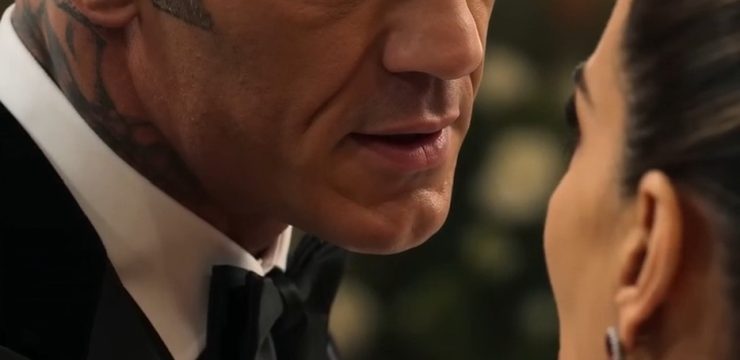
And that’s when she felt it — the weight of everything unsaid pressing down on the room like a storm that had been building for decades. She looked at the bald biker. Really looked at him. And then she saw it: the tattoo on his neck, an old club mark, half-covered but not covered enough.
Her entire face changed.
Because she understood.
These men weren’t afraid of her father’s memory. One of them was afraid of what she might already know.
The bearded biker’s voice dropped to something low and irreversible.
“Take off your jacket.”
The bald man didn’t move.
“Now.”
Slowly, with the reluctance of a man who knows there is nowhere left to run, he pulled the leather jacket from his shoulders. And there, stitched into the lining — faded, old, but unmistakably clear — was the ghost of a thread outline. The exact shape where a founder’s patch had once been removed.
Her breath caught in her throat.
Her eyes filled without permission.
Because she understood it all in an instant. The man who had laughed at her when she walked through that door — the man who had tried to make her feel small and foolish — was wearing the jacket of someone who had been standing beside her father the night he disappeared. Someone who had taken something that was never his to take.
The oldest man in the room rose slowly from his chair. He looked the bald man directly in the face, and when he spoke, there was no anger in his voice — only the quiet weight of a reckoning that had been decades overdue.
“Tell her what really happened to Dutch.”
The bald biker said nothing. His throat worked. His eyes moved around the room searching for an ally, for someone to step in, for anyone to offer him a way out.
Nobody moved.
Nobody helped him.
Because whatever had been buried that night — whatever deal had been made, whatever silence had been purchased — it was finished now. It was over. The ground had finally given way.
And she stood there, clutching that patch to her chest like it was the only piece of her father she had ever been allowed to hold.
When she finally spoke again, her voice was barely above a whisper. But in that silence, it carried like a bell.
“My father didn’t abandon us.”
She looked straight at the man who had laughed at her. The man with the jacket. The man who had spent years hiding in plain sight.
And then she finished the sentence that had taken her a lifetime to say.
“You did.”