The sound of her body hitting the carpet cut through the mansion’s silence. Both boys screamed, but what frightened the older one most was the look on their father’s face—a kind of terror he had never seen before.
For six years, Helena had learned how to disappear without ever leaving the room.
She moved quietly through chandelier-lit corridors, kept her voice low, and finished work before anyone thought to ask. In that house, being needed was safe. Being noticed was not.
She scrubbed floors, carried laundry, and made beds that would be unmade without a word of thanks. But when the boys scraped their knees, it was Helena who found the bandages. When fever kept them awake, it was Helena who sat beside them until morning.
The household called her a maid. The boys had never thought of her that way. She was the person who stayed when everyone else closed a door.
And their father knew something about her that neither child had been allowed to see.
That afternoon, Helena was walking down the long hallway with a stack of freshly folded sheets. Light spilled from the chandeliers onto the carpet. She took another step, and suddenly her hands opened.
The linen scattered. She fell forward, striking the floor so hard that both boys cried out.
“Dad, help her!”
“She’s the only one who cares about us!”
Their father came running. He crossed the corridor with an urgency the boys had never seen in him, dropped to his knees, and carefully turned Helena’s face toward him.
“Breathe, Helena,” he said, his voice unsteady. “Stay with me.”
The older boy stared.
His father didn’t call her Miss Helena. He didn’t speak to her like an employee. He said her name as though he had been afraid of losing her long before this moment.
Then his younger brother spotted something beside her hand.
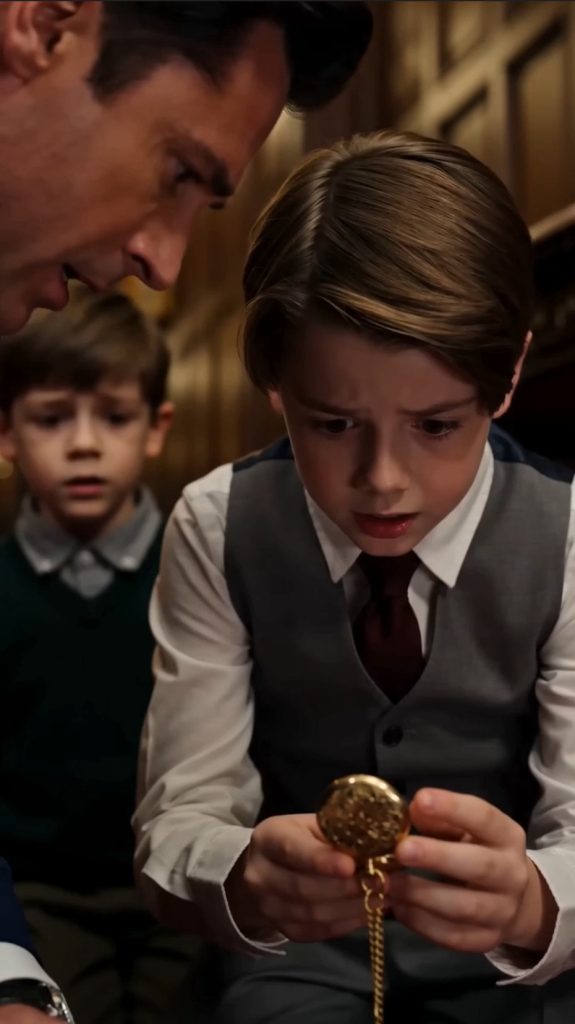
A small gold locket lay against the carpet, its chain loosened by the fall. It looked old, worn smooth at the edges, like something Helena had held onto through years she never spoke about.
The younger boy, still trembling, picked it up. He opened it, expecting a family portrait, perhaps a face he might recognize.
Instead, he found a black-and-white photograph of his father.
Not the stern man who walked through their mansion today. A younger man, smiling openly beside a stone bridge neither boy had ever seen.
“Dad?” the younger boy whispered.
Their father turned. The instant he saw the photograph, his expression changed. All the color seemed to leave his face.
The older boy took the locket from his brother and raised it toward him.
“Why does Helena have your picture?”
No answer came.
Only the strained sound of Helena breathing against the carpet.
Her eyelids flickered. She looked first at the locket, then at the man kneeling beside her. Whatever strength she had left seemed to gather in a single desperate movement as she tried to sit up.
“No,” she whispered. “Please—”
But the younger boy was already reaching for something else that had slipped from the locket.
A folded piece of paper. Wrapped around it was a tiny, faded hospital bracelet, old enough that the writing looked almost lost.
He eased the paper open.
His eyes moved across the words once. Then again. He looked at the bracelet, at Helena, and finally at his father.
“Dad…” His voice broke. “This says Baby Boy A.”
He swallowed, struggling to understand what he was holding.
“And it has my birthday on it.”
His father was still kneeling beside Helena when both boys turned toward him, waiting for the answer he had not given. 👇
Their father’s hand reached toward the bracelet, then stopped halfway.
“That belonged to your brother,” he said quietly. “You were Baby Boy B. You were born minutes apart.”
The younger boy looked at his brother. Neither had ever seen anything from the hospital where they were born.
“Then why does Helena have it?”
Before their father could answer, a sharp voice came from the staircase.
“Put that down.”
Their grandmother stood beneath the chandelier, one hand gripping the banister. Her eyes moved from the open locket to Helena’s pale face, and something in her expression tightened.
“Get the children upstairs,” she ordered. “Immediately.”
“No,” their father said.
It was a single word, but the older boy had never heard him speak to his mother that way.
The grandmother descended another step.
“Don’t be foolish. They’re frightened enough already.”
“They’re frightened because nobody will tell them the truth.”
Helena caught his sleeve.
“Please,” she whispered. “Not like this.”
He looked down at her. For a moment, the authority drained from his face, leaving only a man who had spent years avoiding something he could no longer bear to see.
“She’s your mother,” he told the boys.
The younger boy’s fingers loosened around the bracelet.
“What?”
“Helena gave birth to both of you.”
The older boy stepped backward, his heel catching a fallen sheet.
“No. Our mother—”
He stopped because he suddenly realized he knew almost nothing about her. Only what he had been told, that she had gone away when they were babies and never returned.
But Helena had been there every morning.
Every birthday.
Every night he woke from a nightmare.
“She never left?” he asked.
Helena covered her mouth.
“No, sweetheart.”
Their grandmother’s voice cracked through the silence.
“She signed away her rights. Your father knows that.”
Helena went still.
Their father slowly raised his head.
“You told me she agreed.”
“She did.”
“I never signed anything,” Helena said.
The words were barely audible, but everyone heard them.
The grandmother’s mouth tightened.
“You’re confused. You’ve been unwell for months.”
Helena shook her head.
“I remember the hospital. I remember asking to hold my babies. And I remember you telling me I would never see them again unless I did exactly what you wanted.”
Their father stared at his mother.
“Is that true?”
She said nothing.
“You showed me papers,” he continued. “You said Helena had chosen to leave.”
“I did what was necessary to protect this family.”
“Did you forge her signature?”
The grandmother looked toward the boys.
“Not in front of them.”
That was when the older boy began to understand. The woman who had told them to be grateful for everything they possessed had helped take away the one person who had given them love without asking for anything.
Their father stood.
“Answer me.”
“I arranged what had to be arranged,” she snapped. “She was a servant’s daughter. You were prepared to throw away your future for her. Do you think I was going to let that happen?”
The younger boy began crying without making a sound.
Helena tried to reach him, but the movement made her dizzy. Her father—the boys’ father—knelt again and steadied her shoulders.
“Someone call an ambulance,” he said.
Mrs. Reyes, the housekeeper, was already standing at the corridor entrance with her telephone in hand.
“I have, sir.”
She looked at Helena with wet eyes.
“And I heard everything.”
For the first time, the grandmother seemed uncertain.
Their father turned toward her.
“You made Helena live under this roof as an employee. You knew who she was.”
“I allowed her to be near the children.”
“You threatened to take them away if she told them.”
The grandmother’s silence answered him.
He looked at Helena.
“Why didn’t you tell me?”
She met his eyes, exhausted.
“I tried.”
Those two words struck harder than any accusation.
She had come to him years earlier, after discovering where the boys lived. He had arranged for her to work in the house, telling himself that keeping her close was kinder than forcing a legal battle his mother had threatened to win.
He had accepted the arrangement because it spared him a confrontation.
Helena had accepted it because it meant she could hold her sons when they cried.
“I should have listened,” he whispered.
“Yes,” she answered.
Neither looked away.
The ambulance arrived beneath a gray evening sky. As the paramedics lifted Helena onto the stretcher, the younger boy hurried after them.
“Can we come?”
Helena extended her hand.
He caught it with both of his.
At the hospital, doctors found severe anemia and exhaustion. Helena needed treatment and rest, but she was expected to recover.
The boys sat beside her bed long after visiting hours, their father having quietly persuaded the nurse to let them stay a little longer.
The older boy watched Helena’s fingers resting against the blanket.
“Did you ever want to tell us?”
“Every day.”
“Then why didn’t you?”
Her lips trembled.
“Because I was afraid that if I told you, I might never see you again.”
He looked toward the window.
“All those times you tucked us in…”
“I wanted you to know you were loved, even if I couldn’t tell you why.”
The younger boy climbed carefully onto the edge of her bed.
“Can I call you Mom?”
Helena’s breathing caught.
She nodded, and when he wrapped his arms around her, she held him with a gentleness that had nowhere left to hide.
Their father stood near the door, watching.
Later that night, he returned alone to the mansion.
His mother was waiting in the study.
“This can still be handled privately,” she said.
He laid the hospital bracelet and folded paper on the desk.
“No.”
He had already contacted an independent attorney and requested the original hospital records. He had also found the unsigned letters Helena had sent him, preserved among the documents his mother kept locked away.
Years of desperate requests.
Years of explanations he had never received.
He held up one of the envelopes.
“You kept these.”
His mother glanced away.
“They would have ruined everything.”
“They could have saved us.”
He dismissed her from the household that night, revoked her authority over the family accounts, and began proceedings to remove her control of the estate’s trusts.
The investigation that followed uncovered forged documents and records of payments used to conceal what she had done. The hospital’s original files confirmed that Helena had never voluntarily surrendered her parental rights.
Months later, the grandmother faced criminal charges. Her conviction for fraud and forgery ended the influence she had spent a lifetime protecting.
The boys did not attend the hearing.
Helena did.
When the judgment was read, she closed her eyes and gripped the edge of the wooden bench. There was no triumph in her expression, only the stunned stillness of someone realizing she would no longer have to ask permission to be a mother.
Their father sat beside her, leaving enough space for her to decide whether she wanted him there.
Afterward, he apologized without excuses.
“I knew you were their mother. I knew you were afraid. I told myself keeping you close was enough.”
“It wasn’t,” Helena said.
“I know.”
She looked at him for a long time.
“I don’t know if I can forgive you.”
“You don’t have to.”
For the first time in years, he offered her something without asking for anything in return.
Time.
The months that followed were imperfect.
The boys sometimes woke frightened that Helena might disappear. Their father began attending school meetings and learning things Mrs. Reyes and Helena had always known—favorite foods, bedtime habits, which son hated thunderstorms and which one pretended not to.
Helena moved out of the servants’ quarters and into a room of her own choosing. She no longer wore a uniform, no longer lowered her voice when she entered a room.
Mrs. Reyes remained with the family, now working for a household where her kindness was valued and her silence was no longer expected.
One Sunday, the four of them visited the stone bridge from the photograph.
Autumn sunlight warmed the river below. Helena stood beside the railing, the old locket resting against her chest.
“This is where we first talked about having a family,” their father said.
The older boy looked between them.
“Did you love each other?”
Helena gave a small, sad smile.
“Very much.”
“And now?”
Their father looked at her, but he did not answer for her.
Helena reached for his hand.
“We’re learning how to be honest with each other again.”
The younger boy leaned against her.
Then the older boy pulled a folded drawing from his jacket.
“I made this before you got sick,” he said. “I was scared to show Dad.”
Helena opened it.
Four figures stood beneath a crooked yellow sun.
Two boys.
Their father.
And Helena, wearing her familiar blue maid’s dress.
Across the top, in uneven handwriting, were two words.
OUR FAMILY.
Helena stared at the drawing.
“You drew me?”
The boy nodded.
“I know you weren’t supposed to be in our family pictures. But when the teacher asked us to draw the people who made us feel safe, I couldn’t leave you out.”
Their father turned away, pressing his fingers against his eyes.
For six years, Helena had believed she was hiding her motherhood from her children.
Yet somehow, without knowing the truth, they had already made room for her.
She knelt and pulled both boys close.
Their father lowered himself beside them, uncertain until Helena reached out and took his hand.
The river moved quietly beneath the bridge.
Above them, the afternoon light softened, catching the little gold locket as Helena closed it and tucked it safely against her heart.
This time, when the boys called her Mom, she answered without looking over her shoulder.
And when they walked home together, nobody followed behind.