For one long second, the whole park seemed to hold its breath. Not the leaves drifting lazily from the oak trees overhead. Not the distant footsteps of strangers passing by. Not even the wind, which had been whispering through the afternoon air just moments before. Everything went still — as though the world itself understood that what was happening on that bench was about to change everything.
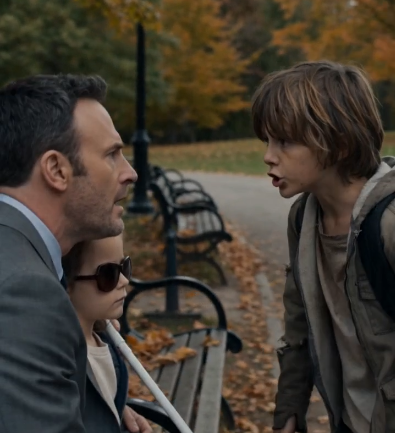
The father looked from the dirty boy sitting beside his daughter… to his daughter… then toward the woman jogging along the winding path ahead. His wife. The mother of his child. The woman he had trusted without question for years.
At first, he wanted to push it away. Children imagine things. Street kids say anything. Fear has a way of turning half-truths into wild accusations. He told himself that. He almost believed it.
But then he looked at his daughter again. Really looked. Not as the fragile little blind girl he had spent months carefully protecting from the world. As a child who had grown too quiet. Too careful. Too perfectly obedient in a way that no child naturally is. There was something hollowed out behind her stillness, something that had been pressed down and kept there by a force he hadn’t let himself see.
The boy’s voice came smaller this time. “She cries after dinner.”
That landed harder than anything else he had said. Because the father had seen that. Every single night. The trembling at the corner of her mouth. The silence that stretched too long after meals. The way she refused to speak, refused to ask for anything, refused to be a child. And always — always — his wife rushing in to explain things for her, to answer for her, to speak over whatever his daughter might have said on her own.
The father’s throat tightened until it ached.
“What does she put in it?” he managed to ask.
The boy shook his head slowly. “I don’t know.” A pause hung in the cool air between them. “White powder. From a little bottle.”
The girl sitting beside the boy said nothing. But her small hands, resting in her lap, had begun to tremble. And it was that — not the words, not the accusation, not even the mention of the bottle — that finally shattered something inside the father’s chest.
Because children can lie with words. They stumble, they exaggerate, they confuse what they dreamed with what they lived. But they cannot lie with their whole bodies. Not like that. Not with hands that shake because the truth is too heavy to hold quietly anymore.
He knelt down in front of his daughter. With hands that weren’t quite steady, he reached up and gently removed her sunglasses. She blinked against the gray afternoon light. Then she turned toward him. Not perfectly. Not with the sharp, confident focus of someone who had always been able to see. But enough. Clearly enough to unmake the story that had been built around her.
She could see.
Maybe not fully. Maybe not the way she once had. But she could see. And the most devastating part of that moment wasn’t the betrayal itself. It was the sudden, crushing understanding that his daughter had known — had known all along — that she was supposed to pretend otherwise.
The boy tightened his grip on the straps of his backpack, like he needed something solid to hold onto. “My mom used to clean there,” he said quietly. “She saw your wife mix it into the food.”
The father looked up sharply. “Used to?”
The boy’s eyes filled with tears he was working hard not to let fall. “She got fired.”
That one sentence explained everything. Not just the boy’s fear in coming forward. Not just his hesitation, the way he had hovered at the edge of the path before reaching out and grabbing a stranger’s sleeve. It explained the mother’s fear too. Because this wasn’t simply cruelty happening behind closed doors. This was concealment with consequences. Someone had witnessed something they were never meant to see. And someone had made sure that witness disappeared quietly, without drama, without explanation.
The father looked back toward the jogging path. His wife was no longer moving. She had stopped completely, standing at a distance among the fallen leaves, completely still. She wasn’t confused by what she was seeing. She wasn’t worried in the way a wife and mother would be, watching her husband crouch before their daughter in a public park. She was watching. Calculating. Measuring exactly how much damage had already been done.
The little girl finally whispered, her voice carrying the weight of far too much silence for someone so young: “Daddy… Mommy said I mustn’t tell you what I saw in Grandpa’s room.”
And there it was. The real wound beneath every other wound. Not blindness. Not illness. A witness. Before the old man passed, this little girl had wandered into a room where she should not have been. She had seen papers being moved, signatures being handled, perhaps a small bottle near a glass. She was too young to understand the full meaning of what she had stumbled into, but old enough to hold the memory of it, clear and unshakeable, in the back of her mind.
Once she began reacting — once she started looking too closely at the wrong moments — a decision was made. Not to silence her with violence. Something quieter than that. Something that would make the entire world simply stop believing what her eyes could tell them.
The father rose slowly from the bench. Around him, the park looked exactly the same as it had ten minutes before — the soft rustle of autumn leaves, the pale light filtering through the trees, the sounds of an ordinary afternoon. But none of it felt gentle anymore. None of it felt safe.
Because a small, dirty boy had not grabbed his sleeve to cause trouble. He had crossed that path, heart pounding, because somewhere inside him, in whatever remained of childhood innocence, he understood that a little girl was in danger. And that the most dangerous thing she had ever done was simply to see the truth with her own eyes.