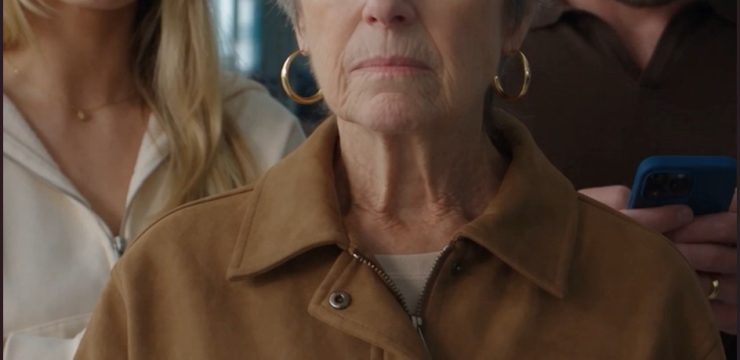
The little girl gripped her father’s sleeve like she was holding on for dear life. Her small fingers curled around the fabric, knuckles pale as chalk, and for a moment, neither of them moved. It was the kind of touch that doesn’t need words to explain itself. It was the touch of a child who had been afraid — deeply, quietly afraid — for a very long time, and had finally decided that today was the day she could no longer stay silent.
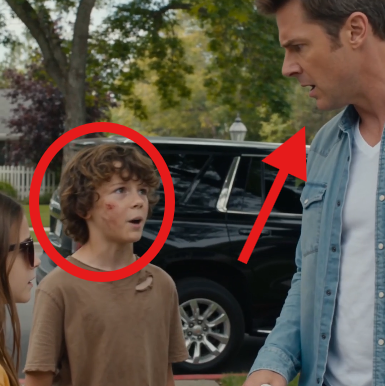
The boy standing nearby held up a white cane. Not as a weapon. Not as an accusation. But as the kind of evidence that changes everything the moment it’s seen.
“She only uses it when your wife is watching,” he said.
The father stared at him. His mouth opened slowly, but nothing came out. The words he needed simply weren’t there yet — because the mind takes a moment to process the kind of truth that rewrites everything you thought you knew about your own family.
Then the SUV door clicked open.
She stepped out with perfect hair and a soft smile, a cream handbag resting in the crook of her arm and an expression already rehearsed — already prepared to smooth this over, to explain it all away, to make the discomfort disappear before it could root itself anywhere too deep.
“What is going on?”
In that instant, the little girl slid the sunglasses back over her eyes.
That single movement — quiet, automatic, practiced — broke her father more than any confession could have. It told him everything. It told him how long this had been happening. It told him how well his daughter had learned to hide.
His voice came out unsteady. “Take them off.”
His wife gave a gentle, practiced laugh. “Don’t pressure her. You know bright light bothers her eyes.”
The boy’s voice cut through the softness like a blade. “No, it doesn’t.”
The wife’s smile didn’t disappear — it just thinned, sharpened at the edges. “You again.” She said it like she already knew him. Like he had been a problem she hadn’t yet figured out how to remove.
The father turned to his daughter. “You know him?”
“He lives next door,” she whispered.
The boy looked down at his shoes. “My window faces her room.”
What he said next came slowly, as if he had rehearsed it a hundred times in private and still wasn’t sure how to say it aloud. He reached into his pocket and pulled out a folded piece of paper. Crayon marks. Uneven lines. A child’s drawing of a little girl standing at a window — no sunglasses, face turned upward, watching the sky.
At the bottom, in handwriting that wobbled with effort, were eleven words that no parent should ever have to read about their own child:
I saw the moon but I’m not allowed to say.
The father held the paper with both hands.
“You drew this?” he asked.
She nodded once. A small, careful movement. Eyes still hidden behind the dark lenses.
He pulled the drawing to his chest when his wife reached for it. And for the first time that afternoon, she looked afraid.
The boy’s voice cracked when he spoke again. “She watches you leave every single morning. She sees you wave. And she waves back after you’ve already turned away.”
The father pressed his hand over his mouth.
Because every morning — every single one — he had waved goodbye to a daughter he believed could not see him. Every morning, she had lifted her hand a second too late, when his back was already turned. And he had never known. He had walked to his car believing she was lost in darkness, while she stood at that window watching him go.
His wife’s voice dropped to something cold beneath its polished surface. “She was fragile. I gave her structure. I kept her safe.”
The girl’s voice was barely above a breath. “You gave me darkness.”
The whole world seemed to go still.
Even the trees stopped moving.
The father turned to face his wife fully. “Why?”
She looked around — at the trimmed lawns and the quiet street, at the kind of neighborhood where things like this aren’t supposed to happen. Then she looked back at him.
“Because when she was sick, you stayed.”
The color drained from his face. “She wasn’t sick.”
“She needed you close to home.”
“No.” His voice broke wide open. “You needed control.”
Their daughter began to tremble. The boy stepped closer to her without being asked — protective, furious, loyal in the way that only someone who has witnessed something for a long time can be.
He told the father everything then. That his wife had told their daughter, over and over, that if she seemed healthy — if she acted like she could see — her father would stop worrying. Would stop staying. Would eventually leave.
A child had been taught to perform blindness to keep her family together.
The father sank to one knee on the sidewalk in front of his daughter. He didn’t reach for her yet. He waited. He had no right to rush this.
“I am so sorry,” he said.
Slowly, the little girl lifted the sunglasses from her face.
She looked at him the way she must have wanted to look at him for years — completely, openly, without pretending.
“You won’t leave?” she asked.
Tears rolled down his face. “I should have seen you.”
“I was right there,” she whispered.
When his wife moved toward the SUV, he stood. “Don’t.”
He took the white cane from the boy and broke it — not in anger at an object, but in grief for the years it had represented a lie. He handed the pieces to his daughter.
“You never have to carry this for her again.”
The girl stood there in the sunlight she had never been supposed to enjoy. She looked at the sky. At the trees. At her father’s tear-streaked face. At the world she had spent years pretending she couldn’t see.
And through her tears, she asked the only question that had ever mattered:
“Then can I look at you now?”