Damien stumbled backward from the altar the moment the wooden helmet hit the cathedral floor.
The sound rang through every stone arch, every carved column, every silent corner of that grand hall. It was the kind of sound that stops time — that makes two hundred people hold their breath without knowing why.
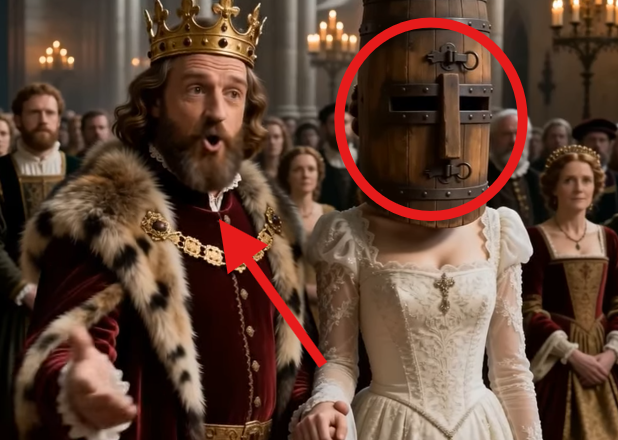
He had expected to see a stranger’s face beneath that ceremonial mask. A princess he had never met. A woman chosen for him by duty and bloodlines and royal arrangement.
Instead, he saw her.
And the color drained from his face like water through cracked glass.
“No,” he whispered. “You are dead.”
But she was not dead. She had survived. And she had come back — not to beg, not to weep, and not to hide.
Her name was Elara. And before this day was over, everyone in that cathedral would understand exactly what that name meant, and exactly what kind of man stood trembling at the altar.
She had not always worn fine lace or carried herself with quiet dignity. There was a time, not so long ago, when Elara worked in the palace laundry with rough hands and tired eyes, the daughter of a poor seamstress who had raised her with love but without answers. She was young then. She was trusting. And when a charming young nobleman named Damien began to notice her, she believed every word he said.
He told her she was beautiful. He told her she was special. He told her he loved her. He promised her a future — one that included his name, his protection, and a life beyond the washbasins and mending piles that had defined her days.
She believed him. Because she was good, and good people tend to believe in goodness.
Then she told him she was carrying his child.
That same night, he took her riding far beyond the village bridge. The road was dark. The river below was winter-cold and fast-moving. She remembered the warmth of the horse beneath her. She remembered his voice going quiet in a way that felt wrong. She remembered his hands pressing against her back — not tenderly, not the way a man touches someone he loves, but with intention.
She remembered the fall.
She remembered the freezing black water pulling her under.
When she woke, she was in a fisherman’s cottage, miles downstream, wrapped in rough wool blankets. Her baby was gone. The child she had carried, the child she had already begun to love and name in her heart — gone. And the grief that wrapped itself around her in that cold little room was so complete, so absolute, that she could not even find the breath to cry.
She healed slowly. She rebuilt herself piece by piece, the way women who have survived the unsurvivable often must — quietly, stubbornly, without anyone watching or applauding.
But she never forgot.
Standing now at the altar, Elara reached beneath the lace at her throat and drew out a small pendant — a royal seal, cracked cleanly down the center. From across the cathedral, the king rose from his seat and lifted the matching half. Two broken pieces of the same insignia. Two halves of a truth that had taken twenty-six years to come together.
“My daughter was stolen from her cradle,” the king said, his voice thick with something between grief and fury. “The woman who raised Elara found this hidden in her baby blanket.”
The murmur that moved through the wedding guests was low and stunned, the sound of two hundred people recalculating everything they thought they understood about the woman standing at the front of the room.
Elara did not look at them. She looked at the man who had tried to destroy her.
“I lived hungry within sight of this palace,” she said. “While men like you decided my birth and my poverty made me disposable.”
Damien’s composure crumbled. His eyes darted toward the cathedral doors. The royal guards were already there, still and immovable as stone.
He turned back to her, desperate in the way that men become desperate when the power they have always counted on suddenly refuses to shield them.
“I did love you,” he said.
She gave him a smile that carried no warmth — the kind of smile that belongs only to someone who has spent years learning the difference between love and control.
“You loved me when I was powerless.”
The king stepped forward and told Damien what his daughter had requested before his arrest: one final confrontation. One moment to stand before him wearing the wooden helmet — to see, with her own eyes, whether time had softened the cruelty in him, or sharpened it.
Damien had passed no test. He had only proved what she already knew.
As the guards pulled him away, he shouted something about queens needing husbands, about law and tradition and her inability to rule without a man beside her. Laughter moved through the cathedral — not cruel laughter, but the kind that rises when someone finally says out loud what everyone has quietly feared and the fear turns out to be powerless.
Elara removed the wedding ring from her finger and set it on top of the wooden helmet lying on the floor. Then she turned to face the man she had only recently learned was her father, and she said the truest thing she had ever spoken aloud.
“I will not begin my new life by marrying the man who ended my old one.”
The king bowed his head. Tears moved down his face without apology.
Before she walked down the red carpet — alone, unhurried, and entirely herself — she turned once more to the guests who had mocked the masked bride only minutes before. Her scar was visible. So were her tears. But her voice was steady and clear.
“For years, I was ashamed of surviving what he did to me. Today, he is the only shame in this room.”
And she walked. Not as a servant. Not as a discarded secret. Not as a bride hidden inside a wooden prison built from someone else’s fear.
She walked as a woman who had been buried — and had clawed her way back into the light.