The room had gone completely still.
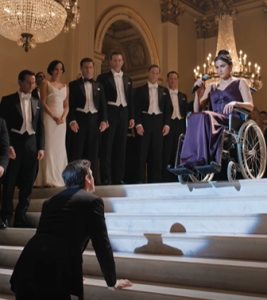
Not the polite, expectant silence of a formal gathering, but the kind of silence that descends when people sense that something irreversible is about to happen. The kind that makes the air feel thick and every breath feel deliberate.
Clara stood at the front of the ballroom with a microphone in one hand and a document in the other. She was seated in her wheelchair, yes — but there was nothing fragile about her posture. Nothing uncertain in her eyes. Every person in that room who had ever underestimated her was about to understand exactly how costly that mistake had been.
The man on the steps stared at the papers in her hand like they had risen from the dead. And in a way, they had. Because everything buried in those pages had been hidden for years — carefully, deliberately, and with the full cooperation of people who were sitting right there in the front row.
Clara let the silence stretch just a moment longer before she spoke.
She told the room about the secret wife. Not a rumor. Not speculation. A legal record, filed quietly overseas just six months after he walked out of her life and let the world believe he was a man too devoted, too heartbroken, to ever love again. He had worn her tragedy like a badge of honor. He had stood at charity events and spoken about loyalty and sacrifice while the ink dried on a marriage certificate that no one was ever supposed to find.
But Clara found it.
And that marriage, as it turned out, had nothing to do with love. His hidden wife was the daughter of the banker who had helped move family money into a network of shell companies — companies designed to strip Clara of her inheritance, her assets, and her voice while lawyers and board members nodded along and signed their names to documents declaring her mentally unfit to manage her own affairs.
The accident had taken her mobility. These men had tried to take everything else.
Clara turned a page. Then another.
Transfers that should never have been authorized. Signatures that appeared on documents Clara never saw. Board members who had accepted payments in exchange for their cooperation. And medical evaluations — paid for, arranged, and delivered on schedule — that painted her as unstable, unreliable, unworthy of the life she had built before the crash.
The man’s mouth opened. Nothing came out.
He was not on his knees at that moment because he loved her or regretted what he had done. He was on his knees because he had just realized something that his arrogance had never allowed him to consider: Clara had not invited him onto that stage to receive her forgiveness. She had invited him there so the entire room could witness his unraveling.
The audience shifted. Eyes moved from Clara to the papers to the men seated in the front row — the men who had dined with him, advised him, and quietly benefited from every decision made at Clara’s expense.
Then a sound broke the stillness from somewhere near the back of the room.
A woman was crying.
Not Clara. Clara’s face was composed, steady, almost serene in the way that only someone who has waited a very long time for a single moment can be.
The woman weeping was his hidden wife. She had slipped into the ballroom only moments earlier, arriving just in time to hear her own name spoken aloud in ways she had never anticipated. She was not crying because she felt betrayed. She was crying because Clara had just revealed something that even she had not known.
The money funneled into accounts held in her name — the money she had believed came from legitimate family business — had not only come from fraud. A significant portion of it had been taken directly from the medical trust fund established to cover Clara’s long-term care and treatment following the accident.
He had stolen from the very woman he publicly claimed to mourn.
The disgust that moved through that room was palpable. You could see it on faces. You could feel it in the way people leaned away from the men in the front row as if proximity itself had become something to be ashamed of.
The man tried to stand. Security was already moving toward him before he made it upright.
And then Clara leaned slightly forward, her eyes never breaking from his, and delivered the sentence that collapsed whatever remained of his dignity.
“I did not bring you here to watch me lose,” she said. Her voice was quiet. Controlled. It cut through the room the way only absolute certainty can. “I brought you here so the world could finally see what really crippled this family.”
Cameras rose across the room. An officer’s hand landed on his shoulder.
Clara placed one final document on the microphone stand. A signed legal order. One that restored her as the sole rightful owner of everything that had been taken from her.
And at the bottom of that order, beneath the official seals and the legal language, was a witness signature. One name. The one person everyone in that room had assumed was his most loyal ally.
His own father.
The room did not erupt. It did not need to. The truth has a weight to it that doesn’t require noise. It simply settles — over everything, into everything — and once it does, nothing in the room can pretend to be what it was before.
Clara had not arrived that evening broken. She had arrived ready. And she left having given back to every person who ever doubted her the one thing they had tried so hard to take: the truth, finally, in full.