She asked the question, but the anger had drained from her voice entirely. What replaced it was something far more fragile — a trembling, barely-held-together sound that seemed on the verge of shattering.
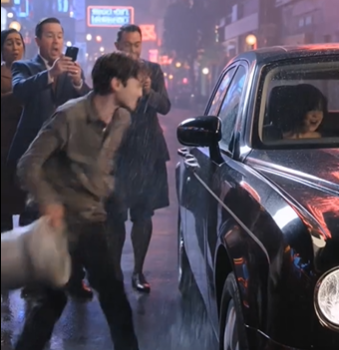
The boy gripped the photograph tighter, as if letting go would mean losing the one thread still connecting him to the woman who had raised him alone.
“She told me she worked one block from the hotel where you got out of that car,” he said quietly. “She wasn’t rich. She wasn’t important. She was just standing there with a baby in her arms and nowhere to go.”
The woman’s breathing shifted. Something moved across her face — a flicker of recognition she was clearly fighting to contain.
“She said she begged you for help.”
Around them, the small crowd that had gathered exchanged uneasy glances. Not a single phone lowered. Not a single person looked away.
“You were the last person she ran to,” the boy continued, his voice steady despite the tears building behind his eyes. “Because she believed you knew my father. She believed you knew exactly what had been done to her.”
The richly dressed woman took a slow, involuntary step backward.
“No…” she whispered.
The boy’s eyes filled, but he didn’t stop.
“She said you looked at me first. Not her. Me.”
He paused, letting the weight of that settle.
“And then you looked at the blanket I was wrapped in.”
The woman’s hand rose slowly to cover her mouth. Her composure, so carefully maintained, was beginning to fracture at the edges.
“My mother said your face changed the moment you saw the name stitched inside.”
The boy unfolded the photograph completely — deliberately, methodically — and turned it over.
Written across the back in faded but still-legible ink was a single word:
Daniel.
The woman let out a breath that sounded like it had been trapped inside her for years.
The boy noticed immediately.
“She told me you knew that name,” he said.
The woman’s eyes closed for just a moment, like someone finally surrendering to an exhaustion they had carried far too long.
“My mother said she begged you not to walk away,” the boy continued. “But you did.”
Rain tapped softly against the roof of the car parked beside them, the only sound filling the space between his words.
“She said one thing before you left,” he whispered.
The woman opened her eyes.
The boy looked directly at her and repeated the words slowly, as if he had rehearsed them a thousand times in the quiet of sleepless nights:
“If they find out whose child this is, both of you will disappear.”
A visible shudder moved through the woman’s entire body — the kind that comes not from cold, but from truth.
The crowd was absolutely still.
The boy stepped closer.
“My mother spent years telling me you abandoned us because you were cruel,” he said. “But right before she died… she told me the truth.”
The woman’s lips parted slightly, her breath coming in shallow waves.
“She said when you drove away…” his voice cracked for the first time, soft and raw, “…you were crying too.”
And that was the moment the woman broke.
Tears spilled freely down her face as she reached for the side of the car to steady herself, her whole body shaking with the weight of something she had never been allowed to release.
“I didn’t abandon you,” she whispered — not to the crowd, not to the cameras, but to him. Only to him.
The boy stood motionless, watching her.
She looked at the photograph, then back at his face — searching it, the way people search for something they lost long ago and feared they would never recognize again.
“I was trying to save you.”
The boy’s expression went completely still.
The woman’s voice broke into pieces as the words came tumbling out, no longer carefully chosen, no longer controlled.
“The man your mother was running from…” she said, her voice barely holding together, “…was my husband.”
A gasp moved through the crowd like a wave.
The boy’s eyes went wide.
The woman stepped forward, closing the distance between them, barely able to breathe.
“And the reason I knew your name…” she whispered, her gaze falling to the blanket in the photograph, then rising slowly back to meet his, “…is because I’m the one who gave it to you.”
The silence that followed was the kind that doesn’t just fill a space — it occupies it completely, pressing into every corner, leaving no room for anything else.
Because in that moment, everything the boy thought he understood about his story, about his mother’s suffering, about the woman he had spent years learning to hate — collapsed into something entirely different.
She had not walked away from a mother and child in need.
She had walked away to protect a child from the man who could destroy them both — the man who shared her last name, her home, her life.
The cruelest part of the truth was also the most heartbreaking: sometimes the people who love us most are the ones who leave without explanation, because the explanation itself is too dangerous to speak aloud.
The boy looked at the woman’s face — really looked — and saw for the first time what grief that has been silenced for years actually looks like on a person.
He saw himself in it.
And slowly, without a word, he held the photograph out to her.
She took it with both hands, trembling, pressing it against her chest like something sacred.
Some secrets don’t destroy families when they finally surface.
Sometimes, after years of silence, they rebuild them — one painful, overdue truth at a time.