He stood frozen in that sterile hallway, holding the worn medical ID as though it had scorched straight through his palm.
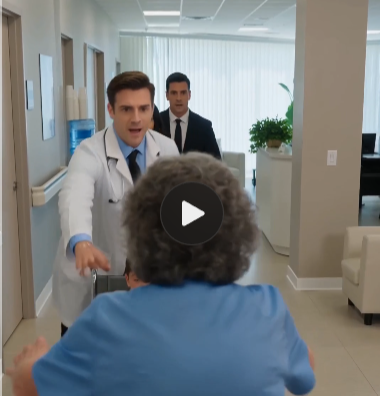
His eyes moved slowly — from the woman gripping her mop handle to the name printed on the laminated card — and in that single moment, something broke open inside him. His chest tightened. His breath came in shallow, uneven pulls. The fluorescent lights above seemed to buzz louder, pressing down on the silence that had swallowed the entire corridor.
The young doctor standing nearby said nothing. He sensed, with the instinct that only comes from years of watching people receive devastating news, that this was not his moment to speak.
The mother pulled her son closer against her chest, her eyes darting between her husband’s crumbling expression and the quiet woman in the faded cleaning uniform. The boy in the wheelchair — pale, fragile, his small chest rising and falling with visible effort — looked up at the woman with eyes that held no fear. Only curiosity. Only a strange, wordless recognition that none of the adults around him could explain.
“You know her?” the mother whispered, her voice barely rising above the hum of the hospital ventilation system.
Her husband couldn’t answer. His mouth opened, then closed. The color had drained completely from his face.
The cleaner — the woman who had been mopping these same floors for three years, who had learned to make herself invisible, who had learned that invisibility was the only armor she had left — looked up slowly. Her eyes, lined with the quiet exhaustion of a woman who had carried grief far longer than anyone should, filled with something raw and unmistakable.
Pain. And beneath it, something fiercer. Truth.
“You told them I was dangerous,” she said, her voice low and steady, the way only someone who has rehearsed a moment in her mind ten thousand times can speak. “You told them I lost my license because I made a mistake.”
The father swallowed hard. The sound of it was almost audible.
The hallway turned colder.
She shifted her gaze to the little boy — this small, struggling child who had come back through the hospital doors gasping for air — and something in her expression softened into a tenderness so profound it was almost painful to witness.
“But the truth is,” she said, her voice breaking only slightly at the edges, “I was the surgeon who saved him the day he was born.”
The mother’s face went white.
Not pale. White. The kind of colorless that happens when the ground disappears beneath a person’s feet.
“What?” The word came out barely a breath.
The cleaner pressed on, because she had waited too long, and the boy deserved the truth even if the adults in the room did not.
“He came into this world with a rare condition. The kind that doesn’t wait, doesn’t negotiate, and doesn’t give second chances.” She glanced briefly at the father, who was now staring at the floor. “Your husband refused the surgery. He said it was too expensive. He said to wait and see.”
A sound escaped the mother — small, strangled, the beginning of something she couldn’t yet name.
“I couldn’t wait,” the cleaner continued. “I had taken an oath, and that child was right in front of me, and he was running out of time. So I operated.”
The silence that followed was the loudest thing in the room.
The mother turned toward her husband with the slow, deliberate movement of a woman whose entire understanding of her life has just shifted on its axis. She didn’t scream. She didn’t reach for him. She simply looked at him, and in that look lived every question, every year, every quiet sacrifice she had made for a family she believed was built on honesty.
His eyes dropped.
They dropped the way the eyes of a man drop when there is no story left to tell. When the lie has finally reached the end of its road and there is nothing ahead but the weight of what was done.
The cleaner wiped a tear from her cheek with a trembling hand, the gesture so small and so human that it was almost unbearable to watch.
“He destroyed my career to hide what he did,” she said simply. No theatrics. No bitterness sharpened into a weapon. Just fact, laid bare in a hospital hallway under flickering lights.
For a long moment, no one moved.
Then the boy — this small, exhausted, beautiful boy who had been fighting his whole short life without ever fully knowing why — reached out from his wheelchair. His arm was thin. His fingers were pale. But his reach was deliberate.
He touched her hand.
Not out of confusion. Not by accident.
He reached for her the way people reach for something they cannot name but somehow, in the deepest part of themselves, have always known.
And for the first time in what felt like years, the woman who used to be a surgeon — who had given up everything for a child who never knew her name — smiled. It was a broken smile, wet with tears, crooked with grief, but it was real. More real than anything else in that hallway.
Then the mother stood.
She straightened her back with the quiet dignity of a woman stepping into the hardest moment of her life, and she looked at the cleaner — truly looked at her — and when she finally spoke, her voice was barely above a whisper.
“You didn’t just save him today.”
She paused, pressing her lips together to hold herself steady.
“You saved him twice.”
No one in that hallway moved for a long time after that. The boy kept his small hand in hers. The father kept his eyes on the floor. And the woman in the faded uniform stood in the middle of it all, finally seen, finally known — holding the hand of the child she had once risked everything to bring into the world.
Some debts cannot be repaid. Some sacrifices live quietly in the background of other people’s lives, never acknowledged, never thanked. But every now and then — in a cold hospital hallway, beneath buzzing lights — the truth finds its way back to the surface.
And when it does, it changes everything.