The wine glass slipped from the man’s hand and shattered on the floor beside his wheelchair. The sound of broken crystal echoed across the terrace, but no one moved. No one breathed.
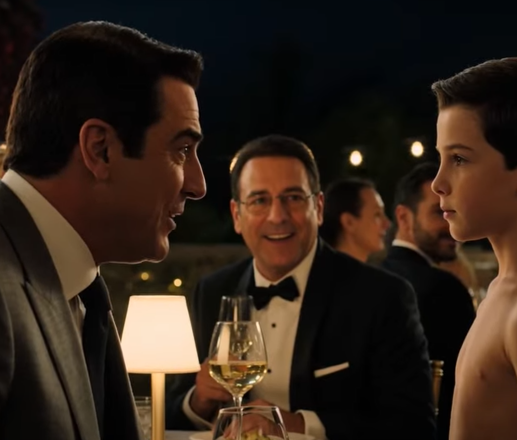
“What did you say?” he whispered.
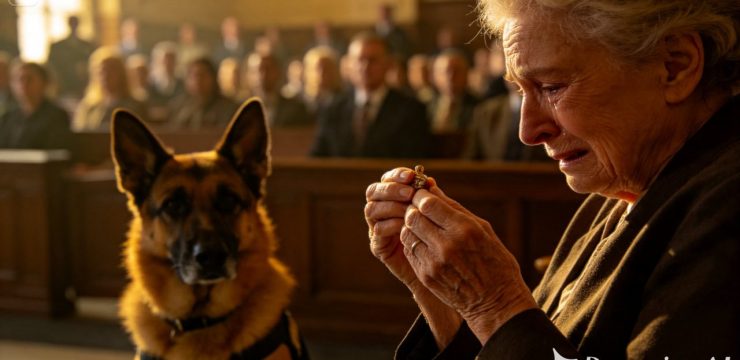
The boy standing before him — small, dusty, with hollow cheeks and tired eyes — slowly reached into his jacket pocket. He pulled out a bracelet. Gold, bent at the clasp, worn thin from years of being held by someone who had nothing else left to hold.
One name was engraved on the inside.
Elena.
The man’s face fell apart in ways that faces shouldn’t. His jaw slackened. His eyes flooded. He looked at that bracelet the way a man looks at something he buried — something he never expected to see again above ground.
“No,” he said, his voice barely a sound. “Elena died.”
The boy shook his head slowly, with a gravity far too heavy for someone his age.
“She died last month.”
The guests on the terrace froze. Conversations died mid-sentence. Champagne glasses hovered in hands that had forgotten how to move. Everyone felt it — that particular silence that falls when a secret finally escapes the room where it’s been locked for years.
The man stared at the bracelet as though it had opened a grave directly in front of him.
“She was pregnant,” he whispered, his voice trembling at the edges. “They told me the baby didn’t survive either. They told me I had nothing left.”
The boy placed both small hands on the armrest of the wheelchair and held the man’s gaze without flinching.
“She said your family paid the doctor to lie,” he said quietly. “She said they didn’t want a woman like her — a poor woman — giving her child your name. So they made sure you’d never know.”
The man’s face twisted into something between devastation and fury.
“My family?” he breathed.
Across the terrace, an older woman in diamonds rose slowly to her feet. Elegant. Composed. The kind of woman who had spent a lifetime perfecting the expression of someone with nothing to hide.
His mother.
Her face had gone the color of chalk.
The boy glanced toward her — and flinched.
“That’s her,” he whispered, lowering his voice as if she might still have the power to make him disappear. “She came to our room once, when I was little. She told my mom that if we ever came near you — if we ever tried to reach you — we would disappear.”
The man’s hands began to tremble against the wheels of his chair.
He looked down at the child kneeling before him. Dusty shoes. Threadbare jacket. A face that carried, in the angle of the jaw and the shape of the eyes, the unmistakable ghost of a woman he had spent eight years grieving. A woman he had loved so completely that losing her had taken something from him he believed he would never recover.
“What’s your name?” he asked, though some part of him already knew.
“Mateo,” the boy said.
The man broke.
It was not a quiet breaking. It moved through him like a tremor — visible, uncontrollable, human in the most raw and unguarded way.
“That was the name I chose,” he managed. “Before. When she was still…”
Mateo swallowed hard. His chin trembled, but he held himself steady with the kind of composure that only comes from having no one to fall apart in front of.
“Mom told me about you,” he said. “She said that when she was scared — really scared — you used to count to three with her. To help her breathe. To help her get through it.”
The man covered his mouth with both hands. Tears fell silently down his face.
Mateo’s voice dropped to barely a whisper.
“She said if I ever found you, I should finish it.”
He reached forward and placed his small hands gently on the man’s knee.
“One.”
The man’s leg trembled beneath the touch.
“Two.”
Something shifted. Something long broken began — impossibly, painfully — to move.
“Three.”
For the first time in years, the man pushed himself forward. His arms shook. His breath came in ragged gasps. But he rose. Slowly, achingly, he stood on legs that doctors had long since stopped believing in — and he fell to his knees in front of his son.
He pulled Mateo into his arms and held him with everything he had.
The crowd erupted — gasps, murmurs, the sound of someone crying softly near the back — but the man heard none of it. There was only this. Only the boy in his arms, who smelled like road dust and something heartbreakingly familiar.
Mateo stood rigid for one long, painful moment.
Then — like a wall finally giving way after years of holding back the flood — he cried. Not politely. Not quietly. He cried the way a child cries when he has been strong for far too long, when he has carried grief that was never meant for small shoulders, when he finally, finally finds the place where he is allowed to just be a child.
“I thought you didn’t want me,” he sobbed into the man’s shoulder.
The man held him tighter, shaking with grief and gratitude and eight years of stolen time.
“I would have crawled across the world for you,” he said. “Across every broken road. If I had known — if I had known you existed — nothing on this earth could have kept me from you.”
Behind them, his mother whispered his name.
He did not turn around.
He kept his arms wrapped around his son, his face buried in the boy’s hair, and he said through tears — quiet enough that only Mateo could hear:
“The million was never the miracle.”
Mateo pulled back just enough to look at him. His eyes — Elena’s eyes — searched his father’s face.
The man reached up and touched his son’s dirty cheek with a trembling hand.
“You were.”