Nobody spoke when the school bell rang.
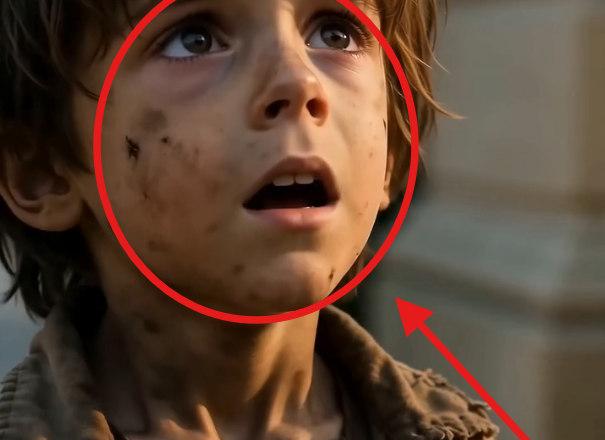
The sound drifted through iron bars, over cracked sidewalks, and landed somewhere near a boy who had no right to be there — at least, that’s what the world had decided. Daniel stood just outside the gate, holding a small flower he had folded from a scrap of paper he’d found near the alley. His shoes were torn at the toes. His shirt had been washed so many times it had forgotten what color it used to be. But his eyes — his eyes were alive in a way that made adults uncomfortable, because hunger like that doesn’t belong to children who are supposed to stay invisible.
He pressed himself close to the wall, the way he always did when the classroom windows were open. That was the only time he could hear clearly. The teacher’s voice would float out on the warm air, and Daniel would close his eyes and absorb every word like rain on dry ground. He never interrupted. He never asked for anything. He simply listened, and learned, and hoped that knowledge was something nobody could take back once it was already inside you.
That morning, a woman arrived at the school gate in polished heels and expensive sunglasses. Her daughter walked beside her, backpack perfectly organized, uniform perfectly pressed. The woman moved with the confidence of someone who had never once had to press their ear against a wall to hear a lesson. She noticed Daniel immediately. She always noticed people like Daniel — not with kindness, but with the careful awareness of someone protecting something she believed was hers.
“This school,” the woman said, her voice clipped and precise, “is for children with parents.”
The words landed like a door slamming shut.
Daniel lowered his eyes. He didn’t argue. He never argued. Instead, he held out the little paper flower — shaking fingers, steady heart — and whispered, “It’s for you,” nodding toward the teacher who had just appeared at the doorway. “For the water. For what you give.”
The teacher had been watching from the entrance. She had been watching for weeks, if the truth were told. She had noticed the small shadow by the window. She had begun pausing after asking questions, giving that shadow a half-second more than usual. And more than once, the answer had come — quiet, correct, and slightly ahead of every child seated at a proper desk inside her classroom.
She stepped forward and took the paper flower from Daniel’s hands as though it were something precious. Because it was.
The woman’s daughter had been watching too. Children always see more than adults give them credit for. She looked at Daniel’s torn shoes, then at her own. She looked at his empty hands, then at her full backpack. And without waiting for anyone’s permission, she reached inside and pulled out her extra notebook — clean pages, unwritten — and placed it gently into his arms.
“You can have mine,” she said simply.
Daniel stared at it. He was almost afraid to touch something so unmarked, so full of possibility. For a boy who had never been given anything without a condition attached, a blank notebook felt like a door left open by accident.
The rich woman stood very still. A moment ago, she had drawn a clear line between her world and his. Now that line was dissolving, and everyone around her could see it happening. Her daughter had crossed it without a second thought. The teacher was holding a paper flower like it was made of gold. And Daniel was standing there — not begging, not demanding — simply existing with a dignity that made her feel, unexpectedly and uncomfortably, ashamed.
She removed her sunglasses slowly.
Her voice, when it came, was smaller than before.
“What happened to yours?” she asked. “Your parents.”
Daniel looked toward the alley behind the school. The one where he slept when the nights were cold. The one that had become his whole world since the only person who loved him stopped breathing.
“My mom died,” he said. His voice didn’t crack. He had learned to say those words the way you learn to carry something heavy — carefully, so it doesn’t break you in front of others. “But she told me if I kept learning, I wouldn’t stay lost forever.”
The silence that followed was the kind that changes people.
The teacher moved to the gate and held it open. Not dramatically. Not with a speech. Just held it open, the way you do when someone has been waiting long enough.
And the rich woman — slowly, with the visible effort of someone rearranging everything they thought they knew — stepped aside.
That moment, small as it was, held the weight of every gate ever built between people who have and people who want. It held the memory of every child who pressed their face against a fence and wondered why the world was divided so neatly into those who are invited in and those who are made to wait outside.
Daniel walked through.
He didn’t run. He didn’t smile with triumph. He simply walked, holding the notebook, into the place where the lesson was already halfway over — and where, somehow, he already knew the answers.
Because learning had never really been about the building.
It had always been about the hunger to understand, the refusal to give up, and the quiet, unshakeable belief that being poor is not the same as being less.
His mother had taught him that.
From the other side of every gate she never got to open for him herself.