Thomas had spent most of his life on that ranch, and if you asked anyone who knew him, they would tell you the same thing: the man and his horse were inseparable. Thunder wasn’t just an animal Thomas happened to own. He was family — the kind of bond that doesn’t need words to explain itself, only years of quiet mornings and shared silences to understand.
It had started long before Thunder even took his first steps. Thomas had been there the night Thunder’s mother gave birth, kneeling in the hay in the middle of the night, helping bring that foal into the world. When the young horse fell ill shortly after, Thomas was the one who bottle-fed him through the night, who sat beside him when others thought he wouldn’t survive. He nursed him through injuries, talked to him on hard days, and somewhere along the way, that horse became the most loyal presence in his life.
Every single morning followed the same quiet rhythm. The sun would rise over the fields, Thomas would fill a bucket with feed, and before he even reached the barn, he could already hear Thunder — that familiar, happy neigh that told him the horse had recognized his footsteps. Thunder would stretch his nose toward Thomas’s shoulder the moment the door opened, patient and calm, ready to be petted. In all those years together, the stallion had never once shown a single moment of aggression.
That was exactly why Thomas had no reason to be afraid that morning.
He pushed open the barn door, stepped inside, and smiled. “Good morning, old friend.”
What happened next would shake him to his core.
Thunder let out a sharp, alarming cry — nothing like his usual greeting. His ears went flat against his head. His nostrils flared wide. His massive hooves struck the ground in short, anxious bursts. Thomas froze, confused, reading the horse’s body language the way only a man who had spent decades with animals could.
He took one careful step forward.
That was all it took.
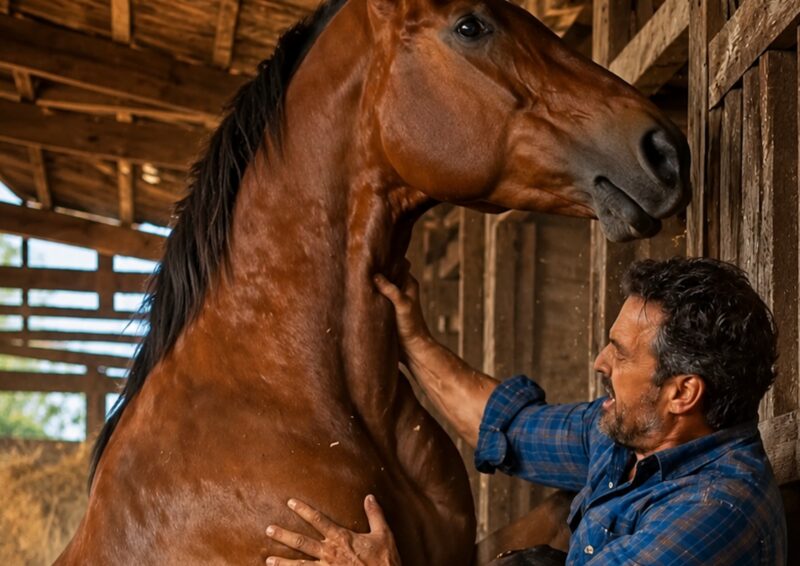
Thunder reared up on his hind legs, and before Thomas could react, the enormous stallion drove his full weight against the man, slamming him hard into the wooden wall of the barn. The air rushed out of Thomas’s lungs in an instant. Splinters flew. Dust filled the air. The horse pressed his chest against Thomas, pinning him there, massive hooves striking the ground just inches away.
Thomas was a practical man. He didn’t frighten easily. But in that moment, with those hooves directly in front of him and no room to move, he genuinely believed he might not walk out of that barn alive.
With every bit of strength he had left, he twisted sideways, squeezed between the stall wall and the wooden boards, and threw himself out through the barn door. He slammed it shut behind him. His hands were shaking. His heart was hammering. From inside, he could still hear Thunder — frantic, pounding, desperate.
The ranch hands came running. Word spread quickly. People started talking about rabies, about madness, about an animal that had simply snapped. A veterinarian came out and examined Thunder carefully but found no signs of illness. Still, the behavior continued. Thunder refused to let anyone near the barn door, striking the ground violently whenever someone approached.
Thomas wrestled with the hardest decision of his life. He loved that horse more than most people could understand. But he had workers on that ranch, people with families, and he couldn’t put them at risk. Quietly, painfully, he made the call. Thunder would have to be put down.
He came to the ranch early the next morning, before anyone else arrived. He wanted one last moment alone with his old friend.
As he walked toward the barn, he heard the anxious neighing begin again. But this time, something made him stop. Underneath Thunder’s cries, barely audible, came another sound entirely. Small. Faint. Human.
Thomas stood completely still and listened.
It was a child crying.
He traced the sound to a far corner of the barn floor. Between the old wooden planks, there was a crack — thin, easy to miss — but when he pressed his ear close, there was no mistaking it. He grabbed a crowbar and carefully pried the boards up, one by one.
Beneath the barn floor was an old, forgotten well that no one on the ranch had thought about in years. And huddled at the bottom, cold and frightened and crying softly, was a little boy — no older than five — the son of one of his ranch workers.
The child had been missing for two days. Officers had searched the surrounding woods, the fields, the roads. Nobody had thought to look beneath the barn floor.
But Thunder had known. Thunder had known the entire time.
On the morning of the attack, as Thomas walked toward the barn with his bucket of feed, he had been heading straight toward the section of rotten flooring directly above that well. Thunder had seen it. Thunder had understood the danger in a way that no one else had.
Every neigh, every rearing, every moment of what looked like madness — the horse had been trying to stop his owner from stepping on that weakened floor. He had pressed Thomas against the wall not to hurt him, but to protect him. And all those hours of frantic pounding near the barn door? He had been trying to make someone — anyone — pay attention to what was happening just beneath their feet.
Rescuers pulled the boy to safety. He was cold and shaken, but he was alive.
When it was over, Thomas walked slowly back into the barn. Thunder stood quietly by his stall, calm now, all the frantic energy completely gone. Thomas crossed the floor and stood in front of him for a long moment, just looking into those dark, steady eyes.
Then he wrapped both arms around the horse’s neck and held on.
“Forgive me,” he whispered. “I thought you had lost your mind. But all along, you were the only one who knew the truth.”
Thunder exhaled softly and pressed his nose gently into Thomas’s shoulder — the same gentle gesture he had offered every morning for as long as either of them could remember.
Some bonds run so deep that words were never needed in the first place.