Some moments on an ordinary commute stay with you long after you’ve reached your destination. Not because of the scenery outside the window, or the music playing through your headphones, but because of what one human being chose to do to another — and what happened next.
This is one of those moments.
The bus that afternoon was packed beyond comfort. Passengers stood shoulder to shoulder, gripping overhead rails to keep their balance through every curve and stop. The air was thick with the sounds of the city — low conversations, the shuffle of feet, the occasional ding of a stop being announced. Most people had retreated into their own little worlds, phones in hand, eyes down, minds elsewhere.
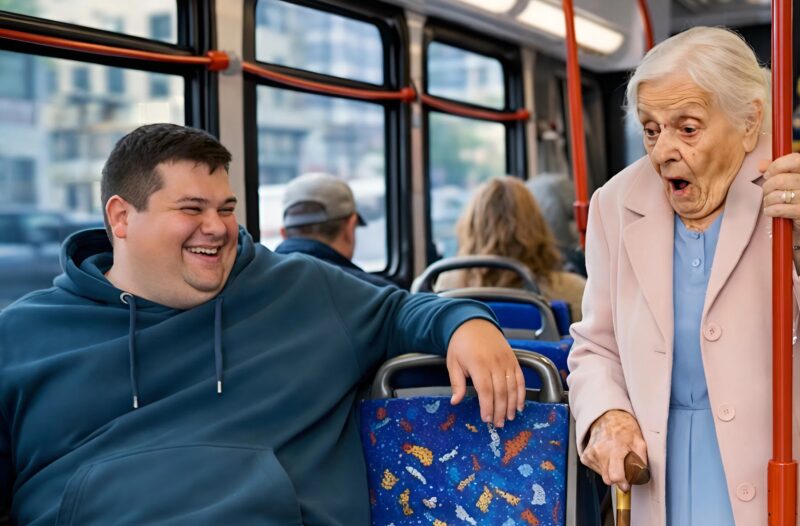
At one of the stops, the doors hissed open and an elderly woman stepped aboard. She moved slowly, deliberately, leaning on a wooden cane with each careful step. You could see in the way she carried herself that standing for any length of time was not easy. She wasn’t asking for special treatment — she simply needed a seat, the way anyone would after a long day on tired legs.
People near the aisle shifted slightly, the way strangers do when they want to help but don’t quite know how. And then she spotted it — an open seat near a young man sitting toward the middle of the bus.
Except it wasn’t entirely open.
The young man was sprawled out like the bus was his personal living room. His backpack occupied the seat beside him. His legs were stretched wide, one of them jutting out into the aisle, claiming space that wasn’t his to claim. He wore the expression of someone who had never once been told no — relaxed, unbothered, completely indifferent to the world around him.
The elderly woman approached him gently. She spoke quietly, almost apologetically, as if she were the one causing an inconvenience.
“Young man, could you please move your bag? I’d like to sit down.”
He didn’t look up. Didn’t flinch. Didn’t acknowledge her at all.
She waited a moment, patient and dignified, then slowly reached toward the backpack to move it herself. That’s when everything changed.
The young man snapped to attention as if she had touched something sacred. He jumped up, voice rising sharply above the noise of the bus.
“What do you think you’re doing?! Don’t touch my stuff! I’ll call the police!”
The bus went quiet. Heads turned. People who had been lost in their own thoughts were suddenly, unavoidably present.
The woman blinked, startled. “I only wanted to sit,” she said softly. “I asked first. The seat looked free…”
He looked down at her with cold, deliberate contempt.
“That seat is taken,” he said flatly.
“By whom?” she asked, her voice barely above a whisper.
He smiled — that kind of smile that has no warmth in it — and answered without a moment of hesitation.
“By my leg.”
Then, to make his point absolutely clear, he lifted his leg and dropped it dramatically across the seat. And as if that weren’t enough, he added something that made the entire bus hold its breath.
“Besides,” he said, curling his lip, “you smell like old age. I don’t want to sit next to you.”
Silence. Real silence — the kind that presses down on a crowd and makes everyone suddenly aware of their own heartbeat. Some passengers looked away. Others stared at the floor. A few pressed their lips together, clearly uncomfortable, clearly conflicted. No one spoke.
No one — until a young woman standing near the window decided she had heard enough.
“Hey,” she said, her voice cutting clearly through the quiet. She wasn’t shouting. She didn’t need to. “Do you even hear yourself right now?”
Every eye on the bus shifted to her. She stood her ground, looking directly at the young man without a trace of hesitation.
“This woman is the only person willing to sit next to you,” she continued, “and only because standing is hard for her. And you’re acting like everyone on this bus owes you something.”
He opened his mouth to respond, but she wasn’t finished.
“Look up. See that sign? Those seats exist for elderly passengers and people who have difficulty standing. Has your arrogance made you blind to that too? Maybe you should walk — the exercise would do you some good.”
A quiet laugh escaped from somewhere in the back of the bus. Then another. Then the quiet rippled into something louder — not cruel laughter, but the kind that rises when a crowd finally exhales after holding its breath for too long.
“She’s right!” called one passenger.
“Have you no shame?” said another.
“Get off the bus!” came a voice from the front.
The driver brought the vehicle to a stop and opened the doors.
The young man sat frozen for a moment, as if his brain genuinely couldn’t process what was happening to him. The smug certainty he’d walked onto that bus with had completely dissolved. Under the weight of every stare, every voice, every pair of eyes looking at him without sympathy, he stood up slowly and walked off the bus without a single word.
The doors closed. The bus moved on.
The young woman picked up the backpack, set it carefully aside, and helped the elderly woman lower herself into the seat. The older woman looked up at her, eyes glistening with a mixture of relief and disbelief.
“Thank you,” she said softly.
“No,” the young woman replied, with a quiet smile. “Thank you. For your patience.”
Something shifted in that bus after he left. The atmosphere that had felt so tense and cold began to thaw. A man offered his spot to someone nearby. A stranger smiled at another for no particular reason. People who had been invisible to one another just minutes before were suddenly, briefly, a community.
It didn’t take a grand gesture or a dramatic intervention to change the temperature of that space. It took one person who decided that silence, in that moment, was not an option.
One act of cruelty. One act of courage. And a reminder that the way we treat the most vulnerable among us says everything about who we truly are — whether we’re twenty years old, or eighty, or somewhere in between trying to figure it out.
Kindness costs nothing. Decency costs nothing.
But the lack of them? That has a price. And sometimes, it gets collected right there — in front of everyone — on a city bus on an ordinary afternoon.