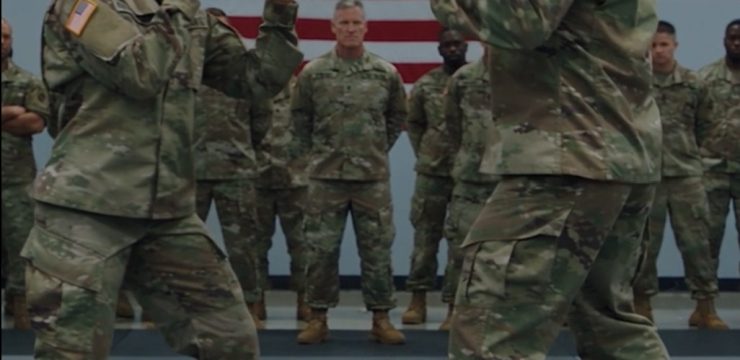
The moment she stepped onto the mat, every man in that warehouse knew something was wrong — they just couldn’t name it yet.
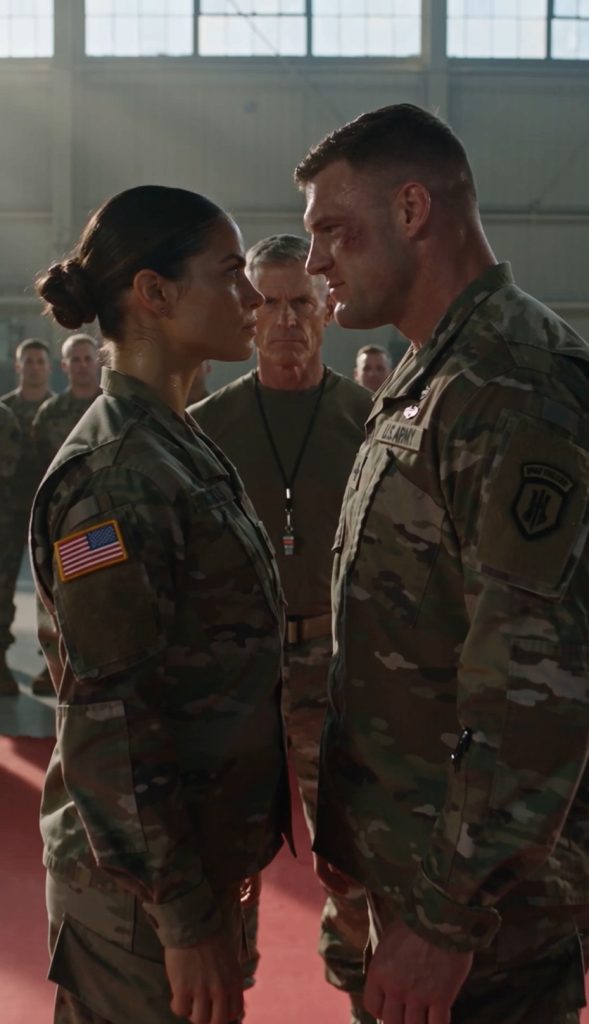
It wasn’t her size. It wasn’t even the silence that had swallowed the room. It was the way she stood there, fists raised, breathing slow and even, like a woman who had already lived through this fight once before.
Dust drifted through the late-afternoon light cutting down from the high windows. The air inside the hangar was thick, motionless, almost suffocating. A circle of soldiers had formed without a single command — drawn in by instinct, by rumor, by the quiet electricity that always precedes something no one can take back.
Sergeant Jake Kinsane stepped forward first.
He was smiling. That same easy, wide grin the entire company had learned to read not as warmth — but as a warning. Six-foot-four. Undefeated. Every unofficial bout this unit had ever held ended the same way: with Kinsane standing, and the other person deciding they’d had enough.
He stopped close enough for her to smell the soap and sweat on his skin.
“You sure about this, Herritt?”
His voice carried just far enough. A few low chuckles rolled through the ranks. Some of the younger soldiers nudged each other, already composing the story they’d tell at chow.
Specialist Lena Herritt didn’t flinch. She kept her eyes fixed on his chest for a long, deliberate beat — then lifted them to his face.
Her expression didn’t change. Not even a little.
First Sergeant Hoston stood at the back of the crowd, arms folded, whistle hanging from his neck like a dead weight. He said nothing. He didn’t need to. Everyone already understood the rule: once your boots touched the red mat, you finished what you started.
Kinsane leaned in slightly. His voice dropped.
“Last chance to walk away. No shame in it.”
She turned her head — just enough to meet his gaze directly. Something flickered behind her eyes. Not fear. Something colder. Something older.
Then she walked.
Her boots struck the concrete floor, then the soft give of the mat. The American flag draped over a nearby bench barely stirred. Soldiers shifted their weight. A few were still grinning. Others had gone quieter than they’d been a minute ago, though none of them could explain why.
She stopped in the center of the mat. Raised her fists. Dropped into her stance — low, compact, perfectly balanced.
Kinsane’s smile thinned.
He had expected hesitation. Maybe a tremor in her hands. Maybe a glance toward the exit. He had seen it a hundred times — the moment when someone’s bravery runs out and their body starts negotiating the retreat.
But she wasn’t retreating. She was waiting.
And she was looking at him the way someone looks at a person they already know how to break.
The hangar lights hummed above them. Somewhere behind her, a voice muttered, barely louder than a breath — “She’s actually going to—”
She exploded forward.
The speed was wrong. Too fast. Too clean. Not the raw, scrappy charge of someone fighting out of pride — but the precise, devastating launch of someone who had been trained by hands that knew exactly where damage lives.
And in the half-second before impact, Kinsane’s eyes went wide.
Because he recognized the move.
Not from a manual. Not from a training video. From muscle memory — from his own hands correcting someone else’s form, years ago, in a different unit, on a different continent. A technique he had only ever taught to one person.
A woman who had been reported dead three years ago.
His fists dropped an inch. His breath caught. And for the first time in his entire military career, Jake Kinsane hesitated on the mat.
That hesitation — it told her everything she needed to know. He remembered. And now, the real fight wasn’t physical anymore.
Her fist connected just below his ribs.
The sound it made was flat, ugly, final. Kinsane folded — not all the way, but enough. Enough for every soldier in that circle to stop breathing at the same time. Enough for the grins to die on their faces like candles snuffed in a single breath.
He staggered back one step. Two.
His hands came up — not to strike, but to guard. And his eyes — his eyes were no longer looking at an opponent. They were searching her face the way a man searches a room he was told had been demolished.
“Who — ” he started.
She didn’t let him finish.
A sharp knee feint drew his guard low, and her elbow came across his jaw in a clean arc that snapped his head sideways. He hit the mat on one knee. Blood threaded from the corner of his lip.
The warehouse was silent now. Completely, absolutely silent. Not even the shuffle of boots.
First Sergeant Hoston’s arms slowly unfolded.
Kinsane looked up at her from one knee — and for the first time in front of his entire unit, his voice cracked.
“Mara?”
The name landed in the silence like a grenade with a pulled pin.
Lena — or whoever she truly was — stood over him with her fists still raised. Her chest was heaving. Her jaw was locked so tight the tendons in her neck stood out like cables. But something in her eyes had shifted. The cold precision was still there, but underneath it, something was breaking open. Something she had held shut for three years.
She didn’t answer him.
Instead, she whispered — so quietly that only he could hear — “You left me there.”
Kinsane’s face collapsed. Not from the pain of the blow. From something far worse. The kind of devastation that starts behind the sternum and doesn’t stop until it swallows everything.
“They told me you were dead,” he said. His voice was barely a sound. “They showed me the report. The photos. I saw — ”
“You saw what they wanted you to see.”
She stepped back. One step. Then another. Her fists slowly lowered. Her hands were trembling now — not from exhaustion, but from the effort of standing in front of this man without screaming.
Soldiers exchanged glances around the circle. Nobody moved. Nobody understood what they were witnessing — only that it was something far bigger than a sparring match on a red mat.
Hoston stepped forward. His voice was calm, measured, the kind of calm that only comes from decades of seeing the worst things human beings can do to each other.
“Herritt. Stand down.”
She didn’t look at him. She was still looking at Kinsane. And Kinsane was still on one knee, blood on his chin, staring up at her like a man watching his own ghost walk toward him.
“Three years,” she said. Her voice shook on the second word. “Three years in a place you can’t imagine. And the whole time — the whole time — I kept thinking, he’ll come. Jake will come. Because he taught me how to survive. Because he promised.”
The words hit the silent room harder than any fist.
Kinsane’s hand came up — shaking, open, reaching for nothing and everything — and his mouth opened, but no sound came out. His chest hitched once. Then again. Then he pressed his fist into the mat and bowed his head, and the sound that came from him was something no one in that unit had ever heard from their sergeant.
It was grief. Unfiltered. Undeniable.
She knelt.
Not to fight. Not to hurt. She knelt in front of him on the red mat, under the hum of the hangar lights, with dust still floating through the late-afternoon sun and fifty soldiers standing in a circle with their mouths shut and their hearts hammering.
She took his face in both hands. Her palms were still taped for combat.
“Look at me,” she said.
He looked.
“I didn’t come back to destroy you. I came back because you’re the only person alive who knows what happened on that mission. And I need you to tell the truth — not to me. To them.”
She tilted her head toward Hoston. Toward the circle. Toward the institution that had declared her dead and buried the file.
Kinsane’s jaw tightened. His eyes were red. His breathing was ragged. But something in him was shifting — the same instinct that had once made him the best soldier in his unit. The instinct to protect. To do the right thing even when the right thing would cost him everything he had built since she disappeared.
He placed his hand over hers. Pressed it against his cheek. Closed his eyes for one breath. Two.
Then he stood.
He turned to Hoston. Blood still on his lip. Hands still shaking.
“First Sergeant,” he said. His voice was rough, but steady. “I need to make a formal statement. About Operation Dawnline. About what really happened to Specialist Mara Voss. And about the officers who signed her death certificate while she was still alive.”
The silence that followed was the loudest sound that warehouse had ever held.
Hoston looked at him for a long time. Then at Lena. Then at the flag draped across the bench.
He reached for the whistle around his neck. Lifted it over his head. Set it down on the bench beside the flag.
“Clear the room,” he said quietly.
Nobody argued.
One by one, the soldiers filed out into the late afternoon sun, squinting against the golden light, not speaking, not looking at each other, carrying the weight of something none of them fully understood yet — but all of them knew had just changed everything.
Inside the warehouse, three people remained.
A woman who had survived the unsurvivable. A man who had just chosen the truth over his career. And a first sergeant who pulled a chair to the center of the mat, sat down, and said five words that cracked open three years of silence.
“Start from the beginning, Sergeant.”
Kinsane sat on the mat. Lena — Mara — sat beside him. Close enough that their shoulders touched. Close enough that he could feel her breathing.
And for the first time since the night she disappeared from a forward operating base in a country the Army still wouldn’t name — she closed her eyes.
Not because she was tired.
Because for the first time in three years, she was sitting next to someone who believed her.
Months later, on a cool Virginia morning, Mara Voss stood in front of a building she had once believed she would never see again. The Congressional hearing had ended two days before. Three officers had been stripped of rank. One was awaiting court-martial. The file on Operation Dawnline had been unsealed, and the truth — ugly, necessary, irreversible — had finally made it into the light.
She wore civilian clothes now. Jeans. A gray jacket. Her hair was longer than it had been on the mat that day.
Kinsane walked up beside her. He looked different too. Lighter. Older in the eyes, but lighter in the shoulders, as if the weight he’d carried for three years had finally been set down in a room where people were willing to hold it.
“You okay?” he asked.
She didn’t answer right away. She watched the morning light move across the steps of the building, touching the stone the way it touches things that have stood for a long time and will stand for longer.
“I keep waiting to feel relieved,” she said quietly. “But mostly I just feel… here.”
He nodded. He understood.
They stood in silence for a while. Not the heavy silence of the warehouse. Not the suffocating silence of secrets. The other kind — the kind that lives between two people who have walked through something together and come out on the other side still standing.
“You know what I keep thinking about?” she said.
“What?”
“That day on the mat. The look on your face when I hit you.”
He let out a breath that was almost a laugh. Almost.
“You hit like a truck, Voss.”
“You taught me.”
He turned to her. And for the first time since she had walked back into his life wearing a different name and carrying three years of silence behind her eyes — he smiled. Not the old smile. Not the warning. Something new. Something earned.
“Yeah,” he said. “I guess I did.”
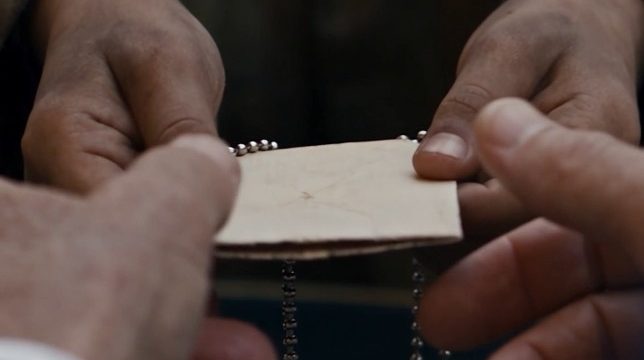
She reached into her jacket pocket and pulled out a small, folded piece of cloth. She handed it to him without a word.
He unfolded it.
It was a unit patch. Their old unit patch — from the deployment where he had trained her, where they had trusted each other with their lives before everything went wrong. It was faded, frayed at the edges, stained with something he didn’t want to identify.
She had carried it. Through all of it. Every day. Every night. Through the place she couldn’t name and the years she couldn’t get back.
His throat closed.
He pressed the patch against his chest and held it there with both hands, and he stood very still in the Virginia morning, and he did not speak, and she did not ask him to.
The sun climbed higher. Somewhere behind them, a door opened, and the ordinary sounds of a building waking up drifted across the steps — voices, footsteps, a phone ringing once and then going quiet.
Mara Voss looked up at the sky. She breathed in. She breathed out.
And for the first time in three years, the air didn’t taste like survival.
It tasted like home.