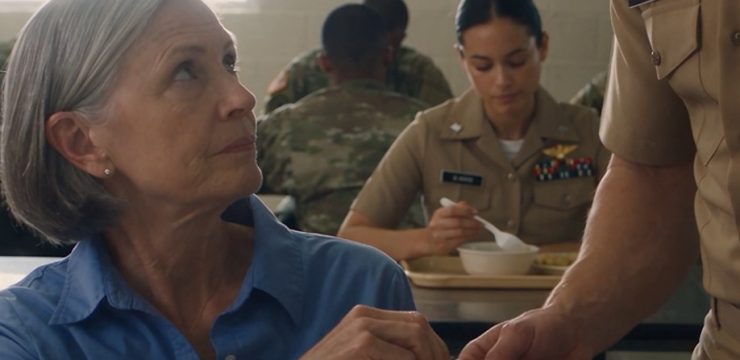
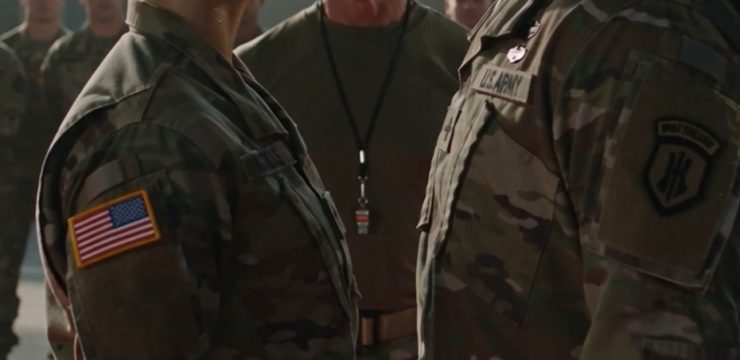
The sound of a fist striking steel cut through the noise like a gunshot — and every fork in that dining hall stopped moving.
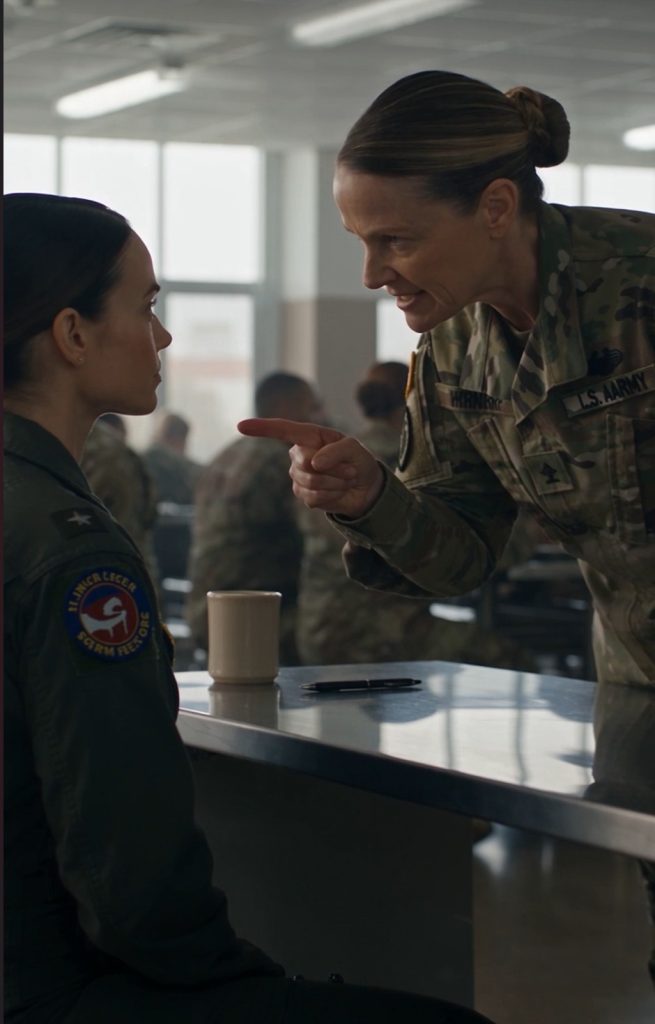
No one breathed. No one turned away. Because the woman standing on the wrong side of the serving line wasn’t scared. She wasn’t lost. She was waiting.
Admiral Reeves locked eyes with her from across the counter. Two silver stars gleamed under the fluorescent lights. Forty years of command sharpened into a single, razor-thin question.
“You have five seconds to explain why you’re here.”
The stranger didn’t flinch. Black tactical jacket. Hair pulled tight against her skull. Hands loose at her sides — the kind of stillness that only comes from training or from having absolutely nothing left to lose.
She tilted her head. Barely a fraction.
“You really don’t recognize me?”
Reeves stepped closer. The air between them turned electric. Two hundred sailors sat frozen in plastic chairs, trays going cold, watching a confrontation none of them understood but all of them could feel in their chests.
“I recognize someone who doesn’t belong in my dining hall.”
A young petty officer at the nearest table leaned toward his buddy. His whisper carried further than he meant it to.
“She’s about to get thrown off the base.”
Reeves almost smiled — the kind of smile that never reaches the eyes. She slid a plain white mug across the steel counter, the ceramic scraping loud in the silence.
“Take this to my table. Then leave.”
The woman in black looked at the mug. Then looked back at Reeves. Her expression didn’t change. Not even a flicker.
“I don’t take orders from you.”
Somewhere behind the admiral, a coffee pot hit a saucer too hard. Lieutenant Commander Hale stood paralyzed near the beverage station, her face losing color so fast it looked like she’d been slapped.
Her lips barely moved.
“Oh God.”
Reeves didn’t turn around. Didn’t blink. But something shifted behind her eyes — a crack so small only someone watching closely would have caught it. The silence stretched until the walls seemed to lean inward.
“What’s your name?”
The stranger’s answer came soft. Almost bored. Like she’d been through this exact moment a hundred times and already knew how it ended.
“You should already know.”
Then the radio mounted on the far wall crackled to life, and a voice — steady, official, unmistakable — cut through the stillness like a blade.
“Command center to Special Inspector Carter.”
Every head in that dining hall turned at once. Two hundred pairs of eyes landed on the woman in the black jacket, and the realization moved through the room like a shockwave you could feel but couldn’t hear.
Hale’s voice cracked open behind Reeves.
“Ma’am… she’s from Washington.”
The admiral didn’t look at Hale. She didn’t look at the sailors. She stared only at the woman who had walked into her mess hall without clearance, without rank insignia, without a single ounce of fear — and hadn’t blinked once.
Reeves’s jaw tightened. A muscle pulsed just below her ear. Her voice dropped to something barely above a whisper, but in that silence, every soul in the room heard it.
“Now. Let’s talk about what you’ve been hiding.”
The white mug sat untouched between them. Steam curled upward and vanished.
No one in that room was eating anymore. No one was even pretending to.
And the woman from Washington hadn’t even started talking yet.
Carter reached into the inside pocket of her jacket. Slowly. Deliberately. The way someone moves when they know every eye in the room is tracking their hands and they want each second to land like a stone dropped into still water.
She placed a manila folder on the counter beside the untouched mug.
“Fourteen months,” Carter said. “That’s how long I’ve been building this.”
Reeves glanced at the folder but didn’t touch it. Her fingers pressed flat against the steel counter, knuckles whitening.
“Building what, exactly?”
“A case.” Carter’s voice carried no malice. No triumph. Just the steady, clinical weight of someone delivering a verdict. “Against this installation. Against the systems you’ve built. Against what’s been buried under your command.”
The fluorescent lights buzzed overhead. A sailor near the back of the hall quietly set down his glass. The clink of it was the loudest sound in the room.
Reeves straightened. Her shoulders pulled back — not in defiance, but in the way a person braces when they feel the ground shifting beneath their feet and refuse to let anyone see them stumble.
“I have served this Navy for forty-one years.”
“I know exactly how long you’ve served.” Carter opened the folder herself. Inside were photographs, printed emails, incident reports with heavy black redaction bars — and three that had no redactions at all. “That’s what made this so hard to believe.”
Hale took a step forward. Then stopped. Her hand gripped the edge of the beverage station so tightly the metal frame groaned.
“Inspector, whatever this is—”
“Lieutenant Commander.” Carter didn’t look at her. “You’ll want to sit down.”
Hale didn’t sit. But she didn’t speak again either.
Carter pulled the first photograph from the stack and laid it face-up on the counter. It showed a storage facility on the east side of the base — a building most of the crew walked past every day without a second thought.
“Building 9-C,” Carter said. “Decommissioned on paper eighteen months ago. Except it wasn’t decommissioned. It was reclassified. Funding was rerouted through a maintenance budget that doesn’t exist. Equipment moved in. Personnel reassigned under falsified transfer orders.”
She placed a second photograph beside the first. This one showed a logbook — handwritten entries, dates, timestamps, each one initialed in the same tight script.
“Those initials belong to Commander Whitford. Your chief of operations.”
Reeves’s expression didn’t change. But her breathing did. A barely perceptible hitch — the kind that only surfaces when the body knows something the mind hasn’t admitted yet.
“Whitford has been running an unauthorized testing program out of that facility for eleven months,” Carter continued. “Unregistered weapons systems. Unapproved trials. Three incidents that were never reported up the chain.”
She paused. Let the silence do its work.
“One of those incidents put two sailors in the hospital. They were told it was a training accident. Their medical records were altered.”
A sound came from the back of the dining hall. A chair scraping. Someone standing. A young woman in enlisted coveralls, her face tight, her eyes wet. She didn’t say anything. She just stood there, hands at her sides, staring at the photographs on the counter.
Carter noticed her. Held her gaze for a long moment. Then looked back at Reeves.
“You signed the budget authorizations, Admiral. Your name is on every funding transfer. So either you knew exactly what was happening in that building — or someone used your credentials without your knowledge. And I need to know which one it is. Right now.”
The dining hall had become something else entirely. Not a mess hall. Not a cafeteria. A courtroom without walls. Every sailor in that room understood, in the marrow of their bones, that what was unfolding in front of them would end careers. Maybe lives.
Reeves was quiet for a long time. Her gaze dropped to the photographs. To the logbook. To the initials she recognized as well as her own handwriting.
When she finally spoke, her voice was different. Stripped of rank. Stripped of authority. Just a woman standing in the wreckage of something she had trusted completely.
“I didn’t know.”
Carter studied her. Reading her the way only someone trained in human deception can — the micro-movements of the eyes, the tension in the throat, the way the hands either clench or go still.
“I believe you,” Carter said quietly. “But that doesn’t save you. Because your signature is the one on those documents. And the person who put it there is still on this base.”
Reeves looked up.
“Whitford.”
“Whitford left the base forty minutes ago. Unscheduled. No logged destination.”
The color drained from the admiral’s face the way a tide pulls back before something terrible rushes in.
“He knows you’re here.”
“He knows I’m here,” Carter confirmed.
Reeves moved. Not slowly this time. She turned toward Hale with the kind of urgency that only comes when someone realizes the danger isn’t behind them — it’s ahead.
“Lock down the east perimeter. Now. Get Shore Patrol to Building 9-C. I want every file, every hard drive, every piece of equipment secured before he can—”
“Already done.” Carter’s voice cut through the admiral’s orders like a scalpel. “My team has been inside that building since 0400. Everything’s been seized. Catalogued. Transmitted to Washington.”
Reeves stopped mid-stride. Turned back.
“You came here with a team?”
“Twelve people. They’ve been on base since yesterday.” Carter closed the folder. “The dining hall wasn’t my first stop, Admiral. It was my last.”
The weight of that sentence settled over the room like snowfall. Quiet. Absolute. Suffocating in its completeness.
Reeves sank into the nearest chair. Not dramatically. Not with defeat written across her face. Just the slow, careful lowering of a woman whose body had finally caught up with what her mind already knew — that everything she had built, everything she had trusted, had been hollowed out from the inside while she stood guard at the door.
Hale moved to her side. Knelt beside her. Didn’t speak. Just placed one hand on the admiral’s forearm — a gesture so small and so human it cracked something open in the silence.
The young enlisted woman who had been standing at the back walked forward. Her steps were unsteady. Her chin trembled. She stopped three feet from the counter and looked directly at Carter.
“I was one of them.” Her voice was barely a whisper. “Building 9-C. I reported what happened. They told me I was mistaken. They changed my file.”
Carter reached into her jacket again and produced a second folder — thinner, older, with a red tab on the edge.
“Petty Officer Dawson.” She said the name like it mattered. Like it had always mattered. “Your original report was recovered from a backup server three months ago. It was the first piece of evidence that opened this investigation.”
Dawson’s hand came up to cover her mouth. A sound escaped — not a cry, not a word, something between the two. The sound of someone who had carried a truth no one believed for so long that hearing it spoken aloud by someone with the power to act on it broke something loose she had been holding in place with sheer will.
Carter stepped around the counter for the first time. She stood in front of Dawson. Eye to eye. Close enough to speak without the room hearing.
But she didn’t lower her voice.
“You were right. You were always right. And I’m sorry it took this long.”
Dawson nodded. Couldn’t speak. Tears ran down her face in clean, silent lines.
Behind them, the radio crackled again.
“Command center to Inspector Carter. Whitford’s vehicle has been intercepted at the north gate. He’s in custody.”
No one cheered. No one clapped. The room just exhaled — a collective breath released from two hundred chests at once, a sound so quiet and so vast it was almost sacred.
Reeves lifted her head. She looked at Dawson. Looked at her for a long time. Then she stood. Slowly. Crossed the three feet between them.
“I failed you.”
Dawson shook her head.
“You didn’t know.”
“That’s the failure.” Reeves’s voice broke on the last word. Not loudly. Just a hairline fracture running through decades of composure. “Knowing is my job. And I didn’t.”
She extended her hand. Not as an admiral. As a woman who understood that the rank on her collar meant nothing if the people under her protection had been harmed on her watch.
Dawson took it. Held it. And for a moment, the dining hall wasn’t a crime scene or a courtroom or a military installation. It was just a room full of people standing in the aftermath of truth, learning how to breathe inside it.
Carter gathered her folders. Tucked them under her arm. She looked at Reeves one final time.
“For what it’s worth — you were the only flag officer whose name came up clean. Every single one. That’s why I came to you last.”
Reeves blinked. The words landed somewhere deep — beneath the shock, beneath the guilt, in the place where four decades of service still meant something.
“You tested me.”
“I verified you.” Carter almost smiled. Almost. “There’s a difference.”
She turned toward the door. Her boots were steady on the tile. Unhurried. The dining hall parted around her without a word.
At the threshold, she paused. Didn’t turn around. But her voice carried back through the silence with the kind of clarity that only comes when someone knows exactly who they are and what they’ve done.
“Admiral. Take care of your people. That’s all Washington needs from you now.”
The door closed behind her.
Sunlight poured through the high windows, catching the steam still rising from forgotten trays. Hale moved first — crossing to Dawson, pulling her into a hug that had nothing to do with protocol and everything to do with the fact that some things can only be held together by human arms.
Reeves stood alone near the counter. The white mug still sat where she had placed it, cold now, untouched by either woman. She picked it up. Looked at it for a long moment. Then carried it to the kitchen herself and set it in the sink with a gentleness that surprised even her.
When she walked back into the hall, the sailors were beginning to move again. Slowly. Quietly. A tray picked up here. A chair pushed in there. The ordinary sounds of a mess hall finding its rhythm again — not because the world had returned to normal, but because the people inside it had decided, together, that it could.
Dawson was sitting now. Hale beside her. Two cups of fresh coffee between them, steam curling upward in the golden light.
Reeves stopped at their table. Didn’t sit. Just rested her hand on the back of the empty chair across from them and looked at the young woman whose courage had started everything.
“Petty Officer Dawson.”
Dawson looked up. Eyes still red. But steady.
“Tomorrow morning. My office. 0700.” Reeves paused. “I’d like to hear your full report. Every word of it. From the beginning.”
Dawson straightened in her chair. Something shifted in her face — not pride exactly, but something close to it. Something that had been taken from her and was only now, in this quiet moment, being handed back.
“Yes, ma’am.”
Reeves nodded once. Turned. Walked toward the far end of the hall where the morning light fell in long, warm rectangles across the floor.
She paused at the window. Looked out across the base she had commanded for six years — the buildings, the fences, the water beyond. All of it the same. None of it the same.
Behind her, the dining hall hummed softly. Forks and voices and the low, steady sound of people choosing to begin again.
And for the first time in forty-one years of service, Admiral Reeves felt the weight on her shoulders shift — not vanish, not disappear, but redistribute — shared now across every person in that room who had watched the truth walk in through the front door and refused to look away.