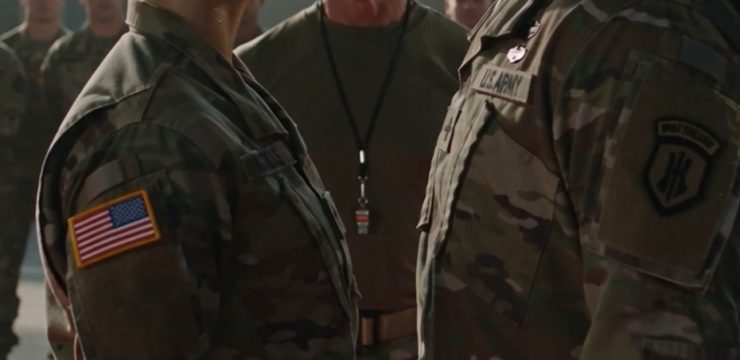
The crack of bone meeting bone echoed through the gymnasium like a gunshot — and every soldier in that room stopped breathing.
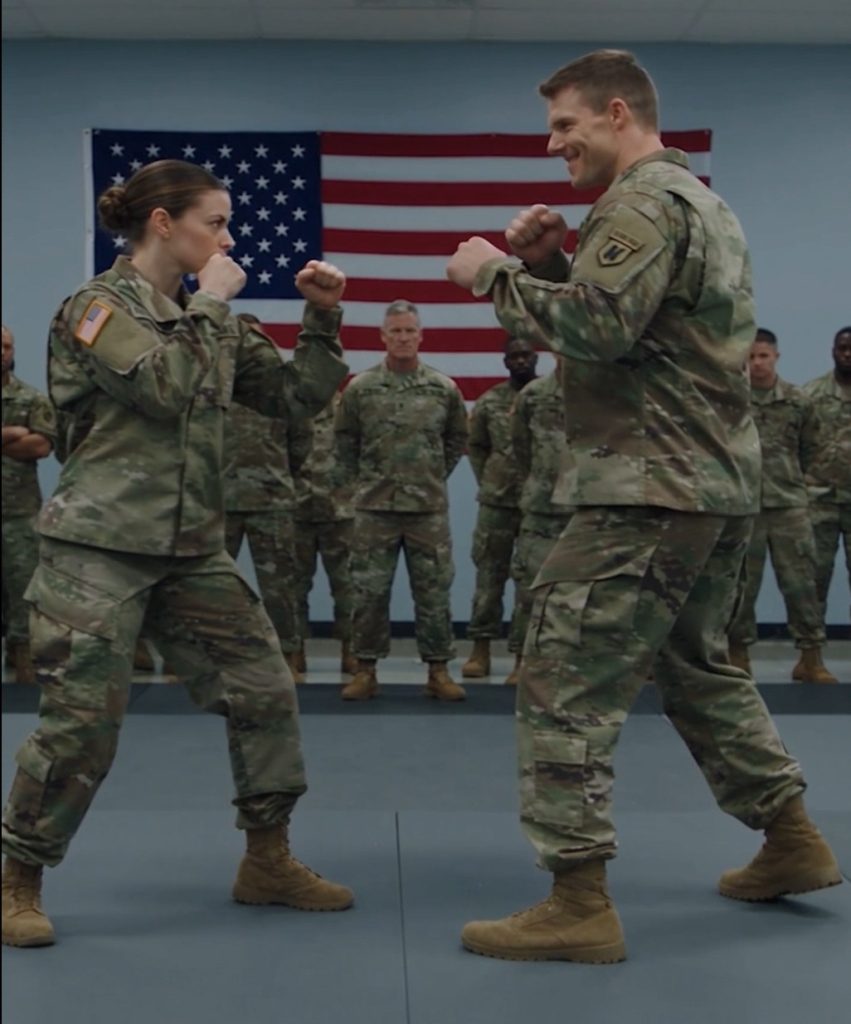
No one had expected it to go this far. No one had expected her to still be standing.
The base gym smelled like sweat and rubber and something older — something closer to fear. Rows of soldiers formed a tight ring on the gray mats, shoulders pressed together, boots barely an inch apart. An American flag hung limp on the wall behind them, watching the way flags do. Silent. Indifferent.
She stepped into the center first.
Feet wide. Fists up. Chin tucked low. Her eyes found his across the mat and didn’t let go.
He walked toward her the way men walk when they’ve already decided how something ends. Loose shoulders. That half-grin curling at the edge of his mouth — the kind that never quite reaches the eyes.
“You sure you wanna do this?”
She didn’t blink. Didn’t shift. Didn’t give him a single inch of uncertainty.
“Try me.”
Somewhere in the back row, a soldier exhaled too loud. Another shifted his weight from one boot to the other. The rest stood locked in place, caught between watching and wanting to look away.
He circled her slowly, rolling his neck, testing the space between them like a predator measuring distance. She turned with him, step for step, never once dropping her guard.
“Last chance,” he said.
Nothing. Just that same hard stare. The kind of quiet that makes a room feel smaller.
An older soldier near the front — a sergeant, maybe, with sun-cracked skin and eyes that had seen too many of these moments go wrong — stepped forward half a pace.
“Keep it controlled,” he warned. His voice carried the weight of rank, but underneath it was something else. Something closer to a plea.
The man across from her nodded once. The grin disappeared. His jaw tightened. He dropped into stance.
She didn’t wait for permission.
The first exchange was brutal and fast — faster than half the soldiers watching could follow. Hands snapped forward and pulled back like pistons. Boots scraped against the mat in sharp, ugly bursts. The circle tightened without anyone realizing they’d moved. Bodies leaning in. Breath held.
Then he launched the kick.
High. Sudden. Vicious. Aimed directly at her head with the full rotation of his hips behind it.
She got her arm up — barely. A fraction of a second between blocking and being carried off that mat on a stretcher.
The impact split through the silence like a fracture through glass.
For one frozen second, the entire room became a photograph. No movement. No sound. Just the echo of that collision hanging in the air like smoke.
Then time crept back in.
She was still standing.
He was off-balance — weight too far forward, momentum spent on a strike that should have ended it.
And her eyes had changed.
Not fear. Fear would have been expected. Not even surprise. Surprise would have been understandable.
Something colder lived there now. Something that had been waiting beneath the surface, patient and still, for exactly this moment. The kind of look that doesn’t ask for permission. The kind that doesn’t negotiate.
The sergeant opened his mouth — maybe to call it, maybe to shout a warning, maybe just to fill the silence before it swallowed the room whole.
But she was already moving.
Her weight shifted. Her back foot pivoted. And every soldier in that circle felt the same thing hit their chest at once — not a sound, not a thought, but a recognition. The sudden, gut-deep understanding that they had all been watching the wrong person this entire time.
Her left hand caught his still-extended leg at the ankle. Not a grab — a redirect. She pulled his momentum past her like opening a door he was already falling through. His body twisted sideways, arms wheeling for balance that wasn’t there.
Before his other foot found the mat, her right elbow drove forward into the center of his chest.
The sound it made was different from the kick. Deeper. Shorter. Final.
He hit the ground flat on his back. The mat buckled under the impact. The air left his lungs in one ugly, involuntary gasp — and the gym went so quiet you could hear the fluorescent lights buzzing overhead.
She stood over him. Fists still raised. Breathing controlled. Not a single tremor in her hands.
He stared up at her with his mouth open, chest heaving, eyes wide with something that had no name yet — something between disbelief and the slow, nauseating realization that he had made a terrible mistake.
Nobody moved.
The sergeant stepped forward. His boots stopped at the edge of the mat. He looked down at the man on the ground, then up at her. His expression didn’t change, but something behind his eyes softened — just barely, just enough for her to notice.
“Match,” he said. Quiet. Almost gentle.
She lowered her fists. Her fingers were trembling now — not from fear, but from the adrenaline finally finding somewhere to go. She stepped back. One step. Two.
The circle didn’t break. Forty soldiers stood frozen, staring at the woman who had just dismantled their best fighter in under six seconds.
Then a voice from the back — young, stunned, almost involuntary — whispered, “Holy shit.”
And the silence cracked.
A murmur rolled through the circle like a wave. Heads turned. Eyes met. Someone let out a breath that had been trapped for what felt like a full minute. The man on the mat rolled to his side, coughing, pressing one hand flat against his sternum like he was checking whether everything inside was still where it belonged.
He looked up at her again. This time, the arrogance was gone. All of it. What was left was something raw and unguarded — something that looked almost like respect trying to find its footing on unfamiliar ground.
She didn’t extend her hand.
Not yet.
The sergeant crossed his arms and turned to face the circle. His voice wasn’t loud, but it reached every corner of the room.
“Anyone else have questions about Sergeant Dawson’s qualification for this unit?”
Silence. But a different kind now. Not the tense, coiled silence of before. This one was heavier. Embarrassed. The sound of forty men recalibrating something they hadn’t known was broken.
She felt it land in her chest — not triumph, not satisfaction, but something older and more tired. The exhaustion of having to prove what should never have been in question. The weight of standing in a room full of people who had already decided you didn’t belong, and making them watch you earn what was already yours.
Her jaw tightened. She swallowed once. Hard.
A young corporal near the back — barely twenty, with wide dark eyes and hands still balled at his sides — stepped out of the circle. He didn’t say anything. He just walked to the edge of the mat, stood at attention, and gave her a single, sharp nod.
Then another. And another.
One by one, soldiers broke from the ring and acknowledged her. Not with applause. Not with words. Just presence. Just the quiet, deliberate act of being seen seeing her.
The man on the mat finally pushed himself to his feet. He stood there for a moment, one hand still pressed to his chest, breathing through his teeth. Then he straightened. Squared his shoulders. Looked her dead in the eyes.
“Fair fight,” he said. His voice was rough, stripped of everything except honesty.
She held his gaze for three long seconds.
Then she extended her hand.
He took it. Not loosely. Not performatively. He gripped it the way you grip something you’ve earned the right to hold.
The sergeant watched the handshake from the edge of the mat. He uncrossed his arms slowly, and for the first time all afternoon, something close to a smile ghosted across his weathered face.
He turned away before anyone could see it.
Later — after the gym had emptied, after the mats had been rolled and the lights switched to half — she sat alone on the bench by the back wall. Her hands hung between her knees. Her knuckles were red. The adrenaline had drained out completely, leaving behind the dull, hollow ache that always followed.
She heard boots on concrete. Slow. Deliberate.
The sergeant sat down beside her without asking. He didn’t look at her. Just stared at the empty mat under the fluorescent hum.
“You know why I put you in that ring today,” he said. It wasn’t a question.
She didn’t answer right away. Then, quietly: “Because paperwork doesn’t change minds.”
He nodded once. “Twelve years I’ve run combatives for this battalion. Twelve years of transfer requests getting blocked, evaluations getting buried, qualified soldiers getting passed over because someone upstairs decided they didn’t fit the profile.”
He paused. His voice dropped.
“I watched your file sit on Captain Mercer’s desk for four months. Four months. You had more certifications than half the men in that circle. Mercer never opened it. Not once.”
Her throat tightened. She kept her eyes on the floor.
“I opened it,” the sergeant said. “First day it landed. And I knew — if I could get you on that mat, in front of his guys, with no rank pulling strings and no politics clouding the picture — they’d see what I saw.”
She turned to look at him. His profile was sharp in the dim light, jaw set, eyes still fixed ahead.
“What did you see?” she asked.
He finally looked at her.
“A soldier who fights like she’s already been told no a thousand times and decided it doesn’t matter.”
The words hit her somewhere behind the ribs. Not like a strike. Like a key turning in a lock she’d forgotten was there.
Her eyes burned. She blinked once. Twice.
She didn’t cry. Not here. Not yet.
But she let herself feel it — the full, devastating weight of being recognized by someone who didn’t have to look, but chose to.
He reached into his jacket and pulled out a single folded sheet of paper. Set it on the bench between them.
“Mercer’s transfer request was denied this morning,” he said. “Reassigned. Effective immediately.”
She stared at the paper. Then at him.
“The new unit commander reviewed your file personally. You’re not just staying.” He tapped the paper once with two fingers. “You’re leading the advanced combatives program. Starting Monday.”
She picked up the paper. Unfolded it slowly. Read the first three lines.
Her name. Her rank. Her new assignment.
She pressed her lips together. Hard. The tremor in her hands came back — not from adrenaline this time.
“Sergeant,” she started.
“Don’t,” he said gently. “You earned it before today. Today just made sure no one could pretend otherwise.”
She folded the paper again. Carefully, like it might disappear if she handled it wrong. Slid it into her chest pocket and pressed her palm flat against it.
They sat together in the silence for a long time after that. The gym lights buzzed above them. The flag on the far wall hung still. Outside, the sun had dipped below the tree line, painting the windows in long strips of amber and gold.
She didn’t say thank you. She didn’t need to.
He already knew.
When she finally stood, she paused at the door. Turned back.
The sergeant was still sitting on that bench, hands on his knees, staring at the empty mat where everything had changed.
She almost spoke. Almost said the thing she’d carried in her chest for twelve years of service, through every blocked transfer and buried evaluation, through every room that went quiet when she walked in, through every sparring session designed to make her quit.
Instead, she stood in the doorway with the last of the daylight warm on her shoulders, and she let herself breathe — fully, completely, all the way down — for what felt like the first time in a very long while.
And somewhere deep inside the silence of that empty gym, she finally heard the only thing she had ever really been fighting for.
Not applause. Not permission.
Just the quiet, unmistakable sound of a door that would never close on her again.