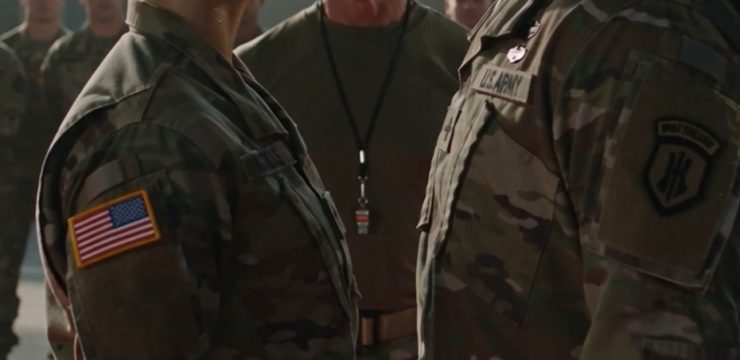
A hand slammed down on the back of her chair — and the entire cafeteria went quiet.
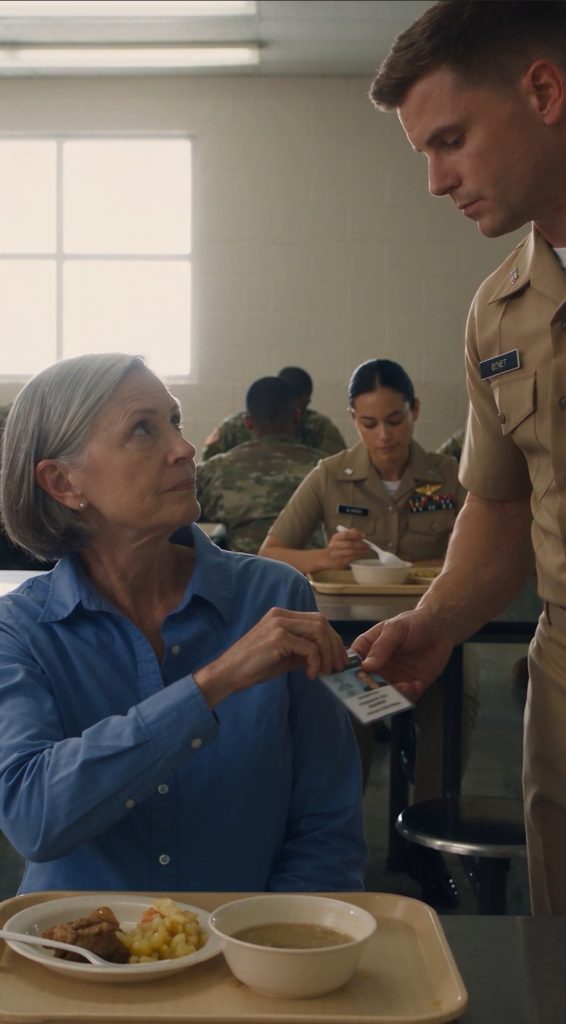
She hadn’t even lifted her fork yet. The soup was still warm, the sunlight still pouring golden through the tall windows behind her. But the voice that came next was loud enough to turn every head within thirty feet.
“You need to get up.”
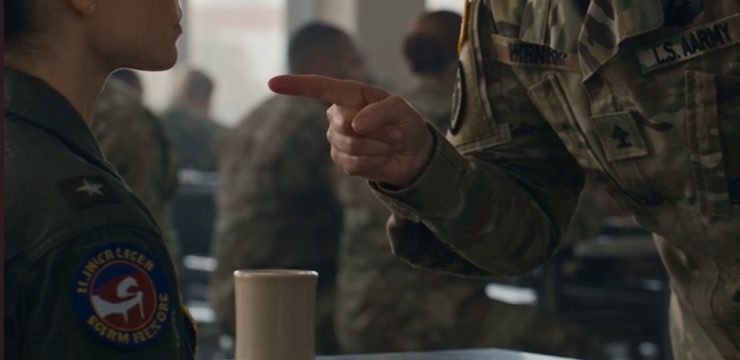
The silver-haired woman looked at the hand first. Then she looked at the man it belonged to — a major, broad-shouldered, jaw tight with the kind of authority that expected instant obedience.
She didn’t move.
“Why?”
Major Ryan Stone’s mouth pressed into a hard line. “This section is for officers.”
Helen Carter glanced at the sea of empty chairs around her. Officers scattered throughout the room sat with civilians, teenagers, engineers — nobody questioned. But somehow, her presence at this particular table had become a problem.
She kept her voice even. “I was invited onto the installation.”
She reached into her shirt pocket and extended a visitor badge. He snatched it before her fingers finished moving. Studied it. Then dropped it onto her tray — right beside her soup bowl.
The plastic clattered against porcelain. Several people flinched.
“A visitor badge doesn’t make you an officer.”
Helen looked at the badge sitting in her lunch. Then back at him.
“Did I say it did?”
A ripple of tension moved through the room. Forks paused. Conversations died mid-sentence. Two lieutenants at the next table sat frozen beside a civilian engineer who suddenly didn’t know where to look.
Ryan stepped closer. “You’re making this more complicated than necessary.”
“I’m sitting and eating lunch.”
He grabbed her tray. Her water glass trembled, nearly tipping — she caught it with one hand, steady as stone.
“Major.”
He ignored the warning. Pointed across the cafeteria toward a table crammed beside two swinging kitchen doors. A rolling trash bin sat a few feet away. Staff moved in and out constantly.
“It would be better,” he said flatly.
“For whom?”
He didn’t answer that. Not really. Just said, “For everyone.”
A captain dropped his eyes. Someone near the drink station cleared his throat but said nothing. The entire room held its breath — waiting to see what this woman would do.
She stood.
That surprised him.
Her movements were slow and deliberate — not defeated, not rushed. She lifted her tray with both hands. The visitor badge stayed where he’d tossed it, sitting in her soup like a small, quiet accusation.
Ryan stepped aside. “Thank you.”
Helen looked directly into his eyes.
“Don’t thank me yet.”
Three words. Barely above a whisper. But something in her tone made his expression crack — just slightly — before she turned away.
She walked toward the kitchen table. Each step carried her farther from the sunlight, deeper into the noise and steam and fluorescent buzz of the service corner. The cafeteria slowly exhaled. Conversations resumed. But softer now. Careful.
Then a chair scraped.
A young lieutenant — Bennett, her name tag read — pushed back from her table. Her face was flushed, her jaw tight with something that looked like it had been building for a long time.
“Major — maybe she can stay.”
Ryan turned on her instantly. “This doesn’t concern you.”
“Sir, I only meant—”
“Sit. Down.”
His voice hit like a slap. The room froze again. Bennett’s shoulders pulled inward, her protest dying before it fully formed. She sank back into her seat, eyes burning.
Helen had stopped walking.
She stood perfectly still, tray in hand, watching the young officer being silenced for defending her. And for the first time, something shifted behind those calm, measured eyes — something colder, sharper, and far more dangerous than anything Ryan Stone was prepared for.
Helen set the tray down on the kitchen table. The plastic badge floated in her soup. She didn’t sit.
Instead, she reached into her back pocket and pulled out a phone.
She dialed one number. Pressed it to her ear. The cafeteria had gone so silent that people three tables away could hear the line connect.
“Jim,” she said quietly. “I’m in the dining facility. I think you should come down.”
She hung up without explanation.
Ryan watched her from across the room. His confidence hadn’t broken — not yet — but something behind his posture had shifted. A slight adjustment of his weight. A flicker in his peripheral vision, scanning the room as if measuring how many people had witnessed everything.
“Who’s Jim?” he asked. His voice carried, still performing authority.
Helen didn’t answer. She folded her hands in front of her and waited.
The silence lasted ninety seconds. It felt like twenty minutes.
Then the cafeteria doors opened.
A tall man in dress uniform walked in. Silver eagles gleamed on his shoulders. Colonel James Whitfield moved through the room the way weather moves across open ground — unhurried, undeniable. Two aides trailed behind him, but they stopped near the entrance. He didn’t need them for this.
Every officer in the room recognized him immediately. Chairs shifted. Spines straightened. Someone near the windows set down a coffee cup so carefully it didn’t make a sound.
Ryan Stone’s face changed. Not slowly. All at once — like a mask being ripped away to reveal something much smaller underneath.
Colonel Whitfield crossed the cafeteria without acknowledging a single person. His eyes found Helen first. Then they found the tray. The soup. The badge floating in it.
He stopped beside her.
“Helen.” His voice was low, warm, and edged with something dangerous. “Tell me what happened.”
She looked at him the way only someone who has known another person for decades can look at them — with trust so deep it doesn’t need performance.
“I sat down to eat lunch,” she said simply. “And this officer informed me I didn’t belong here.”
Colonel Whitfield turned to face Ryan Stone.
The major had gone completely still. His shoulders were locked, his breathing shallow, his face drained of the commanding certainty that had filled it just minutes before. He looked like a man watching the ground open beneath his own feet.
“Major Stone.”
“Sir.”
“Did you remove this woman from her seat?”
Ryan’s throat moved. “Sir, I was maintaining dining area protocol—”
“Did you remove her from her seat?”
The repetition landed like a judge’s gavel. No warmth. No room.
Ryan swallowed. “Yes, sir.”
Colonel Whitfield nodded once. Then he looked at the kitchen table — the swinging doors, the trash bin, the fluorescent glare that turned everything gray.
“And you sent her here.”
It wasn’t a question.
Ryan said nothing.
Whitfield stepped closer. When he spoke next, his voice dropped low enough that only Ryan and the nearest tables could hear — but in that silence, it carried everywhere.
“This woman is Dr. Helen Carter. She holds a PhD in organizational psychology from Stanford. She served as a senior civilian advisor to the Department of Defense for twenty-three years. She has conducted leadership evaluations at eleven military installations — evaluations that have directly influenced the promotion and reassignment of over forty senior officers.”
He paused. Let each sentence settle like stones dropping into still water.
“She is here today at my personal invitation to observe leadership culture on this installation. And you just gave her the most honest demonstration she could have asked for.”
Ryan’s face didn’t move. But his hands — hanging at his sides — had begun to tremble.
Lieutenant Bennett, still seated two tables away, pressed her lips together. Her eyes glistened, but she didn’t look away. Not anymore.
Colonel Whitfield reached past Ryan and picked up the visitor badge from the soup. He wiped it carefully with a napkin and handed it back to Helen with both hands.
“I’m sorry,” he said. Not loudly. Not for the room. For her.
Helen took the badge. Her fingers closed around it gently.
“You don’t need to apologize, Jim.”
She looked past him — directly at Ryan.
“He does.”
The cafeteria held its breath. Every eye in the room rested on Major Stone. The man who had commanded the space five minutes ago now stood in the center of it with nothing — no authority, no audience, no escape.
His mouth opened. Closed. Opened again.
“Ma’am… I—” His voice broke. He cleared his throat. Tried again. “I apologize.”
Helen studied him for a long moment.
“You don’t owe me the apology, Major.”
She looked toward Lieutenant Bennett.
Ryan followed her gaze. And something collapsed behind his eyes — the full weight of what he’d done landing all at once. Not just the tray. Not just the badge. But silencing a junior officer who had shown more courage in one sentence than he had demonstrated in his entire career.
He turned toward Bennett. The young lieutenant stared back at him with red-rimmed eyes and a straight spine.
“Lieutenant,” he said. His voice was barely audible. “I’m sorry.”
Bennett didn’t respond immediately. She looked at Helen first — and the older woman gave the smallest nod.
Then Sarah Bennett stood. Slowly. Shoulders back.
“Thank you, sir.”
Nothing more. Nothing less.
Colonel Whitfield placed his hand lightly on Helen’s shoulder. “Let me get you a fresh lunch.”
Helen shook her head. A quiet smile — the first one — touched her face.
“I’d rather sit by the window, if you don’t mind.”
He pulled out a chair at the brightest table in the room. The same table where this had all started. Helen sat down, and the sunlight caught her silver hair like a crown.
Bennett hesitated across the room. Helen looked up, caught her eye, and gestured to the empty chair beside her.
“Join me?”
The young lieutenant picked up her tray and walked over. She sat down without a word, but her hands were shaking — not from fear anymore, but from the slow, overwhelming release of something she had carried silently for too long.
They ate together in the quiet warmth of the afternoon light.
Around them, the cafeteria moved again — trays lifted, conversations resumed, chairs scraped across linoleum. But something in the air had changed. Something permanent.
Major Ryan Stone remained standing near the kitchen doors — right beside the table he had chosen for her.
He stood there for a long time, alone, in the exact spot where he had sent her.
And somewhere in that silence, he finally understood what she had meant.
Don’t thank me yet.
Weeks later, Helen’s evaluation report landed on every desk that mattered. Lieutenant Sarah Bennett was among three junior officers personally recommended for an accelerated leadership development program — cited for moral courage under institutional pressure.
Major Stone received a formal reassignment. Not a discharge. Not a public humiliation. Just a quiet transfer to a post where authority would need to be earned, not assumed.
Helen never returned to that cafeteria.
But every year after, on the anniversary of that afternoon, a small envelope arrived at Sarah Bennett’s office — no return address, no signature. Just a single handwritten line on a plain white card.
The last one, years later when Sarah had stars on her own shoulders, read simply:
“The bravest thing you ever did was stand up before you were ready. Never stop.”
Sarah kept every card in a small wooden box on her desk — right next to a framed photo of a silver-haired woman sitting in the sunlight by a window, smiling like someone who had always known exactly who she was.