The silence satisfying enough to break a family apart sometimes starts with something as small as a badge thrown into gravel.
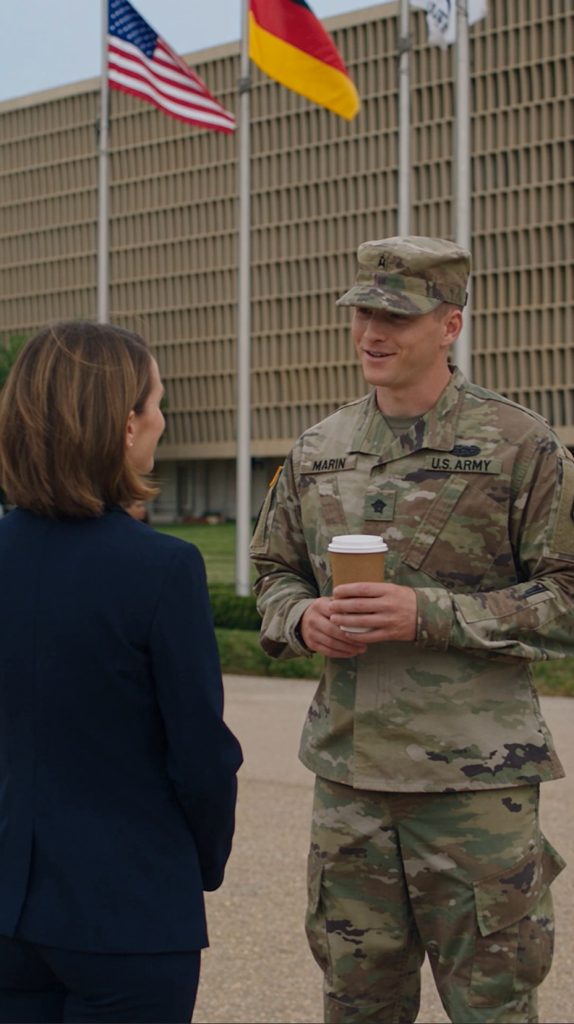
She watched it land face-down in the dirt — her name, her photo, the word VISITOR stamped across it in red. Around her, two dozen Marines and their families stood in the warm afternoon light of Family Day, and her brother Tyler was grinning like he’d just delivered the punchline to a joke only he found funny.
“Go ahead,” he said, loud enough for the nearest cluster of uniforms to hear. “Tell them that ridiculous call sign you mentioned once. The one you made up to sound cool at Thanksgiving.”
Eleanor didn’t flinch. She bent down slowly, brushed the dust off the badge, and clipped it back to her jacket.
Then she looked directly at him.
“Fury Ten.”
Tyler’s smirk widened — but it was the only thing in that courtyard that did. Two Marines mid-conversation went silent. A corporal holding a paper plate lowered it without thinking. And Gunnery Sergeant Marcus Rourke, a man built like a wall of quiet authority, turned toward her so fast that even her mother noticed.
“Where did you hear that designation?” His voice was calm. Controlled. But the calm was the dangerous kind.
“Black Ridge,” Eleanor said. “Two seventeen a.m.”
Tyler let out a short laugh and muttered something about her spending too much time on military forums. Rourke didn’t look at him. Didn’t blink.
“What was the ground element called?”
“Rook Six.”
Something behind Rourke’s eyes shifted — not surprise exactly, but the kind of recognition a man spends years learning to suppress.
“And who was Rook Six?”
“You were.”
The courtyard didn’t just go quiet. It collapsed into the kind of stillness that makes your chest tight. The breeze kept moving, the flag kept snapping overhead, but every human sound within thirty feet simply stopped.
Tyler’s jaw tightened. His confidence cracked for just a fraction of a second before his body overrode it. He stepped closer, grabbed at her badge again — rougher this time — and turned to the group with a forced grin.
“See? She walked in with a civilian visitor pass. That tells you everything.”
Rourke’s gaze stayed fixed on Eleanor for another long beat. Then, slowly, he turned toward Tyler.
“That badge only proves how she entered today.”
The grin died on Tyler’s face. Not all at once — it drained away in stages, the way color leaves skin before a faint. He opened his mouth, closed it, then looked at Eleanor like he was seeing her for the first time and didn’t recognize what he found.
Their mother had been standing near the refreshment table, clutching a plastic cup of lemonade with both hands. She hadn’t moved in nearly a minute. But now she stepped forward, her eyes searching Eleanor’s face with the kind of confusion that comes from realizing you may have never known your own child.
“Eleanor…” Her voice was barely steady. “What exactly do you do?”
The question hung in the humid air like a held breath. Eleanor felt every eye in the courtyard land on her — the Marines, the families, her father frozen mid-step behind their mother, and Tyler, whose humiliation had turned into something far worse than embarrassment.
It had turned into fear.
She parted her lips to answer. But before a single word could leave her mouth, Rourke studied her face one final time — and the recognition that broke across his expression was the kind that couldn’t be hidden, couldn’t be taken back, and couldn’t be explained away with a visitor badge and a brother’s jokes.
His posture changed. Subtly. The way a soldier’s does when he suddenly realizes he’s standing in the presence of rank he didn’t expect.
Eleanor held his gaze. And in the silence that followed, every assumption her family had carried for years began to fracture — quietly, irreversibly, and all at once.
Rourke took one step back. Then he straightened — shoulders squared, chin lifted — and brought his right hand to a crisp, deliberate salute.
Not the casual kind. Not the kind you throw at a buddy across the parking lot. The kind that comes from the spine. The kind reserved for someone who has earned it in ways that never make the newspapers.
A young lance corporal near the flagpole saw it first. Then another Marine. Then three more. One by one, like a wave no one commanded, every uniformed body in that courtyard turned toward Eleanor and followed Rourke’s lead.
Tyler stood in the center of it, the only Marine not saluting. His arms hung at his sides. His mouth was open but empty.
Their father’s hand found the back of a folding chair. He gripped it like the ground had shifted beneath him.
Their mother’s lemonade cup slipped. It hit the concrete with a soft plastic crack, and nobody looked down.
Eleanor’s throat tightened. She hadn’t wanted this. She had never wanted this — not here, not like this, not in front of the family she had spent a decade quietly protecting from the truth of what protecting actually looked like.
She gave Rourke a single, slow nod. The kind of acknowledgment that carries weight only between people who have shared the same darkness and come out breathing on the other side.
Rourke lowered his hand. The courtyard exhaled.
“Inside,” he said quietly, gesturing toward the admin building behind the reception tables. “Now. All of you.”
Nobody argued. Eleanor’s parents moved first, her mother gripping her father’s arm so tightly her knuckles had gone white. Tyler hesitated, his jaw working, his eyes darting between Eleanor and the Marines who had just saluted his sister — his little sister, the one he had mocked at every holiday dinner, the one he had called soft, the one whose career he had dismissed as “some government desk job.”
Inside the building, Rourke closed the door and leaned against it. The fluorescent lights buzzed faintly. A coffee maker gurgled on a counter in the corner. The air smelled like printer ink and old carpet.
“I’m not authorized to explain her file,” Rourke said, looking only at Eleanor. “That’s yours to give or keep.”
Eleanor stood near the window. Afternoon light cut across her collarbone. She could feel her mother trembling from four feet away without turning around.
“Mom,” she said softly. “Dad.”
She paused. Not for effect. Because the next sentence would change the shape of her family permanently, and she wanted to be sure she could carry whatever came after it.
“I’m not a civilian policy analyst. I never was.”
Her mother’s breath caught audibly.
“I work — I’ve worked — in a division that doesn’t appear on any public org chart. Intelligence coordination. Field operations. The call sign Fury Ten was mine for six years. Black Ridge was a joint extraction in a country I still can’t name, and Gunnery Sergeant Rourke’s unit was the ground element we pulled out when their evac was compromised.”
She swallowed.
“Twenty-three people came home that night because of what my team did. And I have never been allowed to tell you that.”
The silence that followed wasn’t dramatic. It was devastating. It sat in the room like something physical — heavy, warm, impossible to move.
Her father spoke first. His voice cracked on the second word.
“How long?”
“Since I was twenty-four.”
He closed his eyes. His chin dropped toward his chest, and his shoulders began to shake — not violently, not loudly — just enough that everyone in the room understood that a man was rearranging the entire architecture of his daughter’s life inside his mind, all at once, in the space of a single breath.
Tyler hadn’t moved. He was standing near the door, arms crossed, but the posture wasn’t defiance anymore. It was the posture of a man trying to hold himself together.
“So every time I —” He stopped. Started again. “Every Thanksgiving when I said you were —”
“Yes.”
“Every time I told you that you’d never understand what real service looked like —”
“Yes.”
His arms uncrossed. His hands dropped to his sides. And then Tyler did something Eleanor had not seen him do since he was eleven years old.
He sat down on the floor.
Not dramatically. Not as a collapse. He simply lowered himself to the thin carpet and put his face in his hands, and the sound that came out of him was so quiet and so broken that their mother covered her mouth.
Eleanor didn’t move toward him. Not yet. She let the moment hold its own weight because she knew — from years of operating in rooms where the wrong word at the wrong second could cost lives — that some truths need space before they need comfort.
Rourke opened the door quietly.
“I’ll give you the room,” he said. Then, to Eleanor: “Fury Ten. It was an honor. It still is.”
He stepped out and closed the door behind him.
The coffee maker clicked off. The building settled into its bones.
Eleanor’s mother was the one who moved first. She crossed the room in three unsteady steps, took her daughter’s face in both hands, and looked at her — really looked, the way only a mother can when she finally sees the child she somehow missed.
“You kept us safe,” she whispered. “And we didn’t even know.”
Eleanor’s composure finally broke. Not all at once — just a single tear that slipped down her cheek and landed on her mother’s wrist.
“That was the point, Mom.”
Her father wrapped his arms around both of them. His hand found the back of Eleanor’s head the same way it had when she was five and afraid of thunderstorms, and for a moment the woman who had coordinated extractions in places the world would never hear about let herself be held like a child.
Tyler was still on the floor.
Eleanor pulled away from her parents gently. She crouched down in front of her brother until their eyes were level.
“Hey,” she said.
He wouldn’t look at her. His jaw was clenched so hard a vein pressed against the skin of his temple.
“I don’t deserve —”
“Tyler. Look at me.”
He did. His eyes were red and glassy, and the shame in them was so complete it almost looked like grief.
“You didn’t know,” she said. “You were never supposed to know.”
“I spent ten years making you feel small.”
“And I spent ten years letting you, because my cover required a sister who looked ordinary. You didn’t fail me. You played the part I needed you to play, even though neither of us knew it.”
He stared at her. Then his face crumpled, and he reached forward and pulled her into a hug so tight she could feel his heartbeat hammering against her shoulder.
“I’m sorry,” he said into her hair. “I’m so sorry, El.”
She held him back. And in that small fluorescent room, on the floor of a Marine base admin building that smelled like burnt coffee and old files, a brother and sister rebuilt something that had been quietly breaking for a decade — not with grand gestures or perfect words, but with the simple, devastating honesty of two people who finally saw each other clearly.
Outside, the courtyard had returned to its gentle noise. Families laughed. Burgers sizzled on a grill somewhere. The flag snapped once, sharply, in a gust of late-afternoon wind.
Later that evening, the four of them sat in the base parking lot in their father’s truck. Nobody had started the engine. The windows were down. The sky had turned that deep amber that only happens in the twenty minutes before the sun disappears entirely.
Tyler reached into his pocket and pulled out Eleanor’s visitor badge — the one he had thrown into the gravel hours earlier. He had picked it up without anyone noticing, and he’d been carrying it ever since.
He turned it over in his hands.
Then he unclipped his own military ID from his lanyard and held both badges side by side.
“These don’t tell the same story,” he said quietly. “But I think they finally belong next to each other.”
Eleanor took the visitor badge from his hand. She looked at her name printed across it, at the red VISITOR stamp, at the small crease in the corner from where it had hit the gravel.
She smiled.
“Keep it,” she said, pressing it back into his palm. “So you remember.”
Tyler closed his fingers around it and nodded once. Then he turned the key, and the engine hummed to life, and the family that had arrived at that base as strangers to each other drove home through the cooling night as something they had never quite managed to be before — whole.
The crickets sang along the dark road. Eleanor leaned her head against the window and watched the sky fill up with stars, and for the first time in ten years, she didn’t have a single secret left to carry.