The House That Was No Longer Hers
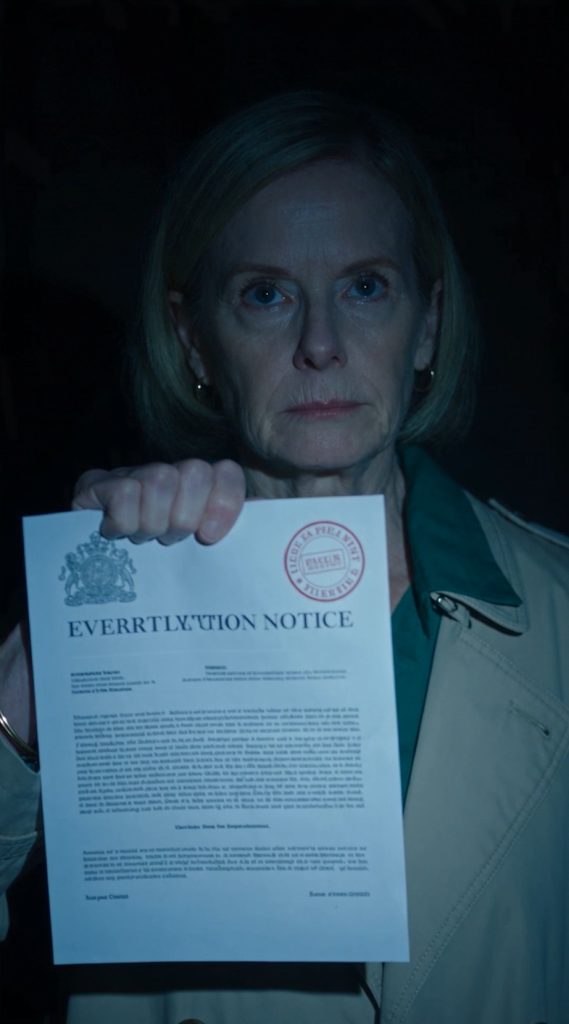
The moving van was already in her driveway before she even turned off the engine.
She sat there with the car still running, grocery bags on the passenger seat, watching two men carry a leather armchair through her front door. A chair she had never seen before. Into a house she had owned for thirty-one years.
Nobody had called her. Nobody had asked.
Inside, her daughter-in-law Sarah stood in the foyer giving directions like a contractor on a job site — confident, decisive, completely at home. Three oversized suitcases sat in the middle of Martha’s entryway. One of them had already left a pale scrape across the hardwood floor her late husband had laid by hand.
Sarah turned and smiled. Not apologetically. Not nervously. Just smiled.
“Martha, there you are. My parents are having issues with their apartment. They’re moving in for a while. Plenty of room here, right? We’re family.”
Martha didn’t answer right away. Her eyes moved past Sarah to the living room, where Linda — Sarah’s mother — was already rearranging things on the mantel. Porcelain figurines that had belonged to Martha’s mother were being nudged aside to make room for beach photographs in silver frames. Bill, Sarah’s father, stood near the fireplace with the quiet authority of a man deciding where his television would go.
Martha looked at her son Lucas.
He was standing by the staircase, thirty-five years old, tall like his father. Staring at the floor.
He didn’t say I’m sorry. He didn’t say We should have asked. He didn’t say This is still your house.
He just looked away.
Something inside Martha went very still then — not broken, not defeated. Still. The way a room goes quiet right before a decision is made.
Sarah touched her arm lightly. “You don’t have to change a thing, Martha. We’ve got this handled.”
We’ve got this handled.
Martha set the grocery bags on the kitchen counter. She said, quietly, “I see.” Nothing more.
Sarah blinked. She’d been ready for tears, maybe raised voices, a trembling speech about respect. She was not ready for calm. Calm, in Martha’s experience, confused people who expected weakness.
Martha had been generous — perhaps too generous, for too long. When Lucas and Sarah first married and money was tight, she’d opened her home. They paid a small monthly amount, barely covering utilities, nothing close to rent. She had told herself it was family helping family.
Watching Linda arrange her photographs on someone else’s mantel, Martha understood exactly what Sarah had heard instead.
Opportunity.
She put away the milk. She folded the paper bags. She moved through her own kitchen the way she always had — unhurried, methodical, deliberate.
Then she went to the basement.
It still smelled of cedar and old paint. Her husband’s tools hung on pegboards, each one labeled in his handwriting. Near the laundry sink, the breaker panel stood exactly where it always had. She opened it slowly. Studied the rows of switches. Read each hand-lettered label.
Kitchen. Living room. Upstairs suite. Main bedroom. Garage.
She didn’t touch a single switch.
She only looked. She only remembered.
Then she closed the panel, climbed the stairs, washed her hands, and sat down quietly at the kitchen table.
Dinner that evening was not a meal. It was a performance — a warm, laughing, completely rearranged version of her life playing out in her own dining room, as if the house had already changed owners and simply forgotten to tell her.
Martha watched it all from her end of the table. Patient. Present. Planning.
What happened at that dinner table was only the beginning. 👇
Bill was telling a story about a fishing trip he’d taken twenty years ago, his voice filling the dining room with the comfortable volume of a man who believed every room he entered was already his. Linda laughed at all the right moments. Sarah refilled the wine glasses — including her own parents’ — without once glancing toward Martha’s end of the table.
Lucas kept his eyes on his plate.
Martha ate her soup slowly. She listened to the sounds of her own home — the familiar creak of the chair near the window, the tick of the clock above the sideboard, the way the heating vent hummed beneath the floorboards when the temperature dropped outside. Thirty-one years of small, private sounds that belonged to her alone.
After dinner, Bill settled into her husband’s recliner without asking. He picked up the television remote. Turned the volume up.
Martha stood in the kitchen doorway and watched him for a long moment.
Then she went upstairs, closed her bedroom door quietly, and made two phone calls.
The first was to her attorney.
The second was to her neighbor Carol, who had been a paralegal for twenty-two years and who answered on the second ring with the particular alertness of someone who already sensed trouble.
“Tell me everything,” Carol said.
Martha did.
By the time she hung up, it was past ten o’clock. The house had grown quiet below her — the television still murmuring, someone’s footsteps crossing the kitchen floor, the unfamiliar sound of strangers becoming comfortable in her space. She sat on the edge of her bed in the dark for a while without turning on the lamp.
She was not afraid. She was not even angry anymore.
She was simply finished being misunderstood.
The next morning, she was dressed and downstairs before anyone else stirred. She made one pot of coffee, poured herself a cup, and sat at the kitchen table with a yellow legal pad and a pen. By the time Sarah came downstairs in her robe, Martha had already filled three pages.
Sarah stopped in the kitchen doorway. She looked at the legal pad, then at Martha, then at the legal pad again.
“You’re up early,” she said carefully.
“I always am,” Martha replied. She didn’t look up from her writing.
Sarah poured herself a coffee. The silence between them was the particular kind that precedes an avalanche — smooth on the surface, enormous underneath.
“Martha.” Sarah set her mug down. “I know this was a surprise. But my parents really needed help, and this house is so big, and you’re here alone most of the time anyway—”
“Carol Hendricks is coming by this morning,” Martha said. She turned the page on the legal pad. “You remember Carol. She lives three houses down. She’s bringing some paperwork.”
A small pause. “What kind of paperwork?”
Martha finally looked up. Her expression was composed, almost gentle. “The kind that clarifies how a household works.”
Sarah’s jaw tightened almost imperceptibly. “Martha, I really think we should talk about this as a family before you—”
“We are going to talk about it,” Martha said. “This morning. All of us. I’d appreciate it if you let your parents know.”
Lucas appeared in the doorway then, hair disheveled, wearing a gray t-shirt and sleep-worn jeans. He looked at his mother’s face, then at his wife’s, and his expression shifted into something that was difficult to name — a complicated mixture of shame and recognition that had been accumulating for years.
He poured himself a coffee without saying a word.
Carol arrived at nine-thirty with a leather folder and the composed efficiency of a woman who had seen many versions of this particular situation. She sat at the dining room table across from Bill and Linda, who had come downstairs uncertain and slightly defensive, sensing something in the air that hadn’t been there the night before.
Sarah sat beside her parents. Lucas sat beside his mother.
That seating arrangement, Martha noticed, said everything.
Carol opened her folder. “I want to begin by confirming something simple,” she said pleasantly. “Martha, you are the sole owner of this property. Is that correct?”
“It is,” Martha said.
“Your name is the only name on the deed?”
“It is.”
Bill shifted in his chair. “Now, hold on — we weren’t told this was going to be some kind of formal—”
“It isn’t formal at all,” Carol said, still pleasantly. “It’s simply a conversation that should have happened before the moving van arrived.” She let that sentence settle. “Martha has outlined some boundaries for how this household will function going forward. She’s also outlined what she expects in terms of financial contribution, conduct, and mutual respect. These aren’t demands. They’re the terms under which she’s willing to allow guests to remain in her home.”
Linda made a small noise — half indignation, half surprise. “Guests?”
“That’s the correct word,” Carol said, “until a formal agreement is signed.”
The room was very quiet.
Martha looked at her son. Lucas was staring at the table, his hands wrapped around his coffee mug. She could see the tension in his jaw, the deliberate stillness of a man holding himself very carefully together.
“Lucas,” she said. Softly. Not accusingly. Just his name.
He looked up.
“I need you to say something,” she said. “Not for me. For yourself.”
The silence stretched. Bill started to speak — “I think what we all need here is—” — and Lucas said, suddenly and clearly, “Dad. Stop.”
Bill stopped.
Lucas set down his mug. He turned to his mother and his eyes were wet in a way he clearly hadn’t planned for. “I should have called you,” he said. “Before any of this happened. I should have asked you. I knew it was wrong and I let it happen anyway and I’m—” His voice broke very slightly. He pressed his lips together. “I’m sorry, Mom.”
Sarah’s face had gone very still.
Martha reached across the table and put her hand over her son’s. She didn’t say it was fine, because it wasn’t — not entirely, not yet. But she held his hand for a moment in the particular way that mothers hold their children’s hands when they are acknowledging pain without erasing it.
“Thank you,” she said. “That’s where we start.”
What followed was not easy. It was not warm, not immediately. Bill resisted. Linda wept in the way people weep when they want to redirect attention from their own behavior. Sarah sat rigid and pale through most of it, saying very little, which Martha understood was its own form of calculation — the retreat of someone reassessing their position.
But the terms were laid out clearly. Bill and Linda could remain — temporarily — in the guest room only, as named guests, with a formal contribution to household expenses. Every shared space was Martha’s. Every decision about the house was Martha’s. Any further rearranging of her belongings, any further assumptions about permanence, and the arrangement would end. Immediately.
Bill signed the agreement with the pen Carol handed him as if it were something distasteful. Linda signed without looking up.
Carol left at eleven-fifteen. Martha walked her to the door.
“You didn’t need me for any of that,” Carol said quietly on the porch. “You had already decided everything before I arrived.”
Martha smiled. “I needed a witness.”
Carol squeezed her hand and left.
The house felt different that afternoon. Not fixed — not yet — but differently weighted, as though the air had been rearranged into a shape Martha could breathe inside again. She went to the living room and moved her porcelain figurines back to the center of the mantel, one by one, where they belonged.
She was replacing the last one — a small blue heron her husband had bought for her the year they got married — when she heard Lucas in the doorway behind her.
She didn’t turn around immediately. She just held the little heron for a moment.
“He bought that in Cape May,” Lucas said quietly. “I remember. I was six. I thought it was ugly.”
Martha laughed — a real laugh, small and surprised. “It is a little ugly.”
“I changed my mind about it somewhere along the way.”
She set it back on the mantel carefully. Then she turned.
Lucas was leaning against the doorframe, arms crossed loosely over his chest, looking at her with an expression she recognized from when he was a boy — that specific, unguarded look children wear when they are trying to figure out how much damage they’ve caused and whether it can be repaired.
“I love her,” he said. “Sarah. I want you to know that. But I’ve been letting her make decisions I should have made myself. And I kept telling myself it was easier that way.” He paused. “It wasn’t easier for you.”
“No,” Martha agreed. “It wasn’t.”
“I’m going to fix that.” He said it simply, without drama. “Not just today. Going forward.”
Martha looked at her son for a long moment — at the gray beginning at his temples, the set of his jaw, the way he still stood slightly lopsided the way he always had since breaking his left ankle playing soccer at fourteen. All of it hers. All of it still here.
“I know you will,” she said.
That evening, Martha made chicken soup — the dinner she’d been planning before she turned into the driveway and found the moving van. She made it from the same recipe she’d used for thirty years, the one written in faded pencil on an index card tucked inside the kitchen drawer, in her mother’s handwriting.
The kitchen filled with the smell of it. Thyme and carrots and the deep, slow warmth of a long simmer.
Lucas set the table. Bill and Linda ate quietly in a way that was subdued rather than hostile — the natural deflation of people who had overreached and knew it. Sarah helped clear the dishes afterward without being asked, which Martha noted without commenting on.
Things were not resolved. Not entirely. There would be more conversations, more friction, more mornings when the arrangement would feel precarious and imperfect.
But the house was hers again. That was not a small thing.
Later, after everyone had gone upstairs, Martha sat alone on the back porch in the cooling evening air. The roses along the fence were late this year, just as she’d told the cashier at the market yesterday morning — a hundred years ago, it felt like. But she could see the buds beginning to form in the last of the fading light. Stubborn and slow and absolutely certain of themselves.
She held a cup of tea in both hands and listened to the neighborhood settle into night around her.
That was when she noticed it — the thing she had nearly missed in all the noise of the past two days. The small wooden planter at the edge of the porch steps, the one Lucas had made for her in his high school woodshop class, painted badly and loved completely. Someone had replanted it. Fresh soil. A single small rosemary cutting, carefully pressed in and watered.
She hadn’t done it. She didn’t know when it had happened.
But the soil was still damp, and the cutting was upright and green, and when she leaned forward slightly she caught the faint clean scent of it on the evening air.
She sat back in her chair.
She understood then — with the particular quiet certainty that arrives not as a shout but as a slow breath finally released — that her son had come back to her. Not just today. Not just with words. He had come back in the oldest way people return to the ones they love: with a small, careful act of tending something that had been neglected.
She stayed on the porch until the stars came out, one after another, above the garden her husband had planted and she had kept alive all these years.
The house was lit warmly behind her. Her house. Her roses. Her rosemary.
Her life, still hers, still here — and finally, quietly, at peace.