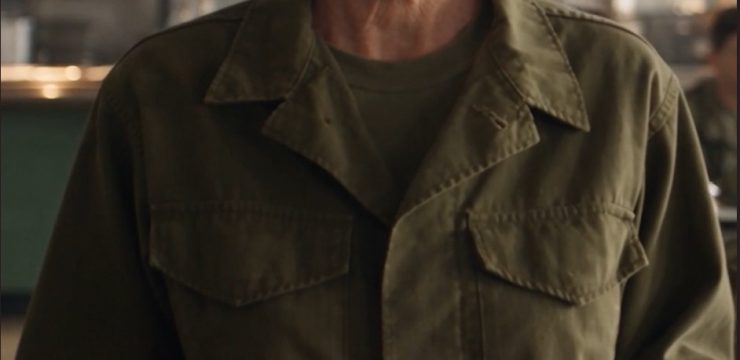
“Don’t embarrass your brother today.”
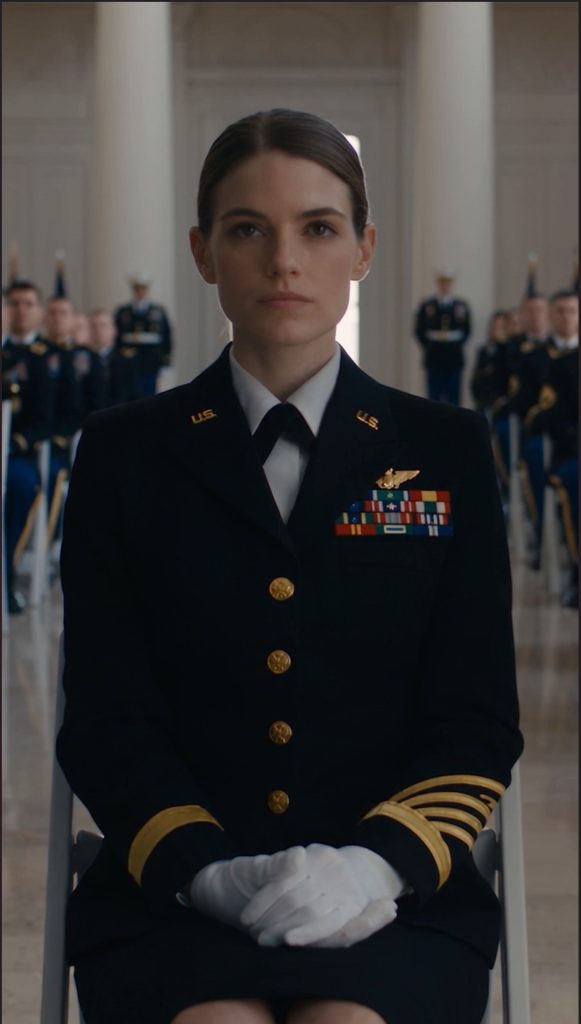
The warning was barely louder than a breath, yet it seemed to cut through the vast military hall. The woman it was meant for kept her eyes forward, while the mother behind her adjusted her smile and prepared to celebrate her son.
Major Emily Carter stood at attention in the center aisle. Around her, row after row of dress uniforms filled the hall, gold buttons glinting beneath the lights, medals catching brief flashes as officers shifted in their seats.
Emily knew how to stand still. She knew how to hold a steady expression when every muscle in her face wanted to move.
Behind her, her mother gave an impatient breath, as though even Emily’s silence might somehow spoil the day.
At the podium, Emily’s brother was receiving another ribbon. Their mother stepped forward to pin it to his uniform, carefully smoothing the fabric beneath it.
When she looked up at him, her expression softened into a kind of pride Emily had spent years trying not to miss.
“Now that is what an officer should look like,” she said.
A murmur of approval moved through the hall. Emily heard it without turning her head, each approving voice making the distance between her and her family feel wider.
She had worn her own uniform into that room. She had earned the rank on its shoulders. But her mother’s gaze had passed over both as if they meant nothing.
When the presentation moved on, Emily took her seat among the officers. Her white-gloved hands settled neatly in her lap, one over the other, concealing the tension in her fingers.
Her brother caught her eye as he moved away from the podium. For a moment, she thought he might acknowledge her presence without their mother listening.
Instead, he leaned close.
“Mom says you’re being transferred.”
He said it quietly, with the assurance of someone repeating a fact that had already been settled. Emily looked at him, noticing how easily he accepted their mother’s version of her life.
“She doesn’t know why I’m here,” Emily replied.
He paused. Something uncertain flickered across his face before he straightened and stepped away.
Then the microphone clicked.
The sound was small. In the tightly controlled silence, it drew every eye toward the podium.
“There is one officer whose identity has been withheld until this morning.”
Emily did not lower her gaze. Above her, the ceiling seemed impossibly high, and the room felt suspended between one breath and the next.
“Major Emily Carter.”
The name settled over the assembly.
Her mother stopped moving. The bright, practiced smile disappeared, and the color left her face so suddenly that she looked almost unfamiliar.
Nearby, Emily’s brother stared toward her, his confidence giving way to bewilderment.
Emily remained seated, her gloved hands still folded, as whispers died before they could become words.
The voice from the podium returned, quieter now.
“Please stand.”
Chairs scraped against the floor. Hundreds of officers rose together, the sound rolling through the hall like a single movement.
Emily waited one heartbeat longer.
Then she stood.
Her mother took a step toward her. Her brother whispered her name, not as a greeting now, but as a question he was afraid to ask.
Only then did the meaning begin to reach them.
Emily was not here to be sent away.
She was the reason this gathering had been called.
She looked at neither of them. Her eyes stayed on the flag ahead as the officer at the podium drew a breath to deliver the next order.
And the words that would change everything were still waiting to be spoken. 👇
“Major Carter. Report to the podium.”
Emily stepped into the aisle. The sound of her polished shoes against the floor seemed unusually loud, each measured step carrying her farther from the two people who had spent years making her feel small.
Her mother reached for her arm as she passed.
“Emily, what is this?”
Emily stopped just long enough to look at the hand gripping her sleeve.
“Please let go, Mom.”
Her mother released her.
At the podium, the commanding general opened a dark folder. His expression remained composed, but his voice carried a weight that made the room utterly still.
“Six months ago, during an operation whose details remained classified until this morning, a medical evacuation convoy came under sustained enemy fire. Nineteen wounded personnel were trapped beyond the designated extraction point.”
A large screen behind him illuminated with a grainy photograph of damaged vehicles beneath a smoke-filled sky.
“The evacuation had been declared impossible. Major Carter disagreed.”
Emily’s brother stopped breathing for a moment.
He recognized the location.
He had been there.
The general continued.
“Despite suffering injuries herself, Major Carter coordinated a second extraction, returned to the danger zone, and remained until the last surviving member of the convoy was evacuated.”
He paused.
“One of those nineteen soldiers was her own brother.”
A sharp, involuntary sound escaped their mother.
Emily stared ahead.
She remembered the smoke, the heat against her face, the unbearable weight of her brother as two medics helped lift him toward the waiting vehicle.
She remembered touching his shoulder before the doors closed.
And she remembered wondering whether he would ever wake up.
Her brother gripped the back of a chair.
“No,” he whispered. “They told me another unit got us out.”
“The operational details were restricted,” the general explained. “Major Carter’s identity was protected until the investigation and security review were completed.”
He closed the folder.
“Today, we recognize her extraordinary courage and appoint her to lead a new recovery and evacuation task force.”
The hall erupted in applause.
Emily accepted the decoration without smiling. When the general shook her hand, she returned his grip firmly, though her fingers had begun to tremble.
Her mother remained standing beside her son’s chair, looking as though the floor had shifted beneath her.
But the worst truth had not yet reached him.
When the ceremony concluded, Emily descended from the podium into a crowd of officers offering congratulations.
Her brother pushed through them.
“Emily.”
She turned.
His eyes were wet, his face strained with an effort to understand something that no longer fit the life he remembered.
“You were there?”
She nodded.
“You pulled me out?”
“I helped get you home.”
He stared at her.
“Mom told me you never came to the hospital. She said you didn’t even call.”
Emily’s expression changed.
For the first time that morning, her composure broke.
“I came three times.”
His mouth parted.
“The first time, I could barely walk. I was still wearing a brace beneath my uniform when I got there.”
She swallowed.
“Mom met me outside your room. She said you didn’t want to see me. That you blamed me for what happened.”
Her brother slowly turned toward their mother.
She was standing several feet away.
“Mom?”
“Not here,” she whispered.
“Did you tell her that?”
Their mother looked around at the officers still lingering nearby.
“I was trying to protect you.”
“From what?”
Her eyes flicked toward Emily.
“From spending your entire life feeling like you owed your sister something.”
The words fell into a silence so complete that even the conversations near the doorway stopped.
Emily looked down.
There it was.
Not a misunderstanding. Not an unfortunate choice of words. Her mother had known enough to understand what Emily had done, and had still chosen to keep her children apart.
“You told me he hated me,” Emily said quietly.
Her mother struggled to answer.
“I thought it would be better if you both moved forward separately.”
Her brother took one unsteady step backward.
“You let me believe she abandoned me.”
“I didn’t want your recovery overshadowed by hers.”
He looked at the ribbon on his chest, the one she had pinned so proudly.
Then he looked at Emily.
“You nearly died getting me out, and she made sure we never talked about it.”
Their mother reached toward him.
“Please understand—”
He moved away before she could touch him.
“No. I understand now.”
She looked between her children, searching for the familiar authority that had always brought them back into line.
It was gone.
“Emily,” she said, her voice breaking, “surely you know I love you.”
Emily’s eyes filled, but she did not turn away.
“I spent my whole life trying to hear you say that without having to earn it first.”
Her mother covered her mouth.
Emily continued, almost whispering.
“I didn’t need you to be proud of my rank. I didn’t even need you to understand my work. I just needed you to believe I mattered.”
The commanding general approached, then stopped a respectful distance away. He had heard enough to understand that this was no longer a military matter.
Emily’s brother stepped beside her.
Their mother stared at the two uniforms standing shoulder to shoulder.
For years, she had controlled the distance between them through praise, comparison, and carefully chosen silences.
Now neither child was looking to her for permission.
“I think you should leave,” her son said.
She shook her head.
“You can’t mean that.”
“I do.”
Her eyes found Emily.
Emily said nothing.
Her mother slowly lowered her hand. With no argument left that either child would accept, she walked toward the doors alone.
Neither followed.
Outside, sunlight fell across the stone steps. She stood there for several minutes, the sounds of the ceremony fading behind her.
Inside the hall, her children remained together.
Whatever authority she had once held over their relationship had ended, not through punishment or public humiliation, but through the truth she could no longer control.
Emily finally sat on a bench near the corridor.
Her brother sat beside her, leaving a careful space between them.
“I should have called you myself,” he said.
Emily rubbed her thumb against the seam of her glove.
“I tried. For a while.”
He nodded, staring at the floor.
“I remember waking up in the hospital. Mom kept telling me how proud everyone was that I’d survived. Then she told me you wanted nothing to do with what happened.”
His voice became unsteady.
“I was angry at you for six months.”
“I know.”
“And you still stood there today while they gave me that ribbon.”
Emily turned toward him.
“You earned it.”
He shook his head.
“I don’t know what to say to you.”
“You don’t have to find the perfect words.”
For a long moment, they sat listening to the distant movement of people leaving the hall.
Then he reached across the space between them.
Emily looked at his hand.
She took it.
His shoulders began to shake.
“I’m sorry,” he managed.
Emily leaned toward him, and he wrapped his arms around her with the desperate care of someone holding something he almost lost without ever understanding its value.
Neither noticed the last officers quietly passing by.
A week later, their mother sent separate letters.
Emily read hers at the kitchen table of her small apartment. It contained an apology, but also explanations about fear, pressure, and how difficult it had been to raise two children with such different personalities.
She folded it without answering.
Her brother received a similar letter.
When he called Emily, he did not ask her to forgive their mother.
“I told her I need time,” he said. “And that she can’t use me to reach you.”
Emily closed her eyes.
“Thank you.”
There were consequences their mother could not undo. She no longer had their unquestioning trust, no longer spoke for their choices, and no longer occupied the center of their lives.
For once, the decision to rebuild anything would not belong to her.
Several weeks later, Emily attended a small gathering with members of the recovered evacuation team.
Her brother came with her.
A medic who had survived the convoy approached Emily, holding a photograph of the rescue team taken before deployment.
“I kept meaning to give you this,” she said.
Emily studied the faces. Several looked impossibly young.
Her brother appeared near the edge, smiling beneath the weight of his equipment.
The medic touched his shoulder.
“You know she argued for your commendation, don’t you?”
He frowned.
Emily looked away.
The medic continued.
“When the citation was being reviewed, your sister submitted the account of how you stayed behind to help two wounded medics reach cover before you were injured.”
Her brother stared at Emily.
“She recommended me?”
Emily gave a small shrug.
“You did something brave.”
“But you knew what Mom was going to say today.”
“I suspected.”
He looked at her for a long moment.
“You could have told them I didn’t deserve it.”
“Why would I do that?”
“Because I was awful to you.”
Emily breathed out slowly.
“You were my brother before any of this happened.”
His eyes filled again.
All those years, he had believed love was something awarded to the child who performed best, who earned the loudest praise, who stood closest to their mother’s approval.
Emily had been trying to tell him something different.
He looked down at his ribbon.
For the first time, he understood that his sister had helped ensure he received it not because she expected gratitude, but because she believed his courage deserved recognition.
That evening, they returned to Emily’s apartment.
Her brother helped prepare dinner, badly overcooking the vegetables while she laughed at his attempts to rescue them.
They ate anyway.
The kitchen was small. Rain tapped softly against the window, and a warm light spilled across the table between their plates.
For the first time in years, neither felt the need to defend an achievement or apologize for having one.
Their mother was not there.
The absence hurt in ways neither tried to pretend away, but it no longer filled the whole room.
After dinner, her brother noticed Emily’s newly awarded decoration resting inside an open presentation case on a shelf.
Beside it was the photograph the medic had given her.
He moved closer.
“You kept the picture.”
Emily smiled.
“Of course.”
He studied the faces again, then carefully placed his own ribbon case beside hers.
“Is it okay if I leave this here?”
Emily looked at the two decorations resting together.
“You don’t want to take it home?”
He shook his head.
“I spent too much of my life thinking we were competing.”
He glanced at her.
“I’d like to remember we were always on the same side.”
Emily’s smile trembled.
She stepped closer and straightened the ribbon case, just as their mother had once straightened the ribbon on his chest.
But there was no comparison in the gesture now.
Only tenderness.
Her brother slipped an arm around her shoulders.
Outside, the rain softened.
Inside, two decorations rested side by side beneath a photograph of people who had survived something terrible together.
And for the first time, Emily Carter understood that coming home did not have to mean returning to the place where she had spent her life waiting to be loved.
Sometimes, home was simply the person who finally reached for your hand and stayed.