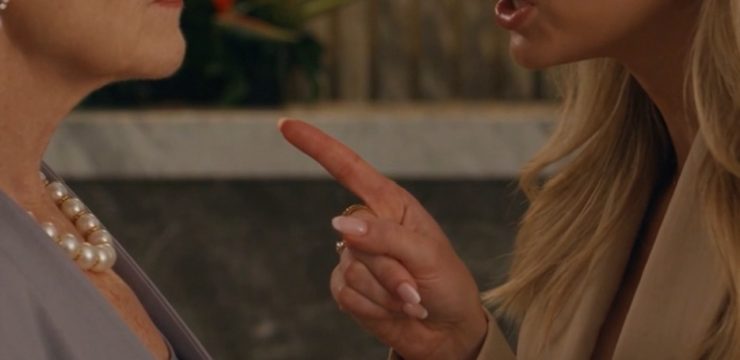
The bride standing in front of the mirror was wearing my wedding gown. The man behind her, smiling as he held a glass of champagne, was my fiancé. And neither of them knew I was about to walk through the door.
What I discovered afterward made the betrayal almost impossible to comprehend.
My name is Juliet Hale. I’m thirty-four, and for eleven months, I’d poured nearly every spare moment of my life into creating the dress I was supposed to marry Graham in.
I’d worked alongside Bellmare’s most sought-after couturière, choosing every detail with care. Ivory silk crepe, an elegantly low back, and hundreds of delicate lily-of-the-valley flowers embroidered by hand.
Four hundred hours of stitching.
Those flowers had been my grandmother’s favorite. I wanted a piece of her with me when I walked down the aisle.
My final fitting was scheduled for Thursday.
But on Sunday evening, just after six, everything changed.
An Instagram notification appeared on my phone. It was a story posted by my younger sister, Sienna.
I opened it without thinking.
There she was, barefoot in a bridal salon, twirling in front of an enormous mirror. My embroidered flowers caught the light as she lifted the skirt.
Then I noticed Graham standing behind her.
He was smiling.
Not awkwardly. Not like someone caught in an uncomfortable situation.
He looked happy.
I watched the video twice, my fingers growing numb around the phone.
Then I picked up my keys.
I didn’t call either of them.
Atelier Fontaine stood on Harbor Row, its windows glowing against the evening darkness. Inside, crystal chandeliers illuminated white marble floors and cream-colored velvet sofas. Fresh gardenias filled the air.
The little brass bell above the entrance rang.
Margot, the salon manager, looked up.
The moment she recognized me, the color drained from her face.
“Ms. Hale. We weren’t expecting you.”
“I know,” I said. “I’ll wait.”
I stood quietly beside the counter, folding my hands together because I didn’t trust them to stay still.
Eight minutes passed.
Then I heard Sienna laughing.
She emerged from the fitting area holding my gown above her ankles, careful not to let the delicate hem touch the marble.
Graham followed, carrying her shoes.
When they saw me, both stopped.
“Jules,” Sienna said, her smile faltering. “It was hanging there. I just wanted to try it.”
I looked at the tiny flowers I’d spent countless nights stitching.
“It looks beautiful on you.”
She shrugged.
“Seriously, Juliet. It’s only fabric.”
Graham placed her heels on the sofa.
“Can we not do this here?”
“Do what, Graham?”
Silence.
Then Sienna caught my reflection in the mirror.
Something in her expression hardened.
“Maybe some things are simply meant for other people,” she said quietly.
I looked from her to Graham.
She wasn’t talking about the gown anymore.
“You didn’t just try on my dress,” I whispered. “You tried on my life.”
I turned toward the entrance before either could answer.
“Ms. Hale?”
Margot’s voice stopped me.
She was standing behind the counter, holding a sheet of paper.
“I think you should see this.”
She slid it across the marble.
An alteration order.
My gown.
The bodice was to be taken in one inch. The hem raised two.
Sienna’s measurements.
My eyes moved toward the top.
Bride: Sienna Hale.
Wedding date: June 7.
My wedding date.
Venue: Ashcombe Glasshouse.
My venue.
I kept reading until I reached the bottom.
Balance paid in full.
Beneath those words was a signature.
A familiar sloping signature I’d recognized since childhood, written on birthday cards, school permission slips, and letters tucked into Christmas presents.
My mother’s handwriting.
For a moment, I couldn’t hear anything except my own breathing.
Then a door opened behind me.
I lifted my eyes.
My mother stood at the entrance to the fitting room.
And in her hands, carefully folded against her chest, was my wedding veil.
She looked at the paper beneath my fingers.
Then she looked at me.
“Mom?” I said.
Her lips parted, but before she could speak, I turned the alteration order toward her.
“Why is your signature on this?”
The entire salon went silent.
And the answer was still waiting between us. 👇
My mother tightened her grip on the veil until the delicate tulle wrinkled between her fingers.
“Juliet, sweetheart, please listen.”
That word.
Sweetheart.
She’d used it whenever she wanted me to accept something painful without making a scene.
“Tell me why you paid for my sister’s alterations.”
Her eyes moved toward Graham.
And suddenly I understood something worse than the document itself.
She wasn’t surprised to see him.
“How long?” I asked.
Graham took one step forward.
“Jules, it’s complicated.”
“How long have you been seeing my sister?”
Sienna looked at the floor.
“Seven months,” she whispered.
Seven months.
I thought about our engagement photographs, the Christmas dinner where Graham had kissed my forehead while Sienna passed him another glass of wine, and the afternoon my mother had cried when I showed her the finished embroidery.
Seven months of them watching me plan a wedding they already knew would never happen.
I reached for the counter to steady myself.
My mother began crying.
“We were trying to find the right moment.”
“The right moment for what?”
She swallowed.
“To tell you that Graham and Sienna have fallen in love.”
Something inside me went utterly still.
“And you decided they could have my wedding?”
Nobody answered.
Margot quietly moved the alteration order closer to me.
“There’s more you should know,” she said.
Graham’s head snapped toward her.
“That’s enough.”
Margot didn’t move.
“The order was submitted three weeks ago. Mrs. Hale requested that we keep the alterations confidential until the final fitting.”
I looked at my mother.
“Three weeks?”
She pressed the veil against her chest.
“Sienna was frightened you’d react badly.”
I almost laughed.
Not because anything was funny.
Because my mother had spent three weeks protecting my sister from the consequences of stealing the life I’d been building.
“Take it off,” I told Sienna.
She stared at me.
“What?”
“The dress. Take it off.”
Her expression hardened.
“You’re seriously going to humiliate me over a dress?”
“No,” I said. “I’m asking you to stop wearing something that belongs to me.”
Graham reached for her arm.
“Come on, Sienna.”
But she pulled away.
“I’ve spent my entire life being second to Juliet. The perfect daughter. The responsible one. The one everybody admires.”
I stared at her.
I remembered helping her study for exams, lending her money when she lost her apartment, and sitting beside her through the night after her first serious breakup.
“I never knew we were competing.”
“That’s because you were always winning.”
My mother whispered her name, but Sienna kept going.
“Graham chose me. For once, somebody chose me.”
I looked at Graham.
“Is that what you told her?”
He looked exhausted.
“I didn’t mean for any of this to happen.”
“But you kept letting it happen.”
He lowered his eyes.
I turned back to Margot.
“Is the dress still legally mine?”
“Absolutely. The original purchase agreement and design commission are in your name.”
Graham went rigid.
My mother’s face changed.
And that was when I noticed the second document beneath the alteration order.
Margot hesitated before handing it over.
It was correspondence between Graham, my mother, and the wedding venue.
A request to transfer the existing reservation to a different bride while retaining the deposit already paid.
My deposit.
Nearly eighteen thousand dollars I’d saved over four years.
I read the final sentence twice.
Please do not contact Juliet Hale regarding these changes.
My stomach turned.
“Who wrote this?”
Graham said nothing.
My mother began speaking rapidly.
“We intended to reimburse you. Once everything settled, we were going to explain.”
“Explain that you stole my money?”
“We didn’t steal anything,” Graham protested.
I held up the page.
“You asked them not to contact me.”
He opened his mouth.
Nothing came out.
Sienna finally disappeared into the fitting room.
I heard the zipper move.
For some reason, that small sound hurt more than the shouting.
It was the sound of four hundred hours being taken off somebody else’s body.
When she returned wearing her own clothes, she placed the gown over a chair.
Carelessly.
I crossed the room and lifted it before the silk touched the floor.
The embroidered flowers were still intact.
I ran my thumb across one tiny white blossom.
My grandmother had taught me that stitch when I was twelve, sitting beside her kitchen window while rain tapped against the glass.
She used to say beautiful things deserved patience, but people deserved honesty.
I hadn’t understood how different those two kinds of devotion could be.
I turned to Margot.
“Please store the gown safely. And send me copies of everything.”
Then I looked at Graham.
“The wedding is canceled.”
He reached toward me.
“Juliet, don’t make a decision while you’re upset.”
I stepped away.
“I made my decision when I learned the truth. You made yours seven months ago.”
Outside, cold rain had begun falling across Harbor Row.
I sat in my car for nearly an hour, staring at the water sliding down the windshield.
My phone kept ringing.
Graham.
Mother.
Sienna.
I switched it off.
The next morning, I called Ashcombe Glasshouse.
The coordinator sounded uncomfortable when I introduced myself.
She confirmed the transfer request had been received but not completed because the deposit agreement required my written consent.
Graham had submitted an authorization bearing my name.
A signature that wasn’t mine.
I asked for every document.
Then I contacted a solicitor.
By Wednesday, formal notices had been sent to Graham and the venue. The attempted transfer was stopped, the reservation canceled under my original agreement, and the venue confirmed that the refundable portion of my deposit would be returned.
Graham’s employer also received information from an unrelated review that revealed he’d used his company’s client expense account for several personal trips with Sienna.
That discovery had nothing to do with me.
But it ended his position as a senior director.
When Graham called from an unfamiliar number, I answered once.
“I’ve lost my job,” he said.
I stood beside my kitchen window.
“I’m sorry you’re going through that.”
He exhaled shakily.
“Could we please talk?”
“We are talking.”
“I made a terrible mistake.”
“You made hundreds of decisions, Graham. You made them every day for seven months.”
He said nothing.
“I hope you become someone who understands that difference.”
Then I ended the call.
My mother came to my apartment that Friday.
She looked older somehow, standing outside my door with rain in her hair.
I let her inside.
She sat at my kitchen table, the same place where she’d once helped me sort hundreds of tiny embroidered flowers.
“I thought I was keeping the family together,” she said.
“You were keeping Sienna comfortable.”
Her eyes filled.
“I’ve always worried about her.”
“I know.”
“She was so unhappy.”
“And you decided her happiness mattered more than mine.”
My mother covered her mouth.
For the first time, she didn’t argue.
I watched her struggle with words that couldn’t make anything better.
Finally, she whispered, “I was wrong.”
I wanted to embrace her.
I wanted to be a little girl again, before love became something I had to compete for.
But I stayed in my chair.
“I believe you’re sorry, Mom. I just don’t know how to trust you.”
She nodded slowly.
“Then I’ll have to live with that until I earn it back.”
It wasn’t forgiveness.
But it was the first honest conversation we’d had in years.
Sienna didn’t contact me for another month.
When she finally did, her message contained only six words.
You were right about everything, Jules.
She and Graham had separated.
I learned later that their relationship had begun unraveling almost immediately after the salon confrontation.
Without the secrecy, without the thrill of taking something forbidden, they were left facing what they’d actually done.
Sienna asked to meet.
I chose a quiet café near the waterfront.
She arrived without makeup, wearing the old denim jacket I’d bought her for her twenty-first birthday.
For several minutes, neither of us spoke.
Then she reached into her handbag and placed a small envelope on the table.
Inside was a handwritten apology.
Not excuses.
Not accusations.
Just a list of specific things she’d done, followed by the admission that none of them could be justified.
“I wanted to hurt you,” she whispered. “And when I finally did, I realized you were the person who loved me when I hadn’t done anything to deserve it.”
I stared at the letter.
“I would have helped you through anything, Sienna.”
She nodded, crying quietly.
“I know.”
That was the hardest part.
She did know.
I couldn’t promise we’d ever be close again.
But I told her I hoped she’d find a life she didn’t need to steal.
She held the letter between us for a moment before letting me keep it.
Summer passed.
Then autumn.
I continued working, seeing friends I’d neglected during the engagement, and learning how to spend evenings without waiting for somebody else’s key in the door.
My mother respected the distance I’d asked for.
She sent occasional messages, never demanding a reply.
Sienna started counseling and moved into a small apartment across town.
We weren’t repaired.
But nobody was pretending anymore.
In November, Margot called.
“Juliet, there’s something I found while preparing your gown for storage.”
She asked me to come to the atelier.
When I arrived, she led me into a private fitting room.
My dress hung beside the mirror, perfectly cleaned, every embroidered flower carefully protected.
Margot held a small cream-colored envelope.
“This was stitched inside the lining. Your couturière said your grandmother left instructions for it before she passed away.”
My breath caught.
My grandmother had died two years before my engagement.
I opened the envelope.
Inside was a small handwritten note, dated shortly before her death.
My darling Juliet,
I know you’ll finish something beautiful one day. Perhaps a wedding gown, perhaps something entirely different.
But I hope you remember what I taught you.
Every flower you stitch is proof that your hands can make beauty from patience.
Never mistake the thing you’ve made for the love you deserve.
If the day comes when you wear this gown, let it be because your heart feels safe.
And if that day never comes, I hope you’ll wear it anyway.
You were always the beautiful thing, sweetheart.
I sat down.
For a long time, I couldn’t speak.
Margot quietly closed the door.
And for the first time since that Sunday evening, I cried without feeling ashamed of my tears.
The following spring, I wore the gown.
Not to a wedding.
To a small gathering in my grandmother’s garden, where my closest friends had planted new lily-of-the-valley along the stone path.
My mother came too, at my invitation.
She didn’t ask for photographs or try to make the afternoon about reconciliation.
She simply brought my grandmother’s old silver sewing scissors, which she’d found while clearing a drawer.
“I thought these belonged with you,” she said.
I took them.
“Thank you, Mom.”
We stood together in the garden, listening to birds settle in the trees.
Then, slowly, I reached for her hand.
She held it carefully, as though she understood how fragile that small gesture was.
Sienna was there as well.
She stayed near the edge of the garden until I walked over and asked if she’d help carry the flowers inside.
It was an ordinary request.
But her eyes filled.
“Of course,” she said.
That afternoon, nobody pretended the past hadn’t happened.
We just made room for something gentler to exist beside it.
Before sunset, I stood beneath my grandmother’s apple tree as Margot took a photograph.
There was no groom waiting.
No wedding music.
No promise I had to make to anybody.
Just my gown, four hundred hours of tiny white flowers, and the people who had begun learning how to love me honestly.
A breeze moved through the garden.
I felt the silk brush against my ankles and looked down at the embroidery.
For months, I’d thought the dress represented everything I’d lost.
Now, finally, I understood.
My grandmother had never taught me to stitch so I could become somebody’s bride.
She’d taught me to make something beautiful with my own hands, and to know when it was time to stop giving that beauty away.
I touched one embroidered flower, then lifted my face toward the last warm light of the evening.
And for the first time in a very long while, I felt completely at home in my own life.