The general stopped so abruptly that the coffee in his hand trembled. Across the mess hall, a young sergeant was ordering a woman and her military dog to leave, unaware that one of the Army’s highest-ranking officers had just recognized them both.
And the woman, who had endured every insult without raising her voice, seemed to know exactly what was coming.
Only moments earlier, the mess hall had been filled with ordinary sounds. Metal trays scraped against tables, soldiers talked over breakfast, and fluorescent lights cast their pale glow across the polished floor.
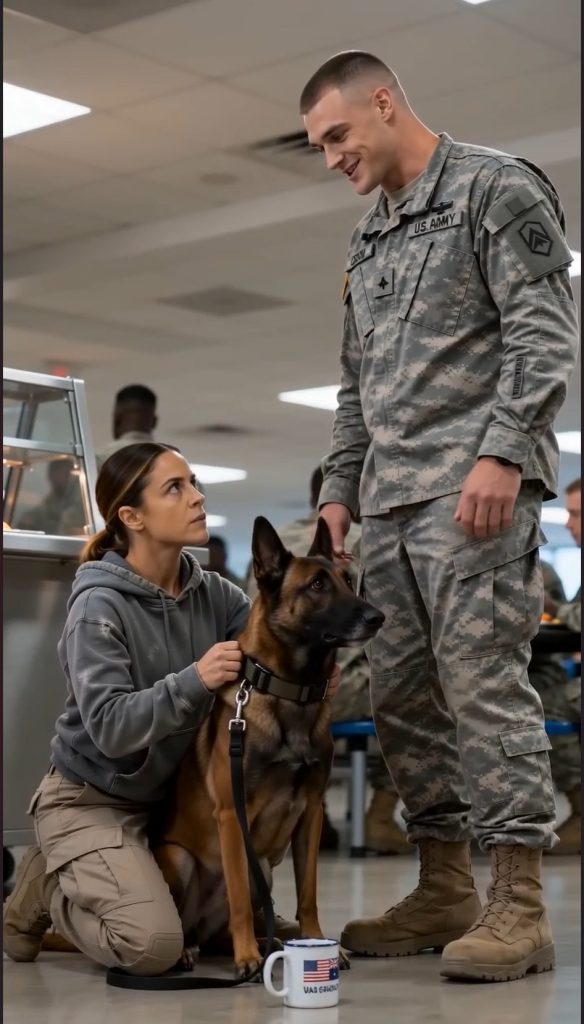
Near the entrance, a woman knelt beside a Belgian Malinois, one hand resting gently on his collar.
The dog sat perfectly still, his ears alert and his eyes attentive. There was something unmistakably disciplined about him, but the young soldier approaching them seemed too amused to notice.
He stopped a few feet away.
“You lost, lady?”
His eyes moved from her face to the dog, and a smirk crept across his mouth.
“This area is for soldiers. Not civilians bringing their pets inside.”
Several conversations nearby faded.
The woman remained on one knee. Her hand stayed on the Malinois’s collar, and when she looked up, her expression carried neither embarrassment nor fear.
“He’s not a pet.”
The sergeant gave a short, dismissive laugh.
“Whatever you say.”
She studied him for a moment, as though deciding whether another word was worth speaking.
Then she said quietly, “You should probably walk away.”
The soldier’s smile widened.
“Excuse me?”
His voice rose just enough to draw attention from the nearest tables.
“Are you seriously giving me orders?”
She offered no answer.
That silence seemed to irritate him more than an argument would have.
He extended his arm toward the exit.
“Take your dog and get out. Right now. Or I’ll have security remove you.”
The Malinois remained motionless, but his eyes followed the soldier’s pointing hand. The woman gave the collar the slightest reassuring touch.
Then she stood.
The dog rose beside her in one smooth movement, settling at her side with the quiet precision of an animal accustomed to commands.
Now the woman and the sergeant faced each other.
He had expected her to retreat. Instead, she held his gaze with a composure he couldn’t understand.
Around them, soldiers watched from their seats, uncertain whether they were witnessing an ordinary dispute or something that had already gone too far.
“You really don’t know who you’re talking to,” she said.
The sergeant leaned closer.
“I know exactly what I’m looking at.”
He spoke with the confidence of someone certain that the uniform on his back settled the matter.
What he failed to notice was the sudden change behind him.
A tall officer in dress blues had entered the mess hall, carrying a cup of coffee. Rows of ribbons covered his chest, and his presence would ordinarily have been enough to straighten every soldier within sight.
But he wasn’t looking at the room.
He was looking at her.
His steps stopped.
For several seconds, his gaze remained fixed on the woman. Then it shifted downward to the Belgian Malinois standing faithfully beside her.
Something in his expression changed.
Recognition.
Then a seriousness that made the soldiers nearest the entrance sit straighter.
The woman saw him, too.
She didn’t salute or speak. Her face remained composed, although her fingers tightened almost imperceptibly around the dog’s collar.
The sergeant still hadn’t turned around.
He was waiting for an apology.
Instead, a commanding voice broke through the silence.
“Sergeant.”
The single word carried across the hall.
The young soldier turned sharply, and every trace of amusement vanished from his face.
Standing a few steps away was the general, his coffee forgotten in his hand, his expression impossible to read.
The general glanced once more at the woman and her dog.
Then he looked directly at the sergeant and opened his mouth.
What he was about to say would change the meaning of everything that had just happened. 👇
“Tell me exactly what you think you’re doing.”
The general’s voice was quiet. Somehow, that made it worse.
The sergeant snapped to attention, his boots striking the polished floor.
“Sir! I was removing an unauthorized civilian and her animal from the dining facility, sir!”
The general didn’t answer immediately.
He placed his coffee on the nearest table, carefully enough that the cup made almost no sound.
“An unauthorized civilian,” he repeated.
“Yes, sir.”
“And what led you to that conclusion?”
The sergeant swallowed.
“She wasn’t wearing a uniform, sir.”
For a moment, nobody moved.
Then the general turned toward the woman.
“Colonel Bennett.”
The sergeant’s eyes widened.
The woman closed her eyes briefly, as though hearing her rank spoken aloud brought back something she had spent months trying to put behind her.
“General,” she answered.
The young soldier looked between them.
“Colonel?”
The general’s expression hardened.
“Colonel Rebecca Bennett. United States Army. And that animal you threatened to have removed is a decorated military working dog.”
The sergeant’s mouth opened, but no words came.
The general continued.
“His name is Ranger. He served alongside Colonel Bennett during an overseas deployment that cost this country some very good soldiers.”
At the mention of Ranger’s name, the Malinois lifted his head.
Rebecca’s hand settled against his neck.
“Easy, boy,” she whispered.
The general noticed the movement.
Something softened in his face.
“It’s good to see you both.”
Rebecca gave a small nod.
“Thank you, sir.”
The sergeant’s posture had begun to unravel.
“Sir, I didn’t know. Nobody told me who she was.”
“No,” the general replied. “They didn’t.”
His eyes remained fixed on the younger man’s face.
“And that’s precisely why I want to know how you treat people when you believe they have no authority over you.”
The words landed harder than a shouted reprimand.
At the nearby tables, soldiers exchanged uncomfortable glances.
The sergeant stared straight ahead.
“I was enforcing the rules, sir.”
Rebecca finally spoke.
“Then why didn’t you ask for identification?”
He turned toward her.
For the first time, he appeared uncertain whether he was permitted to answer.
“You could have told me.”
“I tried to tell you he wasn’t a pet.”
“But you never said you were a colonel.”
Rebecca looked at him for a long moment.
“Would you have spoken to me differently?”
He didn’t answer.
She nodded faintly, as though his silence had confirmed something she already suspected.
The general gestured toward an empty table.
“Sergeant, remain here. Colonel, may I speak with you?”
Rebecca hesitated.
She had come to the installation for a private reason. Having an entire mess hall watching her was the last thing she wanted.
But Ranger pressed his shoulder lightly against her leg, and she followed the general toward the table.
The sergeant remained standing several feet away.
“Rebecca,” the general said softly, “I didn’t know you were coming today.”
“I wasn’t sure I could.”
His gaze lowered toward Ranger.
“Is this about the memorial?”
She nodded.
The general pulled out a chair, but Rebecca remained standing.
“I thought I could walk through the building one more time before the ceremony.”
Her voice caught on the last word.
Ranger leaned into her.
The general’s expression changed.
“I remember the last time you were here.”
“So do I.”
For a few seconds, only the ventilation system could be heard.
Then the general asked, “Have you told anyone why you came back?”
Rebecca shook her head.
“Not yet.”
Across the room, the sergeant listened, his face slowly losing its defensiveness.
The general drew a breath.
“Sergeant, come here.”
The young soldier approached.
“Sir.”
“Colonel Bennett and Ranger were part of a military working dog team assigned to a convoy protection mission. During their final deployment, an explosion struck their vehicle.”
Rebecca looked down.
The general paused.
“Several soldiers were trapped. Communications had failed. The vehicle was burning.”
Ranger’s ears shifted at the sound of his name.
“Colonel Bennett went back into the danger zone to reach the wounded. Ranger helped locate survivors who couldn’t be seen through the smoke.”
The sergeant glanced at the dog.
The general continued more quietly.
“One of the men they brought out was a young specialist who didn’t survive his injuries.”
Rebecca’s fingers trembled.
“His name was Daniel Mercer,” she said.
She looked toward the windows, where the morning sunlight had begun cutting narrow lines across the floor.
“He was twenty-two. He talked about his little sister constantly. He kept a photograph of her taped inside his helmet.”
Nobody interrupted.
“He was still conscious when we found him.”
Her voice grew thinner.
“He asked me if we were all getting home.”
The general lowered his eyes.
“I told him we were trying.”
Rebecca swallowed hard.
“And he asked me to make sure Ranger got home, too.”
The sergeant looked away.
For the first time, the young man seemed to understand that the animal beside her carried memories no medal could adequately describe.
But then he noticed something on Rebecca’s jacket.
A small, worn photograph tucked inside the breast pocket.
He stared.
His breathing changed.
“Wait.”
Rebecca looked at him.
“What?”
The sergeant’s voice dropped.
“Did you say Daniel Mercer?”
“Yes.”
The young man’s face went pale.
He reached slowly toward the identification tag hanging beneath his uniform collar.
“My name is Ethan Mercer.”
Rebecca stopped breathing for a moment.
The general looked sharply at him.
Ethan’s eyes filled.
“Daniel was my brother.”
The silence that followed seemed to swallow the entire room.
Rebecca took a step backward.
Ranger immediately moved with her.
Ethan stared at the woman he had threatened only minutes earlier.
“My family was told a colonel and a military dog tried to save him.”
His words came unevenly.
“We never knew their names.”
Rebecca pressed her lips together.
For years, she had carried the memory of Daniel’s final moments, believing there was nothing she could say that would lessen his family’s grief.
Now his younger brother stood before her.
The same young man who had ordered her out.
“I didn’t know,” Ethan whispered.
Rebecca studied his face.
There was something familiar in the shape of his eyes, the way his jaw tightened when he fought to keep his emotions contained.
Daniel had done the same thing.
“You look like him,” she said.
That broke something in Ethan.
He lowered his head, struggling for breath.
“I’m sorry.”
Rebecca didn’t move.
“I was disrespectful. I treated you like you didn’t belong here. And you were there when my brother…”
His sentence dissolved.
The general started to speak, but Rebecca gently raised her hand.
“Ethan.”
He looked up.
“Your brother was brave. But what I remember most wasn’t his bravery.”
Tears gathered in her eyes.
“It was his kindness. He worried about everyone else, even when he was the one who needed help.”
Ethan covered his mouth.
Rebecca reached into her pocket and withdrew the photograph.
The edges were worn almost white.
It showed Daniel standing beside Ranger, smiling beneath the harsh sunlight of their deployment camp.
“I’ve carried this since the day we lost him.”
She held it toward Ethan.
“He wanted his family to know how much he loved them.”
Ethan accepted the photograph with shaking hands.
On the back, in Daniel’s handwriting, were six words.
Tell Them I Wasn’t Alone. Love, Daniel.
Ethan stared at the message.
Then his knees weakened, and he sat heavily in the nearest chair.
Rebecca crouched beside him.
“He wasn’t alone,” she whispered.
“I stayed with him.”
Ethan began to cry.
Ranger approached slowly and rested his head against the young soldier’s knee.
Ethan reached toward him, uncertain.
“Can I?”
Rebecca nodded.
“He remembers gentle hands.”
Ethan buried his fingers in Ranger’s fur.
For several minutes, nobody spoke.
The general stood beside them, his own eyes wet.
But the encounter still required an answer.
When Ethan finally rose, he turned toward Rebecca.
“Ma’am, I know what I did was wrong. I can’t explain it away.”
“No,” she said. “You can’t.”
He nodded.
“I understand.”
“You saw someone without a uniform and decided she didn’t deserve respect. You saw Ranger and assumed he had no place here.”
Her voice remained steady.
“That’s a dangerous habit for a soldier.”
Ethan stared at the floor.
“I know that now.”
The general stepped closer.
“There will be a formal counseling statement, Sergeant. You’ll also complete remedial training on military bearing, professional conduct, and proper verification procedures.”
“Yes, sir.”
“And until your commanding officer determines otherwise, you’re relieved of supervisory duties in this facility.”
Ethan accepted the decision without protest.
The general waited.
“Do you understand why?”
Ethan raised his head.
“Because I used my authority to humiliate someone instead of doing my job.”
“Correct.”
Rebecca stood beside Ranger.
She looked at Ethan for a long moment.
“Your brother wouldn’t want you to become a soldier who mistakes rank for character.”
Ethan nodded, unable to speak.
The general picked up his coffee, now cold.
“Colonel, the memorial is waiting.”
Rebecca glanced toward Ranger.
For months, she had avoided ceremonies, photographs, and rooms full of people speaking about courage.
She didn’t feel courageous.
She remembered smoke, frightened voices, and a promise she couldn’t completely fulfill.
But now Daniel’s younger brother was standing before her.
And for the first time, she understood that returning might mean more than reopening an old wound.
“Ethan,” she said, “would you like to come with us?”
He looked surprised.
“After what I said to you?”
Rebecca’s eyes softened.
“You’re Daniel’s brother.”
She paused.
“And today is about remembering him.”
Outside, a light breeze moved through the trees surrounding the installation.
The three walked toward the memorial courtyard, Ranger keeping pace beside Rebecca.
Ethan carried Daniel’s photograph carefully in both hands.
The ceremony was small.
Soldiers stood in neat rows beneath the morning sky. A folded flag rested beside a framed portrait of Daniel and several other fallen service members.
When Daniel’s name was read, Ethan straightened.
Rebecca stood beside him.
Ranger sat between them.
After the final salute, the gathering slowly dispersed.
Ethan remained before his brother’s photograph.
“There’s something I need to tell you,” he said.
Rebecca turned.
“My mother kept asking whether Daniel had been afraid.”
His throat tightened.
“Nobody could answer her.”
Rebecca looked toward the memorial.
“He was afraid,” she said gently. “Anyone would have been.”
Ethan closed his eyes.
“But he wasn’t alone. He held my hand. And Ranger stayed beside us until the medics arrived.”
A tear slipped down Ethan’s cheek.
Rebecca continued.
“Your brother made me promise something else.”
She drew a slow breath.
“He said if I ever met his family, I should tell them he’d had a good life. Not a long one. But a good one.”
Ethan let out a broken laugh.
“That sounds like him.”
Then he looked down at the photograph.
“Our mother is here today.”
Rebecca turned sharply.
Ethan nodded toward a woman waiting near the courtyard entrance.
“She wanted to come, but she didn’t think she could stand through the ceremony.”
The woman began walking toward them.
Her eyes went first to Ethan, then to the photograph, and finally to Ranger.
She stopped.
“Oh,” she whispered.
Ranger rose quietly.
The woman knelt before him, touching the gray beginning to show around his muzzle.
“Daniel wrote about you.”
Her hands shook against his fur.
“He said you were the best friend a soldier could have.”
Ranger leaned gently into her.
Rebecca turned her face away, tears finally escaping.
Daniel’s mother stood and looked at her.
“You brought my boy home.”
Rebecca shook her head.
“I couldn’t save him.”
The older woman stepped closer.
“No.”
She took Rebecca’s trembling hands.
“But you made sure he wasn’t alone.”
Rebecca’s shoulders began to shake.
For years, she had carried the weight of what she couldn’t change.
Now, standing between Daniel’s mother and brother, she finally allowed herself to grieve with the people who had loved him first.
They embraced beneath the quiet morning sky.
Ethan stepped closer, and his mother pulled him into the embrace, too.
Ranger settled beside their feet.
Later, as the courtyard emptied, the general approached Rebecca with a small envelope.
“Daniel’s mother asked me to keep this until you were ready.”
Inside was a letter Daniel had mailed home shortly before his final mission.
Rebecca unfolded it carefully.
Near the bottom, one sentence had been underlined.
If Anything Ever Happens To Me, Please Thank Colonel Bennett. She Makes Everyone Feel Like They Have Someone Looking Out For Them.
Rebecca read it twice.
Then she pressed the letter against her heart.
The general stood quietly beside her.
“You spent years believing you failed that young man,” he said.
She couldn’t answer.
“He spent his last weeks telling his family how safe he felt with you.”
Rebecca closed her eyes.
For the first time in years, the memory of Daniel wasn’t only filled with smoke and loss.
She could see his smile.
Hear his laugh.
Remember the young soldier who used to sneak Ranger an extra piece of chicken whenever he thought nobody was watching.
Beside her, Ranger lifted his head into the sunlight.
Ethan approached with his mother.
“Colonel,” he said, “would you and Ranger come have dinner with us sometime?”
Rebecca smiled through her tears.
“I’d like that.”
His mother reached for her hand.
“How about tonight?”
Rebecca looked at Ranger.
The old dog wagged his tail once, then again.
A small laugh escaped her.
“I think he’s already accepted.”
That evening, there were no uniforms at the Mercer family table.
Just warm food, photographs, quiet laughter, and stories about a young man they would always miss.
Ethan listened more than he spoke.
Rebecca told them about Daniel’s terrible singing, his endless letters home, and the way he always saved the best part of his meal for Ranger.
His mother laughed until she cried.
And when dinner ended, Ethan carried Ranger’s water bowl into the kitchen without being asked.
Rebecca watched him from the doorway.
He caught her looking.
“I’ve got a lot to learn,” he admitted.
She nodded.
“We all do.”
Outside, the evening settled softly over the house.
Ranger lay beside Rebecca’s chair, his head resting against her foot.
Daniel’s photograph stood on the mantel, surrounded by family pictures.
For once, Rebecca didn’t look at it and remember only the day she lost him.
She remembered the young man who had trusted her.
The family who had welcomed her.
And the brother who was learning to become a better soldier.
Daniel’s mother brought another blanket and draped it gently over Rebecca’s shoulders.
“You know,” she said, “there’s always a place for you and Ranger here.”
Rebecca touched the blanket.
Across the room, Ethan was laughing at something in an old family album.
Ranger slept peacefully at her feet.
And for the first time since coming home from war, Rebecca felt that she had finally arrived somewhere she belonged.