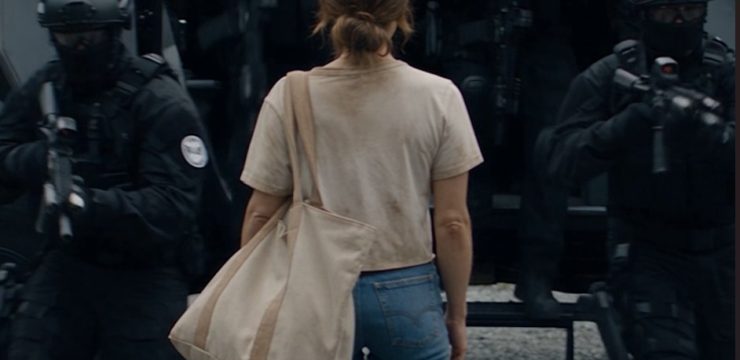
She locked the door with shaking fingers, and the click of the bolt echoed through the small diner like a thunderclap cutting through the storm outside. The rain hammered against the glass windows, but in that moment, everyone inside had forgotten about the weather. Every eye in the room was fixed on the man standing near the entrance — tall, expressionless, one hand still buried deep inside his dark coat.
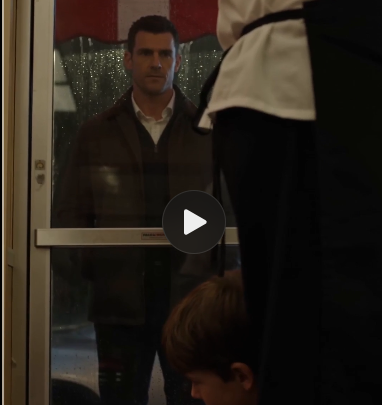
The little boy pressed himself against the cook’s apron, trembling so violently that the older man could feel every shiver traveling through the worn fabric. The child didn’t cry. He didn’t scream. He simply held on, the way a person holds on when they’ve already lost too much and can’t afford to lose anything else.
“Open that door,” the man said. His voice was low and controlled, the kind of voice that had learned long ago that it didn’t need to be loud to be terrifying.
No one moved.
The cook placed himself squarely in front of the boy, arms slightly out, shoulders set. He had worked this diner for over thirty years. He had seen difficult nights. He had seen desperate men walk through that door looking for a meal, looking for trouble, looking for something they couldn’t name. But this was different. He felt it in the air, thick and wrong, like the moment before lightning strikes.
“You heard me,” the man said, stepping forward. “The boy comes with me.”
“He’s not yours,” the cook replied. Simple. Final.
The man’s eyes sharpened into something colder.
Then the child whispered from behind the cook’s broad frame, his small voice barely audible over the drumming rain. “He took my mom.”
The entire diner went still.
A woman seated at the counter slowly raised her hand and covered her mouth. A couple in the corner booth reached for each other without looking. The waitress pressed her back against the wall near the phone, her breathing shallow.
The man reached into his coat.
Every person in that room braced.
But it wasn’t a weapon he pulled out.
It was a photograph.
He held it up between two fingers, steady and deliberate, the way a man holds something he wants you to see clearly. In the photo, a woman sat bound to a wooden chair, her wrists tied, her expression hollow with exhaustion and fear. She was holding a handwritten sign — and on that sign was the address of the diner. This diner. These four walls. This exact moment.
The cook stared at the photograph. The message was unmistakable: come with me, or she suffers for it.
He was reaching for the boy. Using an innocent child to deliver a threat. Using a mother’s life as leverage.
The cook’s jaw tightened. His eyes moved slowly across the image, cataloging every detail the way only a man with a long memory can. The woman’s face. The chair. The rough wall behind her. And then — almost hidden in the far corner of the photograph, barely visible at the edge of the frame — a wrist. A man’s wrist. And on it, a tattoo.
Old ink. Faded and stretched with time, but unmistakable in its shape.
The cook had seen that tattoo before.
Twenty years ago. On the wrist of the man who had taken his brother from him. A case that had gone cold. A face he had never stopped carrying in the back of his mind, in that quiet place where grief and unfinished things live side by side.
The room seemed to tilt slightly, the way rooms do when the past and present crash into each other without warning.
The cook looked down at the boy — this frightened, brave little boy who had whispered the truth even when he was shaking — and then he looked back up at the man standing in his diner.
Something in his expression shifted. The urgency dissolved. The tension in his shoulders released into something else, something quieter and far more certain.
His voice dropped to just above a whisper.
“You picked the wrong diner.”
Outside, the rain-soaked windows suddenly blazed white with headlights. One set. Then two. Then three. Heavy trucks rolling slowly into the parking lot, engines rumbling low beneath the storm, pulling in from different angles as if they had been waiting just down the road, just out of sight, for exactly this moment.
The man’s face — that carefully composed, unreadable mask he had worn since the moment he walked through the door — finally cracked. Just slightly. Just enough.
He looked at the windows. He looked at the cook. He looked at the boy still sheltered behind that apron, no longer trembling quite so hard.
The cook leaned forward until there was very little space left between them, and he spoke the last words quietly, almost gently, the way a man speaks when he no longer needs to raise his voice.
“My family owns this whole street.”
The boy exhaled. The woman at the counter let out a breath she had been holding since the photograph appeared. The rain kept falling, indifferent and steady, against the windows of the diner that had just become the last place on earth this man should have walked into.
Some debts take a long time to come due. Some doors, once locked, don’t open again until justice is ready to walk through them. And sometimes, the most dangerous man in the room isn’t the one holding the photograph.
Sometimes, he’s the one standing behind the apron, remembering everything.