She had already lost two puppies.
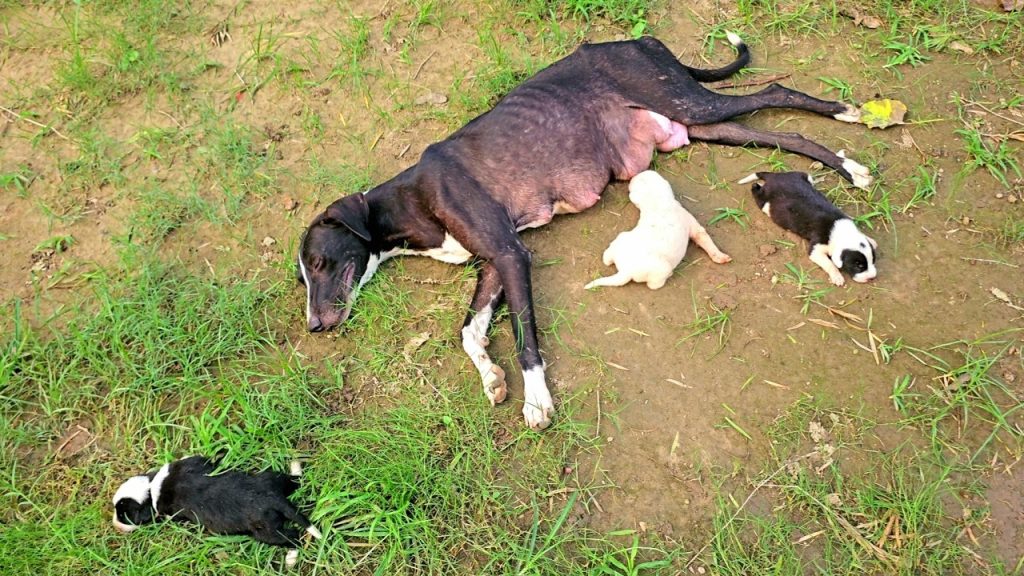
Now, with only three tiny babies left, a painfully thin mother dog was doing everything she could to protect them. Her body was exhausted, her strength was fading, and the ground beneath her offered little comfort. Yet even in her weakened condition, she refused to let strangers come near the little family she had struggled so hard to keep alive.
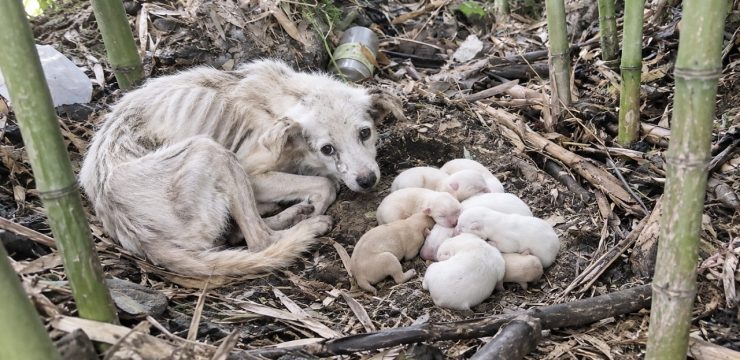
The black dog, with a white chest and white paws, was lying on bare dirt surrounded by patches of grass. Her ribs were clearly visible, and her body showed the strain of hunger and nursing. Close beside her were three puppies who depended entirely on her care. One had a soft cream-colored coat, while the other two were black and white. They were small, vulnerable, and still needed their mother for nearly everything.
There had once been five puppies. Two were already gone.
For a mother who had endured such a loss, protecting the remaining three had become an overwhelming responsibility. The little ones had no safe home, no comfortable bedding, and no dependable protection from the dangers of living outdoors. Their mother was their only source of nourishment and security, even though she had so little strength left to give.
When rescuers discovered the struggling family, they understood that helping them would require more than simply picking up the puppies and carrying them away. The mother was frightened of people, and her behavior reflected that fear. She watched every movement closely, placing herself between the rescuers and her babies whenever she felt uncertain.
She was not willing to trust anyone easily.
Her protectiveness might have seemed intimidating to someone who did not understand her circumstances. But this was a mother who had already experienced loss. With three surviving puppies depending on her, she had every reason to be cautious about unfamiliar hands reaching toward them.
The rescuers recognized that forcing the situation could make her even more afraid. Instead, they approached patiently, giving her the space she needed. They offered food and allowed her to become familiar with their presence without immediately trying to separate her from her puppies.
It was a gentle approach to a difficult situation. The mother desperately needed help, but accepting that help meant allowing strangers close to the most precious lives she had left.
Her physical condition made the need for rescue especially urgent. She was already malnourished and exhausted, yet nursing demanded energy that her weakened body could scarcely spare. Every puppy depended on her, and she continued caring for them despite the hardships of surviving outdoors.
Food alone could not solve everything this family faced. They needed protection, a safe environment, and veterinary attention. Above all, they needed to be rescued together.
The rescuers continued giving the mother opportunities to recognize that their intentions were peaceful. They did not rush to take her babies. They respected her hesitation and allowed trust to develop gradually.
Then something important began to change.
The mother became less guarded around the people trying to help her. Rather than continuing to keep the rescuers away, she eventually led them to her puppies.
For a dog who had been so protective, this was an extraordinary turning point. The same mother who had feared human contact was now allowing people to approach the babies she had been guarding so carefully.
No one could know exactly what she understood about the rescuers or what had changed in her mind. But her actions made one thing clear: she was finally willing to accept their help.
The rescuers were able to approach the three puppies, handle them carefully, and gather them safely. The cream-colored baby and the two black-and-white siblings would not have to remain exposed on the ground where their mother had struggled to care for them.
Just as importantly, their mother would not be left behind.
The rescue was never about taking the puppies away from her. It was about protecting the entire family and giving them a chance to remain together somewhere safer.
After everything she had endured, the mother did not need another separation. She needed relief from the constant responsibility of trying to keep her little ones alive without dependable food, shelter, or support.
The rescuers brought the mother and all three puppies away from their vulnerable outdoor surroundings. Their next important step was veterinary care, where the family could be examined after the difficulties of living as strays.
For the mother, whose thin body reflected the strain of malnutrition and nursing, professional attention was an essential part of her rescue. Her puppies also needed to be checked and cared for, with their health and immediate needs given proper consideration.
The veterinary visit was an important step toward a more secure future. Although their longer-term recovery was not yet known, the family was no longer facing its difficulties entirely alone.
And their journey did not end with medical attention.
The mother and her puppies were brought into a clean, sheltered living space with food and bedding. It was a remarkable contrast to the bare dirt where they had previously been found.
The difference was about far more than comfort.
Outdoors, the mother had been responsible for finding food while nursing three growing puppies. She had also faced the burden of guarding them in an environment that offered little security. Every unfamiliar approach had been another reason for caution.
Now, there was a protected place where the family could remain together.
Her puppies were still close to her, but the responsibility for their safety no longer rested entirely on her exhausted body. People were helping provide the necessities that had been so difficult to find before.
For an animal who had spent so much energy simply trying to survive, that change meant an opportunity for something wonderfully ordinary: rest.
The mother had not forgotten the two puppies she had lost, and nothing could undo that part of her experience. But the three little lives still beside her had been given a safer beginning than the one they had known outdoors.
Their future health and eventual permanent homes were not yet established. What mattered was the change already made possible through patience, careful rescue, veterinary attention, and a sheltered place to recover.
The exhausted mother no longer had to face every challenge by herself. Her remaining babies were together, protected, and receiving care.
There is something deeply moving about a frightened animal gradually allowing people to help. Trust cannot be demanded, especially from a mother whose first instinct is to protect her young. Sometimes it must be earned through quiet patience and the simple willingness to respect an animal's fear.
This mother's journey reminds us that compassion is not always expressed through dramatic gestures. Sometimes it means offering food without rushing closer. Sometimes it means waiting until a frightened dog feels safe enough to accept a helping hand. And sometimes the greatest gift is making sure a struggling family can stay together.
She had already endured the sorrow of losing two puppies. The rescuers could not change that loss, but they could help protect the three who remained.
For this weary mother, a second chance did not begin with anything grand. It began with understanding, patience, and people who refused to overlook her suffering.
At last, she had a sheltered place to rest, with her three precious puppies safely beside her. And after all she had been through, that simple peace was something beautiful.