Nobody laughed anymore.
The laughter that had filled the restaurant just moments before dissolved into something else entirely — something heavier, something that pressed against every chest in the room like a hand laid flat over a beating heart. The wealthy man sat rigid in his wheelchair, staring down at his own foot as though it had suddenly become a stranger to him. His breath came in short, fractured bursts, each one sharper than the last, while the young boy beside him kept one hand resting gently, almost tenderly, against the man’s leg.
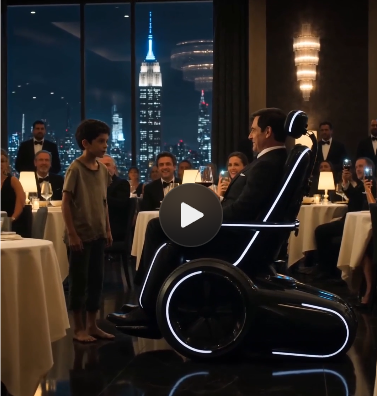
Across the table, the woman draped in diamonds slowly lowered her phone. The wine in her glass trembled, sending tiny ripples across the surface like something invisible had just walked through the room.
The man’s voice came out barely above a whisper.
“What are you?”
The boy raised his eyes to meet the man’s gaze, and for the first time, everyone in that elegant room truly saw him — not the torn clothing, not the dirt on his hands, not the poverty written plainly across his thin frame. They saw something else. Something that lived much deeper than any of that.
He was exhausted.
Not the kind of tired that sleep can fix. The kind that comes from walking through an entire lifetime of locked doors — doors that never opened, doors that had no handles on his side, doors behind which warm light glowed for everyone else but him. He had carried that weight all the way to this marble table, and somehow, impossibly, he was still standing.
“My mother said you would know me,” the boy said quietly, “when I touched your leg.”
The man’s face changed.
It wasn’t a gradual shift. It was the kind of change that happens when something buried deep finally breaks the surface — sudden, violent, and impossible to stop. A memory struck him so hard his hand slipped from the edge of the table. He gripped the armrest of his wheelchair instead, knuckles whitening.
Long before the money had become the whole of his identity, long before the wheelchair had defined his days, there had been an accident. A bad one. The kind that should have left him with nothing. But in the wreckage of that time, a woman had appeared — quiet, steady, with eyes that held a strange and unexplainable calm. She had done something that no doctor could explain. She had given him back something precious, something he had been certain was gone forever.
And he had been afraid of her for it.
So he had paid her to go away. He had handed her money like it was an answer, like it could settle a debt that had no number. He had told himself it was generous. He had never truly believed that.
His lips began to tremble.
“What was her name?”
The boy reached into the pocket of his worn, torn jacket and pulled out something small and folded — a hospital bracelet, the kind they put on your wrist when they don’t yet know if you’re going to make it. He placed it on the table between them.
The man looked down at the name printed on the faded band.
Elena.
The color left his face entirely.
The boy’s voice, steady until this moment, finally broke.
“She died last night.”
The restaurant disappeared around the man. The clinking glasses, the murmured conversations, the soft music playing somewhere beyond the walls — all of it fell away. There was only this boy standing before him, this child with exhausted eyes and a broken voice, holding the last piece of a woman who had once given him everything and asked for nothing in return.
The boy looked at the wheelchair. Then he looked at the man’s face.
“She told me not to hate you,” he said, his voice barely holding together. “She said if I ever found you, I should give back what she once gave you.”
The man felt something move through him — not pain exactly, though it was close. Something older than pain. Something like the memory of who he used to be before money made him forget.
His legs shook.
And then, slowly, with every person in that room holding their breath — he stood.
Gasps broke through the silence like stones through glass. Someone at a nearby table pressed a hand to their mouth. The woman in diamonds forgot entirely about her phone.
But the boy stepped back.
There were tears in his tired eyes, but he didn’t reach out. He didn’t move toward the man’s outstretched hand.
He shook his head gently.
“I didn’t come here for your money,” he said. “I didn’t come for any of it.”
He reached out one last time and placed the hospital bracelet carefully on the cool marble surface of the table. He smoothed it flat with his fingertips, like he was tucking someone in.
“I came,” he whispered, “so that you could walk to her grave yourself.”
There are moments in life that strip everything unnecessary away — the titles, the bank accounts, the armor we wear to protect ourselves from feeling too much. This was one of those moments. A boy who had every reason to arrive with anger came instead with grace. A man who had spent years building walls found himself standing — truly standing — for the first time in longer than he could remember.
Not because of money. Not because of power.
Because a dying woman had raised her son to understand something that most people spend their whole lives trying to learn: that what we give in love, we never truly lose. And that sometimes the greatest gift we can offer the person who hurt us most is simply the chance to find their way back to who they were supposed to be.
Elena knew that. She taught it to her son. And her son, exhausted and grieving and barely holding himself together, walked through every locked door to deliver it.