The grand ballroom of the Beaumont Estate was a swirling kaleidoscope of silk, diamonds, and low conversations. Crystal chandeliers hung from the ceilings, casting an amber glow over the wealthy elite.
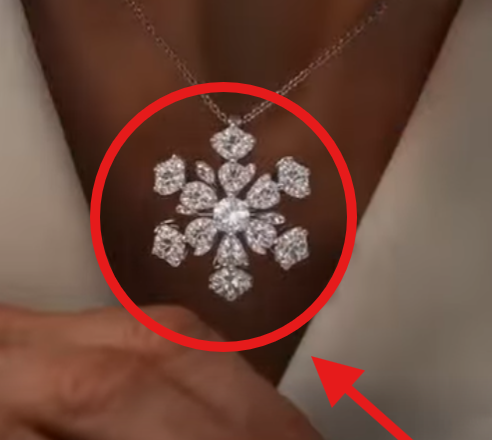
Waiters glided through the crowd, carrying silver trays laden with champagne flutes. Among them was Rosie, a twenty-two-year-old working the shift to pay her rent. Her feet ached, and her wrists strained under the weight of the tray, but she kept a polite smile fixed on her face. To the guests, she was just part of the background, a fixture of the staff. But hidden beneath the collar of her apron, resting right against her collarbone, was something that connected her to a completely different world. It was an antique silver pendant, housing a deep sapphire surrounded by intricate filigree. It was her only inheritance, her prized possession, and the thread tying her to the memory of her late mother.
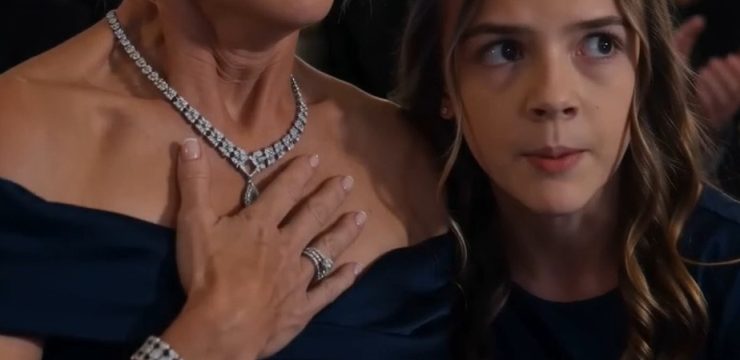
Rosie adjusted her grip on the tray, navigating past a group of laughing businessmen. As she stepped near the center of the room, an older woman dressed in a magnificent sapphire gown turned around. The woman was the epitome of old-money elegance, her silver hair perfectly coiffed, a string of pearls gracing her neck. But the moment her eyes swept over Rosie, she froze. Her laughter died instantly. Her gaze locked onto Rosie’s chest, specifically onto the small glint of silver peeking out from her apron.
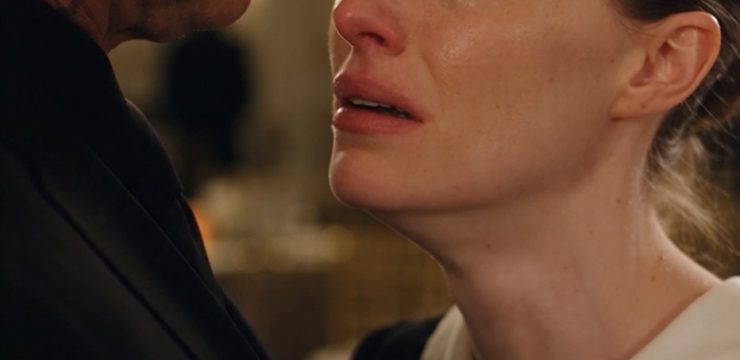
Suddenly, the ballroom seemed to fade into a muffled distance. The clinking of crystal, the murmurs of society, the music playing in the background—all of it vanished, replaced by an oppressive silence. Rosie stopped in her tracks, her heart hammering against her ribs as she noticed the stare of the matriarch before her. The older woman took a shaky step forward, her eyes wide with disbelief, shock, and sorrow. Tears began to well in her eyes, falling onto the front of her expensive sapphire gown.
Rosie’s fingers locked around the pendant so tightly it hurt. She felt exposed, terrified that she had somehow violated a rule or done something wrong. The ballroom had gone silent around them. No more cutlery clattering against plates. No more empty chatter. Just Rosie’s shaky breathing and the older woman’s silent tears falling onto the front of her sapphire gown.
“My mother gave it to me,” Rosie whispered, her voice barely audible over the roaring pulse in her ears.
The woman’s face collapsed, her sophisticated composure shattering into pieces. “Your mother?” she echoed softly, her voice cracking with deep pain.
Rosie nodded slowly, still deeply confused, still gripped by sudden fear. “She died last winter,” she added softly, her throat tightening at the raw memory of her mother’s final days.
A sound left the older woman’s throat—small, broken, almost like she had been hit physically by an invisible blow. She stumbled back half a step. “What was her name?” she pleaded, her eyes searching Rosie’s face with intense desperation.
Rosie hesitated for a moment, looking around at the sea of curious faces staring at them. Then, she looked back at the weeping woman and said it softly. “Elena.”
The woman covered her mouth with both hands, letting out a stifled sob. The room tilted for her. For years, everyone in her social circle had told her Elena ran away. They told her that Elena didn’t want the family, that she chose poverty over them and disappeared without a trace. But now, standing right in front of her, was a trembling waitress with her daughter’s exact eyes, wearing the necklace she had fastened around Elena’s neck on her eighteenth birthday.
Rosie looked at her carefully now, her initial fear giving way to a strange realization. She looked at the woman’s tears, at the way this stranger was staring at her face like she was reading an old prayer.
“My mom…” Rosie whispered softly, her own tears breaking through, “used to say this necklace belonged to the women in her family.”
The older woman nodded through cascading tears, her shoulders shaking. “It did,” she choked out.
Rosie’s breath caught in her throat. The pieces of a lifelong puzzle were suddenly crashing together. “She told me if anyone ever recognized it…” Her voice shook. “I should ask them why they never came for us.”
The older woman broke completely. “I did,” she cried out in anguish. “I searched for her for years. Your grandfather cut her off completely. He lied to me. He told me she sold it. He told me she never wanted to be found, that she hated us.”
Rosie’s eyes filled instantly with tears. All her life, her mother had spoken about a rich family that abandoned her when she needed them most. It was a family Rosie had learned to hate without ever meeting them. But the woman standing before her didn’t look cruel. She looked ruined.
The older woman reached slowly into her evening clutch and pulled out an old photograph, protected by a plastic sleeve. A younger version of herself stood beside a smiling girl wearing the exact same necklace. Elena. Rosie’s mother.
Rosie stared at the photo, then at the woman, then back at the photo again. Her lips parted. “You’re…”
The woman nodded, crying openly now. “I’m your grandmother.”
Rosie’s tray slipped from her hands, hitting the marble floor with a dull sound. She didn’t even look down. All she could see was her mother’s face in that picture. Her mother’s necklace in her own trembling hand. And the woman who had arrived too late for one life—but maybe not too late for hers.
Then Rosie pulled one more thing from her apron pocket. A folded note, worn soft from being opened too many times. “My mother told me,” she said through tears, “to give this to the woman who cried when she saw the necklace.”
The grandmother took it with shaking fingers. Inside, in Elena’s handwriting, was one line: If Rosie finds you, please love her faster than life loved me.