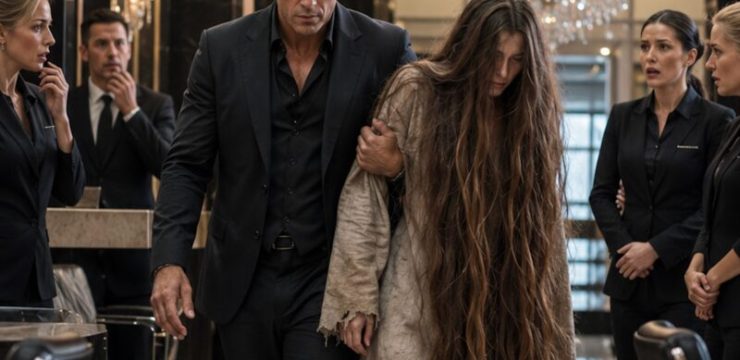
The woman standing in the hotel doorway stopped smiling the moment her eyes landed on the locket around the little girl’s neck.
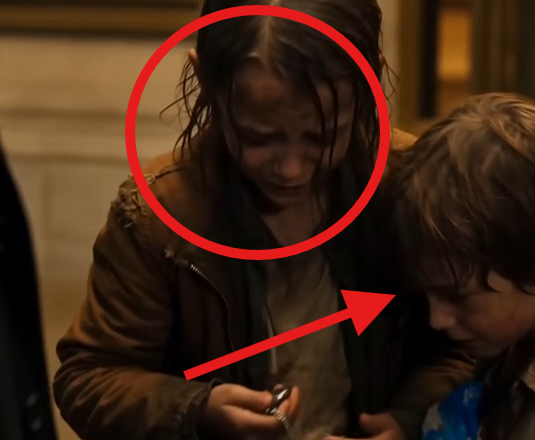
The man noticed.
So did the child.
For a brief, suspended moment, not one of them made a sound. Rain fell steadily against the hotel awning, quiet and indifferent, while the little boy’s bloodied knee left faint traces on the wet pavement below.
When the man finally spoke, his voice barely had the strength to carry.
“Clara… did you know about this?”
The woman in the doorway — Clara — tightened her grip on her handbag until her knuckles went pale.
“I can explain,” she said.
The girl instinctively pulled her younger brother closer to her side.
Those three words frightened her more than the storm outside. She had heard a lot of things in her short, difficult life. But an adult scrambling to explain themselves before anyone had even asked a question — that kind of fear was something a child recognized in her bones.
The man turned to face Clara fully, and something in his expression seemed to come undone, like a carefully held structure finally giving way under too much weight.
“You told me Mia lost the baby.”
The girl blinked.
Mia.
Her mother’s name.
Clara looked away from him, toward the wall, toward anything that wasn’t his face.
“She was going to ruin you,” Clara said quietly.
The words fell into the space between them like shattered glass — sharp, irreversible, impossible to gather back up.
The man stared at her for a long moment.
“She was carrying my children.”
Clara’s eyes filled, but what swam in them wasn’t remorse. It was something closer to panic, the kind that comes not from guilt but from being caught.
“Your father made the decision,” she said, her voice barely above a whisper now. “I only delivered the message.”
The little girl’s lips began to tremble.
“My mom waited outside this hotel every winter,” she said, her voice so small against the rain.
The man turned back to her, something shifting in his chest.
“She came here? She actually came here?”
The girl nodded, tears sliding freely down her face now.
“She said maybe one day you’d walk out those doors and remember her. She said she just wanted you to see us. Even once.”
The little boy reached into his worn plastic bag — the kind children carry when suitcases aren’t something their family can afford — and pulled out a folded envelope. It was soft from rain and from years of being carefully carried from place to place, treated like something sacred even by small hands.
“She told us to give you this,” he said quietly. “She said to give it to you if she couldn’t do it herself.”
The man took the envelope with hands that could not stop shaking.
Inside was a letter, written in a steady hand that had clearly taken great care with every word.
If they told you I disappeared, they lied. I kept the twins as long as I could. I never hated you. I only hated that they made our children beg outside the life that should have known their names.
The sound that left the man’s throat was something between a breath and a sob, the kind of grief that doesn’t announce itself cleanly but ruptures quietly from somewhere too deep to name.
“Where is she now?” he asked, though something in his voice already seemed to sense the answer.
The girl looked down at the wet pavement.
“She stopped waking up last week.”
The hotel lights blurred in his vision.
The little boy, still so young, still so heartbreakingly earnest, whispered the last thing his mother had asked him to say.
“She said not to be mad at you. She said she tried.”
That was the moment that broke him completely.
He dropped to his knees on the wet pavement — right there, in front of the doorman, in front of the well-dressed guests moving through the lobby, in front of the woman who had helped quietly dismantle his life — and in front of two children who had spent years too afraid to believe that anyone would ever truly choose them.
“I’m not mad at her,” he said, his voice fractured but certain. “I want her to know I’m not mad at her.”
He opened his arms toward the children, then made himself stop.
He let them choose.
The boy moved first. Small, cautious steps, and then none at all — just the sudden collapse of a child into a father’s arms. The girl followed a breath later, and the sound they made was not pretty. It was the raw, unguarded crying of children who have spent too long simply surviving — who have never had the luxury of breaking down because there was always one more day to get through, one more night to endure, one more winter outside a hotel that didn’t know their names.
Clara stepped back, retreating slowly toward the hotel’s glass doors.
The man looked up at her once.
He didn’t raise his voice. He didn’t threaten. There was no rage left in his face, only grief that had gone very, very cold — the kind that is somehow more final than anger.
“Call my lawyer,” he said.
Then he pulled his children closer, wrapped his arms around their shivering frames, and pressed his lips to their wet hair.
“You’re not chasing cars anymore,” he whispered. “You’re home.”
Some secrets eventually find their way to the surface no matter how many years they’re buried or how many powerful people work to keep them down. And sometimes, the children who were never supposed to be found are the ones who carry the truth home — folded inside a worn envelope, soft from the rain, carried in small hands that never once let go.