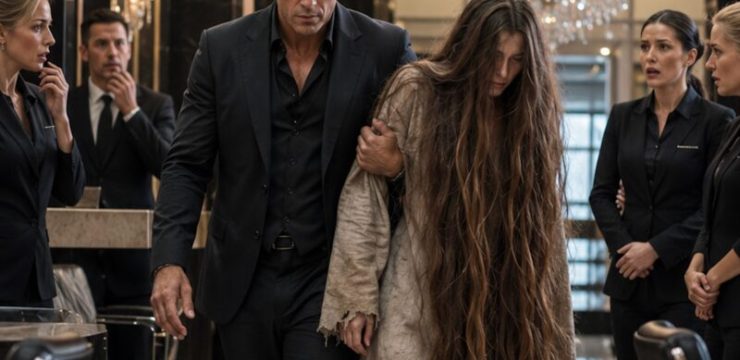
No one in that hallway moved.
The papers from the lawyer’s folder had scattered across the marble floor like something long buried had finally broken through the surface. Nobody bent down to pick them up. Nobody could.
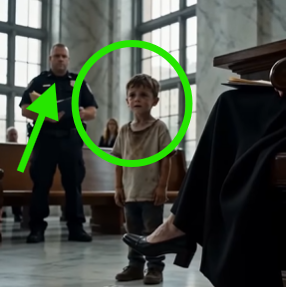
The judge stood frozen, her eyes locked on the small child standing before her. He couldn’t have been older than seven. His shoes were worn at the toes. His jacket was two sizes too big. And clutched against his chest, like a lifeline, was a cracked plastic toy car with a dent along the side where something small and metal had been carefully hidden inside.
She had seen a lot in her years on the bench. She had watched grown men crumble under cross-examination. She had delivered verdicts that shook entire families to their foundations. She had sat across from grief so raw it seemed to bleed right through the courtroom walls.
But nothing had prepared her for this.
“The man I freed?” she repeated, her voice barely above a whisper.
The boy nodded. His eyes were wet, his chin trembling, but he wasn’t making a sound. It was the kind of crying that only happens when a child has been holding something unbearable for far too long — when the weight of adult secrets has been pressing down on small shoulders that were never built to carry them.
“My mom said you didn’t know,” he whispered. “She said they lied to you.”
The judge’s fingers tightened slowly around the key he had just placed in her palm. It was old. Worn smooth at the edges. The kind of key that opens something that was never meant to be opened again.
The lawyer cleared his throat. He was the first one to find his voice, which said something about the kind of man he was.
“This is absurd,” he said. “The child has clearly been coached.”
But the confidence was gone. You could hear it — the way his words came out thinner than usual, stretched too tight, like fabric about to tear. The other people in that hallway heard it too. You could see it on their faces.
The judge turned her gaze toward him. Slowly. Deliberately.
“Coached by who?” she asked.
The boy wiped his cheek with the back of his hand. He held the toy car closer.
“My mom worked here,” he said quietly. “At night. In the records room.”
The judge went very still.
“She found a box,” the boy continued, his voice steady in that heartbreaking way only children can manage when they’ve rehearsed something painful until it no longer makes them fall apart. “She said it had proof. She said if anything ever happened to her, I had to bring you the key.”
The hallway seemed to drop ten degrees.
The security guard who had been standing near the far wall took a step forward — not toward the boy, but toward the lawyer. Something had shifted. Everyone in that corridor could feel it, even if none of them could have named exactly what it was.
The judge opened the case file she had been holding. She turned to the page she had reviewed dozens of times before. And there it was — something she had glanced over without understanding. A small symbol. An evidence notation that had been marked as cleared. A sealed storage reference that, according to every record she had ever been shown, no longer existed.
But the key in her hand said otherwise.
The boy’s breath came out uneven.
“She hid the key inside my toy,” he said. “She told me he would try to find it first.”
The judge’s eyes moved to the lawyer.
He looked like a man watching the floor give way beneath him. Sweat had appeared at his temple. The confident posture was gone. The smug certainty he had carried into every room for years had simply vanished, replaced by something closer to fear.
The judge’s voice dropped low and quiet — the kind of quiet that is more powerful than shouting.
“Where is his mother?”
The boy’s composure finally broke.
The tears came harder now, the way they do when a question touches the wound directly. He held onto that cracked little toy car with both hands, squeezing it like it was the only solid thing left in the world.
“She’s gone,” he said, his voice barely making it out. “She told me to run if they ever came.”
The judge closed her eyes for just a moment — one brief, pained second. When she opened them again, something had changed in her expression. The shock was still there, but underneath it, something sharper had taken its place.
She was furious.
Not the loud, theatrical kind of fury. The deep kind. The kind that moves slowly and doesn’t stop.
She looked at the security guard. Her voice was calm and absolute.
“Do not let him leave.”
The lawyer stepped back. “You cannot do this.”
The judge turned to face him fully. She didn’t raise her voice. She didn’t need to.
“Oh, I can.”
Then she did something that made everyone in that hallway exhale at once. She knelt down, right there on the courthouse floor — her robe spreading out across the cold marble — and she looked the boy in the eyes.
Her voice, when she spoke to him, was soft.
“Your mother was very brave.”
The boy’s mouth trembled. His whole face trembled.
“She said you would help me,” he whispered. “She said if I found you, and if I told you the truth, you would fix it.”
The judge looked at the key resting in her palm. She looked at the case file. She looked back at the child kneeling in front of her who had carried a secret across God knows how many miles and how many sleepless nights to place it in her hands.
“She was right,” the judge said.
Behind her, the security guard moved. The lawyer tried to step away. He didn’t get far.
And as the scattered papers shifted quietly across the floor, and every person in that hallway held their breath, the judge rose to her full height and spoke four words that made the lawyer’s face fall completely apart.
“Open the evidence box.”