The morning at the naval base began the way it always did. A thick gray fog rolled in low across the concrete pathways, carrying with it the familiar bite of salt water and engine fuel. Personnel moved through their routines with practiced efficiency, eyes forward, minds focused, and no one paid much attention to the woman pushing a rattling cart of tools along the service corridor.
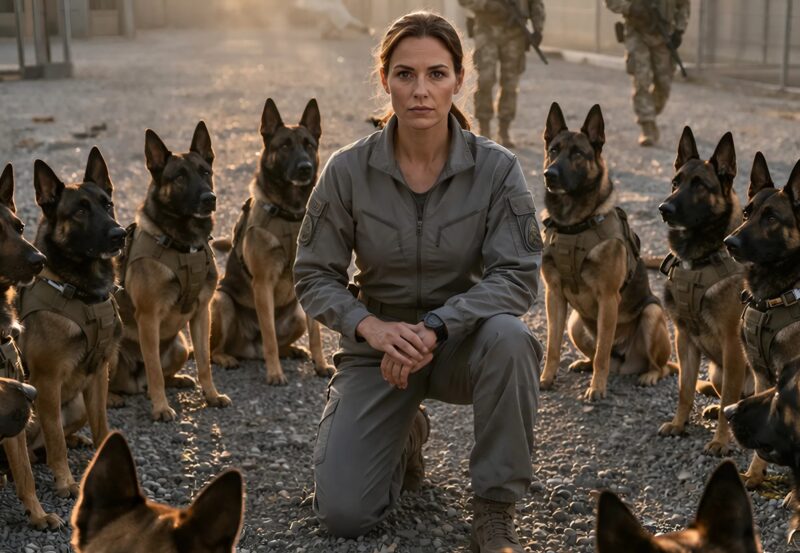
She wore a faded work jumpsuit. A simple name patch on her chest read “R. Collins.” Nothing about her appearance demanded notice. There were dozens of maintenance workers moving through the base on any given morning, and she was, by every visible measure, just one of them.
But someone noticed her anyway.
The officer who stopped her was well known throughout the base — not for warmth, not for fairness, but for his absolute insistence on rigid obedience and his sharp instinct for making examples out of people. He spotted R. Collins near a service passage, and something about the way she moved — unhurried, unafraid — seemed to catch in him like a splinter.
He found his reason quickly. A slight delay at the gate. A response that didn’t follow the exact phrasing of protocol. A tone that was calm and measured but carried no trembling in it, no visible submission. That was all it took.
The first remark came loudly, deliberately in front of others. Then a second, sharper than the first. The woman did not flinch. She did not lower her eyes or rush to apologize or smooth things over with nervous words. She answered clearly, quietly, with the kind of steadiness that made the air in the area feel suddenly different.
People nearby slowed without meaning to. The situation had shifted from routine to something else entirely, and everyone present could feel it.
The officer stepped closer. His jaw tightened. His voice dropped into that particular register that career military people recognize immediately — the one that means things are about to escalate beyond a simple reprimand.
He raised his hand in a sharp signal.
Within seconds, fifteen service dogs were brought onto the grounds. Belgian Malinois in full tactical harnesses — powerful, disciplined animals trained for high-stakes work — moved across the gravel in tight formation. Their handlers positioned them with precision. The leashes pulled taut. Every dog’s gaze locked onto the woman standing at the center of the gathering crowd.
The circle began to tighten.
Bystanders stepped back. Someone looked away. The tension in that open space became something almost physical, something you could feel pressing against your chest.
The officer’s voice cut through the air.
“Attack.”
Silence.
Not a single dog moved. Not one leash jerked forward. Not one animal lowered into an aggressive stance. There was no growl, no surge, no response to the command at all.
The officer’s expression darkened.
“Attack!”
Still nothing. The seconds stretched long and strange. And then, in that suspended moment, something happened that nobody standing there had any framework to explain.
All fifteen dogs turned at exactly the same time.
The movement was so synchronized it looked almost choreographed. Their bodies shifted, reformed, and settled into a perfect circle around the woman — not to corner her, not to threaten her, but to surround her in the oldest and most unmistakable way that animals know how to communicate. Ears raised. Bodies alert. But every line of their posture said the same thing clearly.
They were protecting her.
No one in the crowd moved. Even sound seemed to go still.
The officer took a step forward, ready to reassert control, to force the moment back into the shape he intended.
The dogs were no longer looking at him.
One approached her first, moving slowly, deliberately. Then another. Then a third. R. Collins lowered herself to one knee on the gravel, her hands — calloused hands, working hands, hands that knew tools and hard labor — reaching out without hesitation.
The first dog pressed its head against her gently. She touched its fur without a word. Another came close and rested its muzzle on her shoulder. A third sat beside her. A fourth nudged her palm softly with its nose.
The silence had changed completely. It wasn’t threatening anymore. It was something deeper than that — something that settled over the crowd the way certain moments do when you realize you are watching something you will not forget.
And slowly, the pieces came together for those who were paying close attention.
These dogs had known those hands before. They had learned to read those gestures, to respond to that voice, to trust those movements during long and demanding training sessions. R. Collins had not always been a maintenance worker pushing a cart through service corridors. There had been another chapter — one of active duty, of specialized training work with military animals, of guiding these same dogs through difficult missions and bringing them back safely.
Then came the kind of life changes that happen quietly and without announcement. Maternity leave. A shift away from high-risk assignments. A transition into work that was necessary but invisible, the kind that keeps a base running but earns no recognition.
Her name came off the active duty lists. She became unremarkable by design.
But the dogs had not updated their records the way the paperwork had. They had not reclassified her. In whatever deep and wordless way that trained animals carry their trust, they had held onto exactly who she was to them.
The officer stood motionless. No further command came. Words, rank, and authority had run up against something they couldn’t move — fifteen animals forming a living circle of loyalty around a woman the system had long since stopped seeing.
There are things that cannot be ordered into existence, and cannot be commanded away. Loyalty is one of them.
That morning at the base, it became undeniably clear that some bonds hold long after the paperwork says otherwise — and that sometimes, the most powerful statement in a room is made without a single word spoken.