The sound came first: a heavy boot, a dull thud, and a dog’s body slamming against the base of a diner booth.
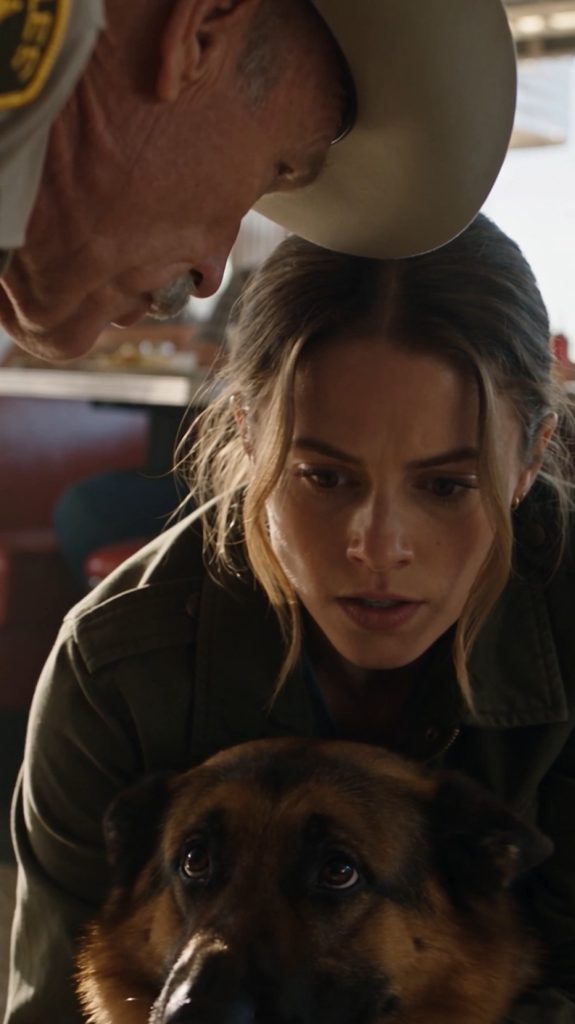
Then silence. The kind that makes grown men stare into their coffee and pretend they saw nothing.
The woman holding the leash didn’t flinch. She simply rose to her feet, and something in her stillness should have warned the man in uniform to step back.
He didn’t.
Brianna Cole had spent twelve years in Naval Special Warfare. She knew danger by its quiet: a room going hushed, strangers stopping mid-sentence, people learning to keep their distance from a single name.
In Ashford Ridge, Colorado, that name was Sheriff Clayton Rusk.
She hadn’t come here for trouble. She’d come for a cabin outside town with pine trees pressed against the windows, for cold mountain air, for mornings that didn’t begin with alarms or shouted coordinates.
She’d come with Kodiak.
The retired working dog carried a faint scar near one ear and a discipline no retirement could erase. He watched doorways. He never panicked. Brianna used to joke that his instincts were better than most people’s.
Two weeks in, she stopped joking.
A patrol car idled outside the same shops at strange hours. Conversations died when a uniform walked in. One night, a bartender leaned close to tell her something, then spotted a deputy through the window and swallowed the words whole.
Nobody complained about the sheriff. Nobody even said his name for long.
Brianna noticed. And she chose, deliberately, to stay out of it.
Until Sunday morning at Miller’s Diner.
The air smelled of bacon grease and coffee scorched on the warmer. She’d taken the corner booth, back to the wall, Kodiak folded beneath the table, leash looped neatly around her hand.
Not fear. Training.
“You’re new around here,” the waitress said, setting down a glass of water.
“Just passing through.”
The bell over the door jingled, and the whole room changed.
He didn’t need to raise his voice. He was broad-shouldered and gray at the temples. The waitress’s smile vanished. A couple at the counter dropped their eyes to their plates.
Under the table, Kodiak lifted his head. The leash tightened by less than an inch.
The sheriff saw it.
“You’re in my town now,” he said. “Keep that mutt in line, or I will.”
Brianna said nothing. His boots stopped beside her booth.
“He’s not bothering anyone.”
“That wasn’t the question.”
“It wasn’t a question.”
Rusk leaned in close, coffee and wintergreen on his breath. “People who come here thinking they know better learn fast.”
Her fingers rested on Kodiak’s harness. Beneath the fabric, hidden in his fur, a tiny camera was already recording.
She’d installed it weeks ago, not for this. It was for the doors left open, the shadows near the property line, the car that passed her cabin twice in one night.
Kodiak shifted, and his shoulder barely grazed the sheriff’s boot.
“Did you see that?” Rusk asked the room.
No one answered.
And then the kick.
Now Brianna stood, leash still in hand, face unreadable. Kodiak was breathing hard at her feet, eyes locked on hers. Waiting.
Something inside her had gone cold and exact. It was the part of her that had survived twelve years of war by never moving a second too soon.
Rusk looked satisfied. “Control your animal.”
She met his eyes.
“Kick my dog again,” she said softly, “and your whole department goes down on camera.”
The smile slid off his face.
He didn’t know about the harness. He didn’t know the footage was transmitting. He didn’t know that somewhere beyond Ashford Ridge, someone had just watched the first thirty seconds.
He lifted his boot again.
Brianna’s grip closed on the leash.
And behind him, the diner door swung open.
“Sheriff Rusk. Step away from that dog.”
He turned. A woman stood in the doorway, a federal badge raised in her hand.
But she wasn’t looking at the sheriff. She was staring straight at Kodiak’s harness.
“We need to talk,” she said, “about what that camera just recorded.”
Nobody in that diner was ready for what that footage was about to set in motion. 👇
The federal agent’s name was Dana Mercer. She was compact and precise, the kind of woman who moved like she already knew the floor plan of every room she entered. Her badge said Department of Justice. Her eyes said she had been waiting for this moment for a long time.
Rusk’s hand moved toward his belt.
“I wouldn’t,” Mercer said. Quiet. Flat. Final.
The diner held its breath. A fork trembled against a plate somewhere near the window. The refrigerator hummed behind the counter, indifferent to everything.
Rusk didn’t draw. But he didn’t step back either. He stood between the booth and the door with his jaw set and his eyes doing the calculation that men like him always did when the ground shifted beneath them — searching for the fastest way to reframe, redirect, regain control.
“You’ve got nothing,” he said.
Mercer tilted her head just slightly. “Forty-one seconds of footage, Sheriff. Your boot. His ribs. Your badge clearly visible in frame.” She paused. “And that’s just today.”
Brianna hadn’t moved. She was crouched beside Kodiak now, one hand resting against his side, feeling for the rhythm of his breathing. It was shallow. Faster than it should have been. She pressed her palm flat and felt him lean into her touch, that small unconscious trust that nearly broke something open in her chest.
She kept her face still.
Later. She could feel it later.
Rusk looked around the diner. A reflex, the powerful man’s instinct to find his audience, to remind the room who they belonged to. But the waitress had taken two steps backward toward the kitchen. The couple at the counter sat frozen, staring at the table. The cook had appeared in the serving window, dish towel in hand, watching.
Nobody looked away.
For the first time, nobody looked away from Clayton Rusk.
He felt it. She could see it in the almost imperceptible shift of his shoulders. The weight of being seen.
“Whatever she told you,” he started, nodding toward Brianna.
“She hasn’t told me anything yet,” Mercer said. “I’ve been building this case for fourteen months. She just handed me the last piece.” She took one step into the room. “Clayton Rusk, you are under arrest for federal civil rights violations, obstruction of justice, and abuse of authority. There are four more agents outside. I suggest you make this easy.”
The silence that followed was the loudest thing Brianna had ever heard.
Rusk didn’t explode. She had expected him to. Men who ruled through fear usually did when the fear ran out — they reached for rage because it was the only other thing they knew. But instead he went very still, and for just a second, standing in the warm morning light of Miller’s Diner, he looked exactly like what he was.
An old man whose borrowed time had finally expired.
“This isn’t over,” he said.
“It is,” Mercer told him simply.
The door opened behind her. Two agents in plain clothes stepped inside. Rusk’s hands were cuffed without a struggle, without a word. He walked out through the diner door and the bell above it jingled once, cheerful and oblivious, the same as it always had.
The room stayed quiet for a long moment after he was gone.
Then the waitress — the one who had offered Brianna that cautious smile at the beginning of everything — sat down on a stool behind the counter and covered her mouth with both hands. Her shoulders shook once. Then she pressed her lips together, lifted her chin, and breathed.
The cook set down his dish towel.
The couple at the counter looked at each other in a way that suggested they had not looked at each other like that, openly and without fear, in a very long time.
Mercer crossed to the booth and crouched to Brianna’s level.
“How is he?”
“He needs a vet.”
“There’s one two blocks over. I already called ahead.” Mercer held her gaze. “How are you?”
Brianna looked down at Kodiak. He was watching her, steady and patient, waiting for her signal the way he always had. The scar near his ear caught the morning light.
“I’ve been better,” she said. “I’ve been worse.”
Mercer nodded, recognizing the specific grammar of someone who had learned to hold damage quietly. “I know. I read your file.”
That pulled Brianna’s eyes up. “You read my file.”
“Fourteen months ago, when your name came up in connection with a property inquiry out here. We flagged it because the property sits on land Rusk had been trying to acquire through a shell company for three years.” Mercer sat down across from her in the booth, unhurried now, the urgency of the arrest already settling into something more deliberate. “He’s been forcing people out. Businesses, families, anyone with land he wanted. Using the department to do it. Code violations that didn’t exist. Traffic stops that went wrong. Noise complaints that turned into something else.” She folded her hands on the table. “People left. Nobody talked. We had patterns and no proof.”
“Until the camera.”
“Until the camera.”
Brianna was quiet for a moment. Outside, through the window, she could see the patrol car and the two federal vehicles parked behind it. Rusk was in the back of one of them. She couldn’t see his face.
“The bartender,” she said. “The night he almost told me something.”
“Marcus Webb. He’s been cooperating with us for six months. Too afraid to testify alone. He needed someone else to move first.” Mercer paused. “You moving first changed everything.”
Brianna absorbed that. The weight of it was strange — not heroic, just heavy. The way the right thing so often was.
She looked down at Kodiak again.
He had moved his head into her lap. She hadn’t noticed him doing it.
The vet’s name was Dr. Elaine Cho, and she had the gentle efficiency of someone who understood that the animal on her table was not just an animal to the person standing beside it. She worked quickly, spoke quietly, and kept her hands calm.
“Two bruised ribs,” she said. “Nothing broken. He’s going to be sore for a week, maybe two. Rest, limited activity, and this.” She placed a small bottle on the counter. “Anti-inflammatory. Once a day with food.”
Brianna nodded.
“He’s in remarkable condition otherwise,” Elaine added, running one hand along Kodiak’s back. “Whoever trained this dog did exceptional work.”
“A lot of people did,” Brianna said.
She said it simply, but the doctor must have heard something in it, because she looked up briefly with an expression that understood more than it said, and then quietly returned to her notes.
In the parking lot afterward, Brianna sat in the truck with Kodiak’s head in her lap and the window cracked open to let in the cold mountain air. She could hear pine trees. Wind moving through them in long, slow waves.
Her phone rang. She looked at the screen.
It was the number she hadn’t called in eight months. Her brother, Danny, three time zones away, who had never quite understood why she’d needed so much distance and had tried anyway to leave the door open.
She answered.
“Hey,” she said.
A pause. Then: “Hey.” His voice was careful, the way it always got when he was trying not to scare her off. “I saw something online. Something about a sheriff in Colorado and a dog and a federal arrest. There was a name in the article.”
“Yeah.”
“Bri.” Another pause. Longer. “Are you okay?”
She looked out the windshield at the mountains, blue and enormous in the late morning light. Kodiak breathed slowly against her legs.
“I think I might be,” she said. “That’s the strange part. I think I actually might be.”
She heard him exhale. The sound of a man setting down something he’d been carrying for a long time.
“Can I come visit?” he asked. “Not right away. Whenever you’re ready. I just—” He stopped. Tried again. “I just want to see you.”
“Yeah,” she said. “Yeah, Danny. You can come.”
The case moved quickly after that, the way federal cases did when the evidence was clean and the witnesses were finally unafraid. Marcus Webb testified first. Then the family who had lost their hardware store to a fire three years ago that the insurance company had ruled suspicious. Then the deputy who had resigned eleven months earlier and driven four states away and spent those eleven months rehearsing what he would say if anyone ever gave him the right room to say it in.
They gave him the room.
Rusk’s bail was denied. His department was placed under federal oversight. The town of Ashford Ridge held a meeting in the gymnasium of the elementary school that went four hours long and felt, by every account, like the first full breath a room of people had taken together in years.
Brianna didn’t go to the meeting.
She stayed at the cabin with Kodiak and a pot of coffee and the particular quiet of a place that felt, for the first time, entirely safe.
Dana Mercer came by the evening after the meeting, unannounced, carrying two paper cups from the gas station down the road.
“It was standing room only,” she said, handing one cup to Brianna through the cabin doorway.
“I heard.”
“Marcus Webb spoke for twenty minutes. The whole room cried.” Mercer leaned against the porch railing. “He asked about you.”
“What did you tell him?”
“That you were here. That you were fine.” She paused. “That you didn’t need anything from anyone right now, but that you wouldn’t be hard to find if someone wanted to say thank you.”
Brianna wrapped both hands around the cup. The coffee was terrible. She drank it anyway.
“There’s something else,” Mercer said.
Her tone had shifted just slightly. Brianna looked at her.
“We pulled the full record on the shell company Rusk was using to acquire the land.” Mercer turned the cup slowly in her hands. “The cabin you bought. The deed. We traced the full chain.” She met Brianna’s eyes. “The original owner was a woman named Helen Foss. She sold it in 2019 for significantly below market value, under what we now know was coordinated pressure from Rusk’s office.” A pause. “Helen Foss was seventy-three years old. She’d lived in that cabin for forty years. She died eight months after the sale. Her daughter filed a civil complaint that went nowhere.” Mercer reached into her jacket. She set a folded piece of paper on the porch railing. “Her daughter’s name is Catherine. She lives in Durango. She wasn’t asking for the cabin back. She just wanted someone to know what her mother went through.”
Brianna looked at the paper but didn’t pick it up.
“Why are you telling me this?”
“Because Catherine asked me to. She looked up who bought the cabin. Read the news. And she wanted you to know—” Mercer’s voice was steady, but something in it had gone careful. “She said her mother used to say that house needed someone strong in it. Someone who wouldn’t let it be afraid.” She nodded once, quietly. “Catherine said she thinks her mother would have liked you.”
The wind moved through the pines.
Kodiak lifted his head from the doorway and looked out at the darkening treeline, then rested his chin back on his paws.
Brianna picked up the piece of paper.
She held it for a long time.
A week later she drove to Durango. She brought a photograph she had taken from the porch — the mountain light hitting the tree line at the exact angle that made the whole world look like it was made of something worth protecting. She didn’t know why she brought it. She just knew she wanted Catherine Foss to see what the cabin looked like when it wasn’t afraid anymore.
They sat at Catherine’s kitchen table for three hours.
Catherine was sixty-one and had her mother’s eyes, or so she said, though Brianna had no way to know that. She talked about Helen the way people talked about someone who had been the fixed point around which everything else orbited. Slow Sunday mornings. Bread on the counter. The specific way she laughed when something genuinely surprised her.
Brianna listened. She was good at listening.
At the end, Catherine held the photograph for a long time.
“She planted those three trees on the right side,” she said. “The tall ones.”
Brianna thought of the trees she’d been looking at every morning for two months, the ones the light hit first.
She hadn’t known.
She didn’t say anything. There wasn’t anything to say that would have been large enough. She just sat with it, the way you sit with the things that crack you open gently, not violently, the things that make you understand why you ended up somewhere you didn’t plan to go.
On the drive back to Ashford Ridge, she called Danny.
“I think I’m staying,” she said.
A pause. “Yeah?”
“Yeah.” She watched the mountains come back into view, enormous and blue and permanent. “I think the place needs someone in it.”
When she pulled up to the cabin, the evening light was doing the thing it sometimes did where the whole sky went amber and the pine trees turned gold at the edges. She sat in the truck for a moment, just looking.
Then she got out.
Kodiak was waiting on the porch, his dark coat catching the last of the light, his eyes on her as she came up the steps.
She sat down beside him.
The mountain held them both in its silence — warm, undemanding, complete.
She put her hand on his back, and he pressed himself gently against her side, and the three tall trees that Helen Foss had planted stood at the edge of the yard exactly as they always had, patient and alive, as if they had simply been waiting for someone to finally come home.