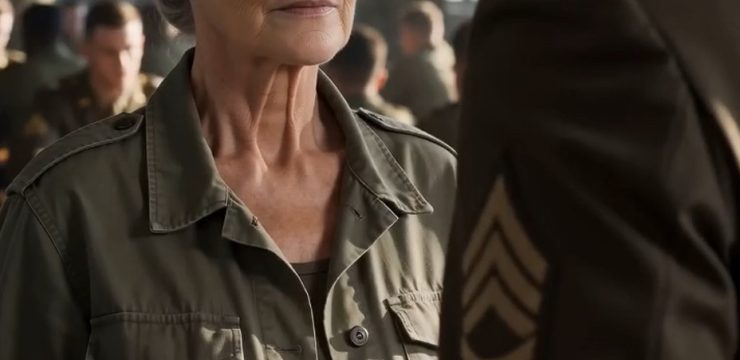
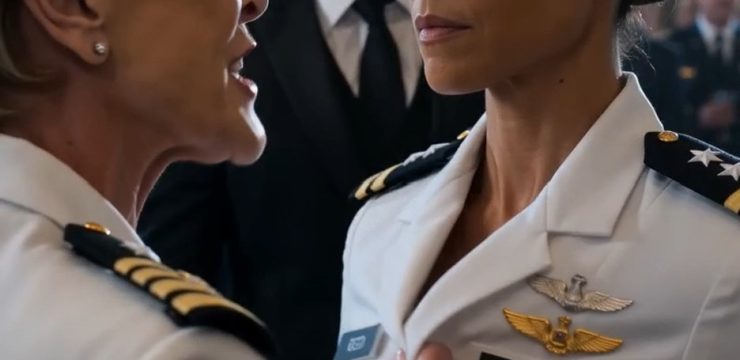
The captain’s smile disappeared the moment Sergeant Major Bennett warned him that his career was in danger.
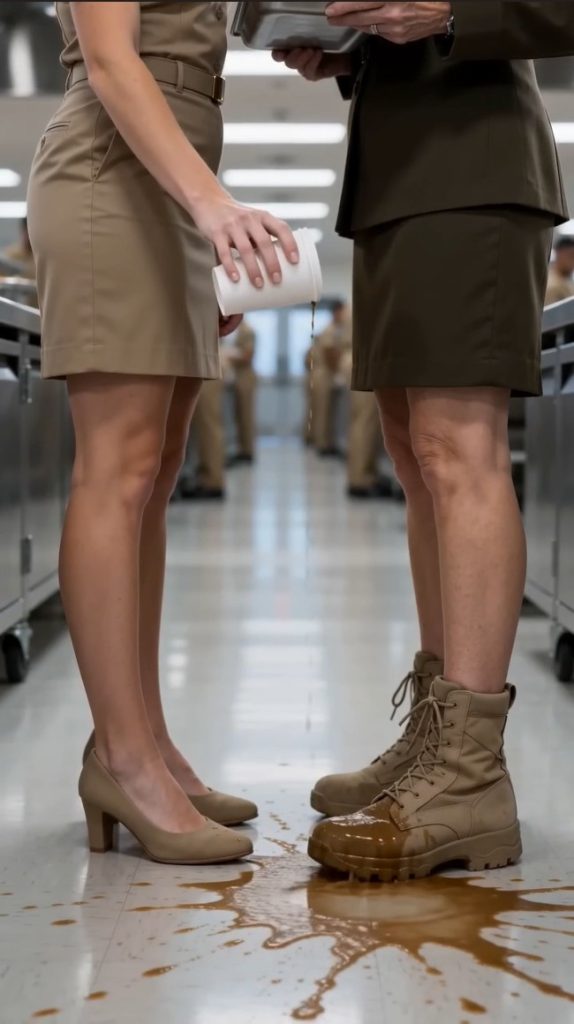
Forty soldiers stood frozen around a red training mat inside an old military hangar. No one understood why a senior officer suddenly seemed so concerned about a young female lieutenant.
And Captain Ryan Cole was beginning to realize there was something about me he didn’t know.
“Who she really is?” Cole repeated, forcing a laugh. “She transferred here three weeks ago. She’s a lieutenant. What am I supposed to be missing?”
Bennett held his gaze.
“Something important, Captain.”
The silence that followed was almost unbearable.
Cole looked around, searching for reassurance. But the soldiers who had been laughing moments earlier now watched him with growing uncertainty.
I could see the change in his expression. Irritation first. Then confusion. And beneath it, something he desperately wanted to hide.
Fear.
“Captain,” I said quietly, lowering my hands, “we can stop this right now.”
I meant it.
I hadn’t challenged him because I wanted to hurt him. I wanted to see whether he could recognize a mistake before his pride made it irreversible.
For three weeks, I’d watched him turn authority into humiliation.
Private Torres had been publicly ridiculed for dropping a magazine during a timed drill. Specialist Parker had been called useless for finishing an obstacle course twelve seconds too slowly.
And me?
Cole had mocked my height, my voice, and the fact that I was a woman wearing the same uniform he did.
Always with that easy, confident smile.
The smile of someone convinced his rank made him untouchable.
But now that smile was fading.
Cole stepped onto the mat.
“No,” he said sharply. “You wanted one round. You’re getting one.”
Bennett caught his shoulder.
“Captain, I’m strongly advising you to reconsider.”
Cole jerked away.
“Why? What exactly are you afraid of?”
Bennett didn’t raise his voice.
“I’m not afraid for her.”
Several soldiers exchanged uneasy glances.
Bennett continued.
“I’m afraid for your career.”
Cole went still.
For the first time, he looked genuinely unsettled.
“What is that supposed to mean?”
Bennett glanced toward me.
I barely shook my head.
Not yet.
He understood immediately and stepped back.
Cole mistook the movement for surrender. His familiar arrogance returned.
“That’s what I thought.”
He rolled his shoulders and faced me.
“Lieutenant. Still want your round?”
I lifted my hands.
“Yes, sir.”
The soldiers retreated from the mat.
Behind us, someone pulled the enormous hangar doors shut. Metal slammed against metal, sending a heavy echo across the concrete floor.
Cole stood six-foot-three, weighing at least two hundred pounds. He had the strength, experience, and physical advantage to make most opponents hesitate.
I knew he was counting on all three.
Bennett positioned himself beside the mat.
“One controlled round,” he ordered. “No unnecessary contact.”
Cole nodded, almost amused.
“Understood.”
Then Bennett turned toward me.
His expression carried a warning I recognized instantly.
He wasn’t questioning whether I could defend myself.
He knew exactly what I was capable of.
And he understood what might happen if Cole pushed too far.
I gave him a small nod.
“Understood, Sergeant Major.”
Bennett raised one hand.
For a moment, nobody seemed to breathe.
Then his hand dropped.
“Begin.”
Cole charged immediately.
Fast. Aggressive. Certain.
His first punch came straight toward my shoulder.
I shifted aside.
His fist cut through empty air.
A murmur rippled through the watching soldiers.
Cole turned sharply, his jaw tightening. The effortless confidence was gone.
He came at me again.
This time, he threw a combination.
Left.
Right.
And as his second fist came toward me, I saw the opening he’d left completely unguarded.
Everything Bennett had tried to prevent was suddenly one decision away. 👇
I stepped inside his reach, caught his arm, and turned my hips.
Cole’s momentum carried him forward.
A second later, his back struck the red mat with a heavy thud.
The entire hangar fell silent.
I maintained control of his wrist without applying pressure, giving him enough room to breathe.
“That’s enough,” I said quietly.
But Cole wasn’t looking at me.
He was staring at the soldiers surrounding us.
Forty witnesses.
Forty people who had just watched the man they feared lose control of a situation he had created.
His face darkened.
“Get off me.”
I released him immediately and stepped back.
For half a second, I thought he might accept what had happened.
Then he scrambled upright.
“You think that proves something?”
“Captain,” Bennett warned.
Cole ignored him.
He rushed me again.
This time, there was no controlled technique. No measured movement. Only anger.
I caught his arm, shifted my weight, and guided him down again, using just enough force to stop the attack.
He landed on his knees.
Bennett stepped between us.
“Round over!”
Cole tried to rise, but Bennett’s voice cracked through the hangar.
“Captain Cole! Stand down!”
Something in that command finally reached him.
He stopped.
His breathing sounded harsh against the silence.
Then he looked up at me.
“Who the hell are you?”
I lowered my hands.
“A lieutenant, sir.”
“Don’t play games with me.”
Bennett moved closer.
“She isn’t playing games, Captain. That’s what I’ve been trying to tell you.”
Cole turned toward him.
“Then tell me.”
Bennett looked at me one last time.
This time, I nodded.
He drew a slow breath.
“Lieutenant, you should explain.”
I could feel every eye in the hangar settling on me.
“Before this assignment, I spent four years working with an advanced military combatives training program. I helped train instructors, evaluate defensive techniques, and prepare soldiers for situations where strength alone wouldn’t keep them alive.”
Cole’s expression shifted.
I continued.
“Sergeant Major Bennett attended one of those instructor courses. That’s how he knew me.”
Bennett nodded.
“She was one of the best instructors in that program.”
No one spoke.
Cole glanced at the mat, then back at me.
“You deliberately kept that from me?”
“My personnel record wasn’t hidden, Captain. You never asked about my experience.”
A few soldiers lowered their eyes.
Cole swallowed.
Then his expression hardened again.
“So this was a setup?”
“No,” I answered. “I offered you a way to stop.”
Bennett stepped forward.
“And I warned you twice.”
Cole looked between us.
For a moment, his anger seemed to have nowhere to go.
Then he pointed at me.
“She’s been undermining my authority since she arrived.”
My stomach tightened.
Because I knew what came next.
He would try to turn the entire incident into an accusation against me.
And if nobody challenged him, there were soldiers in that hangar who might spend the rest of their careers believing that speaking up was more dangerous than staying silent.
“Sergeant Major,” I said, “there’s something else.”
Cole’s eyes narrowed.
I reached into the pocket of my training jacket and removed a folded sheet of paper.
It was a copy of a formal complaint I’d submitted earlier that week.
Not about his insults toward me.
About his treatment of the soldiers under his command.
Cole recognized the document heading.
His face lost color.
“You filed a complaint?”
“Yes, sir.”
“Without coming to me?”
“I tried.”
He opened his mouth, then closed it.
Three days earlier, I’d requested a private conversation about the way he addressed enlisted personnel.
He’d laughed, told me I was too sensitive, and ordered me out of his office.
I hadn’t forgotten the sound of the door shutting behind me.
Neither, apparently, had he.
“You’re destroying unit morale,” Cole said.
Before I could respond, a voice came from behind the soldiers.
“No, sir.”
Private Torres stepped forward.
His hands were trembling.
Cole turned so sharply that Torres instinctively stopped walking.
“What did you say, Private?”
Torres glanced at me.
I wanted to reassure him, but I knew the choice had to be his.
He swallowed.
“I said you’re not the one destroying morale, sir.”
Nobody moved.
Torres stared at the floor for a moment before lifting his eyes.
“When I dropped that magazine, you made me stand in front of everyone while you called me incompetent.”
Cole’s jaw tightened.
“It was corrective training.”
“No, sir.”
Torres’s voice shook.
“You told everyone they’d be safer if I never touched a weapon again.”
The words hung painfully in the air.
Then Specialist Parker stepped beside him.
“And when I finished the obstacle course twelve seconds late, you told me I was a burden to the unit.”
Cole looked around.
“Are you seriously allowing this, Sergeant Major?”
Bennett stood perfectly still.
“I’m allowing soldiers to answer questions about their treatment.”
Parker continued.
“I stayed after training that night and ran the course six more times.”
His voice cracked.
“Not because you ordered me to. Because I was afraid you were right about me.”
That was the moment something changed.
Not in Cole.
In the soldiers watching him.
I saw shoulders straighten.
I saw people looking at one another instead of looking down.
Cole saw it too.
“You’ll regret making accusations against a commanding officer,” he said.
Bennett’s expression turned cold.
“Captain, that’s enough.”
But Cole wasn’t finished.
“I’ll have every one of you investigated for insubordination.”
The threat was barely out of his mouth when Bennett reached for his phone.
“Your statement has been heard by forty witnesses, Captain.”
Cole stared at him.
Bennett continued.
“The complaint has already been forwarded through the appropriate channels. And your conduct today will be added to it.”
Cole’s eyes returned to me.
Suddenly, the fight on the mat seemed insignificant.
“You planned all this.”
“No,” I said. “I hoped you would make a different choice.”
For the first time, I saw something beyond his anger.
He was beginning to understand that rank could not erase witnesses, documents, or his own words.
Still, he tried one final time.
“Those soldiers belong to my command.”
Bennett stepped closer.
“They belong to the Army, Captain. They are not yours to humiliate.”
Cole had no answer.
The silence lasted until Bennett directed him to leave the training area and report to the battalion commander.
He walked toward the hangar doors without looking back.
Nobody applauded.
Nobody celebrated.
Because what had happened wasn’t a victory anyone had wanted.
It was a failure of leadership that had finally become impossible to ignore.
As the soldiers began dispersing, Torres remained beside the mat.
“Ma’am?”
I turned.
He rubbed his palms against his trousers.
“Am I going to get in trouble for saying that?”
The question hurt more than I expected.
I looked toward Bennett.
He came over immediately.
“You had the right to report what happened, Private. If anyone retaliates against you for making a protected complaint, report it.”
Torres nodded, but his hands were still shaking.
I crouched to pick up my jacket.
“Torres, can I ask you something?”
“Yes, ma’am.”
“After you dropped that magazine, did you finish your drill?”
He blinked.
“Yes, ma’am.”
“Safely?”
“Yes.”
“Then remember that too.”
His mouth tightened.
For several seconds, he seemed unable to speak.
Finally, he whispered, “Nobody mentioned that part before.”
The investigation took time.
There were interviews, statements, training records, and questions nobody enjoyed answering.
Cole was temporarily removed from command responsibilities while his conduct was reviewed.
The investigation substantiated repeated abusive behavior and his retaliation threats. He received formal disciplinary action, was relieved of command, and was eventually separated from the service through the applicable administrative process.
I never saw him again.
But I remembered the silence after he left the hangar.
And I remembered how long it had taken Torres to believe he was safe enough to speak.
Several weeks later, I found Parker alone on the obstacle course.
The afternoon sun was low, throwing long shadows across the climbing walls.
He was standing in front of the last barrier.
“Going for another run?” I asked.
He shrugged.
“Just trying to get faster, ma’am.”
I stood beside him.
“You know twelve seconds doesn’t define you.”
He gave a small, embarrassed smile.
“I know.”
Then he looked at the wall.
“I’m still trying to believe it.”
We stood there quietly.
Finally, he asked, “Why didn’t you tell the captain who you were?”
I considered the question.
“Because I wanted to know how he treated someone he thought couldn’t fight back.”
Parker nodded slowly.
Then he said something I carried with me long afterward.
“I’m glad you saw how he treated us.”
I looked at him.
He swallowed.
“Not the humiliating part. I wish you hadn’t seen that.”
His voice softened.
“But I’m glad somebody finally understood.”
That evening, Bennett called me into his office.
An old photograph lay on his desk.
I recognized the training facility immediately.
It showed a group of exhausted instructors standing together after an advanced course.
Bennett was in the back row.
I was near the front.
But what caught my attention wasn’t the photograph.
It was a folded note beside it.
Bennett pushed it toward me.
“Torres and Parker asked me to give you this.”
I unfolded the paper.
Inside were forty signatures.
Beneath them was a simple request.
The soldiers wanted me to lead their next unit combatives training session.
Not because they wanted to learn how to defeat someone larger.
Because they wanted to learn without being afraid of making mistakes.
I read the note twice.
Then I sat down.
Bennett looked out the window, giving me a moment.
“I thought I was coming here to help improve a training program,” I said.
“You still are.”
I looked at the signatures again.
“It’s just different from what I expected.”
Bennett smiled faintly.
“The important assignments usually are.”
On the morning of our first new training session, the hangar doors stood open.
Sunlight stretched across the concrete.
The same red mat lay in the center.
But nobody stood around it waiting for someone to be embarrassed.
Torres was helping Parker adjust his protective equipment.
Someone laughed after missing a practice movement.
Nobody punished him for it.
I stepped onto the mat.
“Before we begin,” I said, “there’s one rule.”
The soldiers grew quiet.
I looked around the circle.
“Everybody gets to learn.”
Torres smiled.
Parker straightened his shoulders.
And from beside the open hangar doors, Bennett gave me a small nod.
I raised my hands.
“Ready?”
Forty voices answered together.
“Ready, ma’am.”
For the first time since arriving, I didn’t hear fear behind their response.
Only trust.
And as the morning light settled over the red mat, I realized that the most important thing I’d taught these soldiers had never been how to win a fight.
It was that they deserved to stand tall without having to fight for the right.