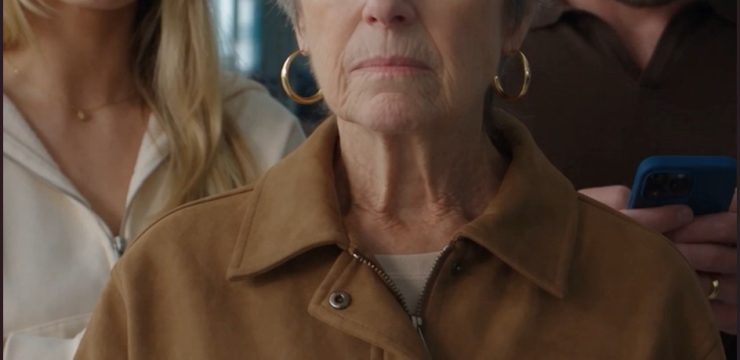
That was the moment the boy understood he had touched something no one else had dared to reach — not the wheelchair itself, not the little girl’s legs, but the mother. The silent, unspoken grief that had settled into the bones of this entire family like dust no one could bring themselves to sweep away.
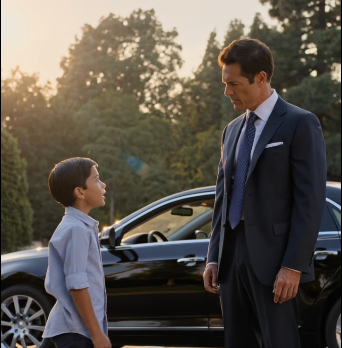
The girl’s eyes had filled with tears, but not the kind that come from pain or fear. These were something far more complicated. Something older. The look in her eyes wasn’t terror — it was recognition. The kind that only surfaces when someone accidentally names the thing you have been carrying alone for far too long.
She looked down at the boy’s hands still resting gently on her knees, then back at her own foot, as though she didn’t quite trust her body enough to believe what she had just felt. As though the connection between her mind and her legs had become a foreign language she once spoke fluently but had slowly, quietly forgotten.
Her father stepped forward — not with urgency this time, but with caution, the way a person moves when they are afraid that any sudden motion might shatter something irreplaceable.
“What did you just do?” he asked, his voice barely steady.
The boy shook his head once, calm as still water.
“I didn’t do it,” he said. “I just found where she forgot how.”
Those words fell into the warm afternoon air and didn’t bounce back the way ordinary words do. They landed. Slowly. Like something heavy wrapped in something soft.
Not childish. Not dramatic. Not the kind of thing you explain away easily.
Specific. Quietly, devastatingly specific.
The father stared at this boy as if seeing him for the first time.
The girl’s breathing had shifted. Her chest rose and fell differently now, like something that had been locked for a long time was beginning — just barely — to loosen. She moved one foot again, only a small motion, just an inch or two, but it was enough to make the wheelchair creak beneath her.
Her father’s hand flew to his mouth. For just one second, he covered everything he was feeling.
The boy wasn’t watching him. He was watching her.
“She still pulls away on the left side,” the boy said softly, almost tenderly. “Because that’s where she was holding on when she fell.”
The father went absolutely still.
Not because of the movement in her foot. Not because of the miracle unfolding in his own driveway on an ordinary afternoon. But because of the detail. That specific, impossible detail.
The left side. The fall.
No doctor had been present in that moment. No specialist had witnessed the accident as it happened. No stranger had stood in that particular spot and seen what occurred. Only three people in the world had ever known exactly how everything went wrong.
Her father. The girl herself. And the girl’s mother.
For the first time since the boy had placed his hands on her knees, the girl looked up at him with genuine fear in her eyes.
“How do you know that?” she whispered.
The boy reached into the pocket of his worn shorts and pulled out something small enough to hold between two fingers. A folded square of faded cloth. He opened it slowly, carefully, the way you handle something that has waited a long time to be found.
Inside lay a tiny silver charm bracelet clasp — bent from age, worn from time, but clean in the way that only intentional, loving care produces. Someone had kept this on purpose. Someone had held onto it.
The color drained from the father’s face.
Because he knew exactly what it was.
His wife’s. His wife’s bracelet clasp, the one his daughter had not touched, had not worn, had not spoken about since the day of the accident. The day everything in their lives was divided permanently into before and after.
The boy held it up quietly, without ceremony, without drama.
“My grandmother found it in the donation box at the church clinic,” he said. “She told me the woman who brought the little girl in that day kept repeating the same sentence over and over, through all her crying, through everything.”
He looked directly at the girl.
“Move her knees first. She can still feel below the fear.”
The father forgot how to breathe like a normal person.
This was not a coincidence. This was not some unexplainable driveway moment that would be whispered about for years without meaning. This was a message. A message that had somehow found its way through years and strangers and grief and silence to arrive exactly here, exactly now.
The girl’s voice came out trembling, fragile as old glass.
“My mother said that?”
The boy nodded, once, without flinching.
Then the father asked the question he had been terrified to speak from the first impossible moment this child appeared in front of his daughter.
“Who is your grandmother?”
The boy met his eyes steadily.
“The woman who was with your wife when she died.”
Silence fell over the driveway like a curtain dropping at the end of an act no one had known they were watching. Golden light stretched long across the car. Shadows reached far down the pavement. One small girl, half-risen from a sentence the whole world had buried and moved on from.
Then the girl whispered, and this time the tears came freely, without apology.
“So she didn’t forget me.”
No. She never did. Not even at the very end. Not even when she had nothing left except one sentence and the desperate hope that it would someday reach her daughter.
Some love doesn’t stop just because the person carrying it is gone. It finds another way. It waits in a folded square of fabric in a church donation box. It travels in the pocket of a boy in worn shorts on an ordinary afternoon. It arrives exactly when the heart has almost — but not quite — given up believing anyone still remembers.
She never forgot you. Not for a single moment.