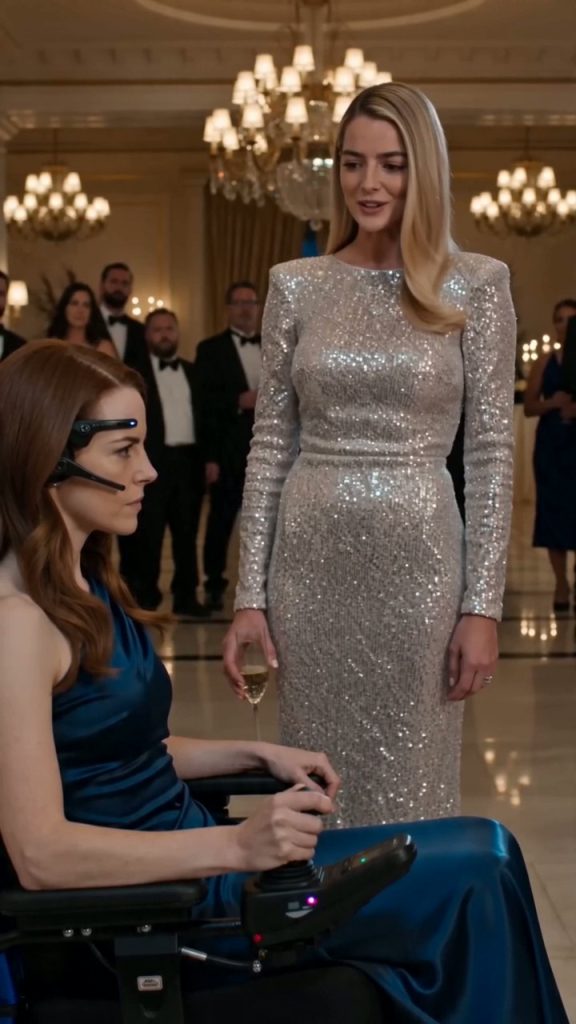
For one long second, the entire ballroom forgot how to breathe.
Not the glittering chandeliers suspended above. Not the elegantly dressed guests standing in quiet stillness. Not even the musicians frozen at their instruments, bows hovering mid-air in perfect silence. Time itself seemed to pause, as if the universe understood that what was about to happen deserved every ounce of attention the world could offer.
Only one thing moved.
The girl.
Her small, bare hand reached out and found his — steady, warm, certain. With a look on her face that no one in that room would carry to their graves and still not fully understand, she pushed herself forward from the wheelchair. It was an expression no artist could quite capture: terror and hope had fused together so completely inside her eyes that they had become a single, indistinguishable emotion.
Her father took half a step toward her, then stopped himself.
Because sometimes love wants so desperately to protect that it builds walls it never intended to build. And something in the young man’s expression told him — without a single word — that if he reached out and touched this moment, he would shatter it beyond repair.
The girl placed one foot on the marble floor.
Then the other.
Her legs trembled beneath the soft blue shimmer of her dress.
The crowd inhaled together — a single, collective breath — soft as a prayer.
Not because they feared she would fall. Every person standing in that ballroom had lived long enough to recognize something far more significant than a stumble. They understood, in that quiet and devastating way that only comes with age and loss, how many times she had already fallen before this night. How many times she had fallen in private, in hospital corridors, in the darkness of her own bedroom, where no applause ever followed.
Months before, following the accident, the doctors had spoken to the family in the careful, measured language that medical professionals use when hope is uncertain and promises are dangerous. Recovery would be long. Whether she would walk again was unclear. Dancing — the one thing she had loved above all else — was never even mentioned. Her father, a man who had built his life around solving problems with resources and determination, bought the finest wheelchair, hired the best therapists, flew in the most respected specialists that wealth could summon.
But every expensive kindness arrived wrapped in quiet grief.
He stopped allowing her to hope out loud, because he could not bear to witness hope fail her a second time. He thought he was protecting her. He thought silence was safety. And so, gradually, she learned to keep the most important desire of her heart locked away where no one — including herself — had to look at it directly.
She stopped saying the one thing she wanted most.
She stopped talking about dancing.
But the boy had known.
Not because anyone told him. Not because he had been invited into her confidence or welcomed into her world. He was the stable hand’s son — the quiet young man who ran errands through back corridors and polished shoes in the kitchen where invisible people still hear everything worth hearing. He had seen her at the ballroom doors late in the evening, standing at the threshold, watching the empty floor as if it were a language she was slowly forgetting. He had noticed her fingers moving against the frame of the doorway — tracing rhythms to music that only lived inside her now. He had watched, again and again, as the people who loved her most carefully shielded her from disappointment until, without realizing it, they were also shielding her from the one thing she needed more than anything else.
Her own courage.
Now he held her hand like it was the most natural thing in the world.
“Just one step,” he whispered.
She took it.
The room broke open — not loudly, not dramatically, but emotionally, the way a dam breaks not with an explosion but with a slow, unstoppable release of everything that had been held too long.
Her father’s face was the first to go.
Not because she was miraculously healed. Not because suffering had been erased or the hard road ahead had disappeared. But because she was trying — openly, vulnerably, in front of every eye in that room — and she was choosing to try anyway.
The boy guided her gently toward the center of the floor. No grand performance. No dramatic gesture designed for an audience. Simply another step forward. Then another. The wheelchair sat behind her, and somehow, impossibly, it looked smaller than it had one minute before.
The music rose.
The crowd began to clap — first one pair of hands, then five, then all of them at once, filling the ballroom with a warmth that had nothing to do with celebration and everything to do with recognition. Every person there had loved someone through something. Every person there understood what it meant to watch someone choose bravery over comfort.
The girl laughed through her tears, genuinely stunned by the sound of her own shoes against the marble. And when the boy gently turned her beneath the golden chandelier light, she looked across the room at her father with a face illuminated from somewhere deep within and said simply:
“Daddy… I’m really here.”
That was the line that undid him completely.
Because the cruelest dimension of watching a child lose her former life is not the wheelchair, not the medical appointments, not even the fear that never fully leaves. It is the quiet, heartbreaking moment when you realize she has begun living beside herself rather than inside herself — watching her own life from a careful distance, never quite trusting the ground beneath her feet.
And now, for the first time since everything changed, she was not beside herself.
She was back. Not entirely. Not without trembling. Not without the long road still stretching ahead. But back — present, breathing, alive inside the moment rather than watching it from the outside.
The boy released her hand for just one second.
And she stood alone in the center of the ballroom.
The room erupted. The father pressed his hand over his mouth, his shoulders shaking with something too large for tears alone to carry. And in that moment, every single person present arrived at the same quiet understanding.
The barefoot boy from the back corridors had not interrupted the evening. He had not overstepped or acted beyond his place. He had simply returned the one thing that money, medicine, and even the most devoted parental love had been unable to restore.
Her courage.
And that — as everyone standing in that ballroom knew in their bones — was worth more than everything else in the room combined.