The hot oil struck the back of her hand, but Helen barely felt it.
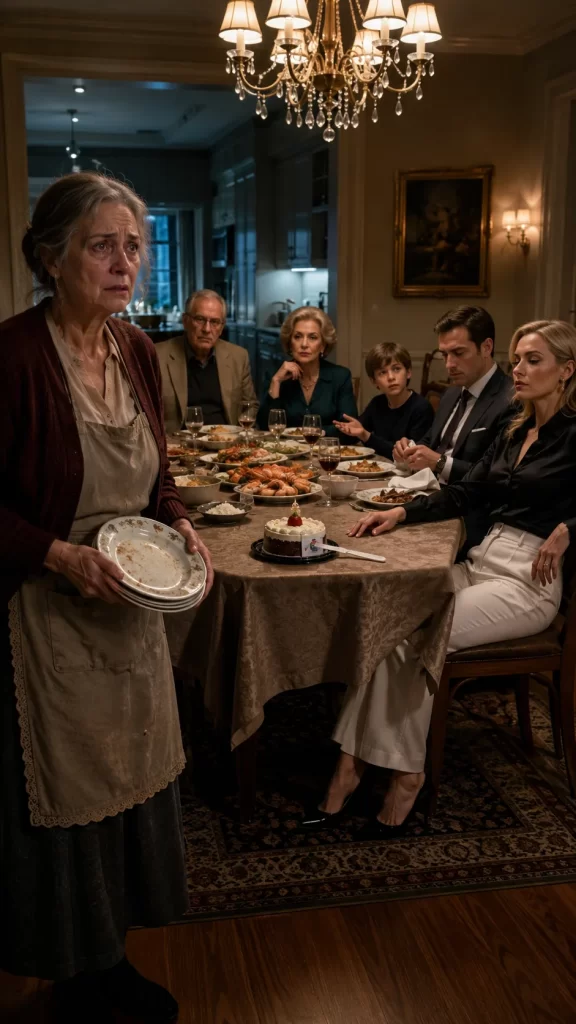
What hurt was the way her daughter-in-law stared at her after hearing, “Today is my 60th birthday”—as if Helen had announced an inconvenience instead of something worth remembering.
At five that morning, Helen had opened her eyes in the dark. A faint streetlamp glowed beyond the window. She pulled on the old fleece robe Arthur had bought before he died, washed so many times it had nearly lost its color.
Then she slipped quietly into the kitchen, afraid of waking Ryan and Megan.
By sunrise, breakfast was already underway.
Ryan liked fresh pancakes. Megan wanted a green smoothie. Little Leo needed scrambled eggs. Three different meals, every morning, for five years.
Helen hardly had to think anymore.
Mix. Blend. Whisk. Flip.
Forty of her sixty years had been spent feeding someone else.
The first pancake had barely begun to sizzle when Megan’s voice cut down from upstairs.
“You old hag, making all that noise so early. Are you trying to keep people from sleeping?”
Helen tightened her grip on the spatula.
Seconds later, Megan stormed into the kitchen wearing a white sheet mask, already irritated.
“Today is my—”
“Who cares what day it is?” Megan snapped. “I have an important meeting at nine. What if the smell of fried food gets on my suit?”
Helen quietly lowered the heat.
Then came the rest.
The plumber was coming. Helen needed to stay home.
For lunch, Megan wanted grilled salmon with very little salt.
And dinner had to be bigger because Megan’s parents were coming over.
“Make a few extra dishes.”
Helen’s spoon slipped into the pan.
“Today is my 60th birthday.”
Megan raised an eyebrow.
“So? Is being sixty some big accomplishment? People live past eighty now.”
Before Helen could answer, Ryan entered, adjusting his tie while staring at his phone.
“Mom, where’s my coffee?”
“It’s almost ready.”
“Hurry up. I’m in a rush.”
He drank without looking at her, then added, “Buy extra seafood tonight. My father-in-law likes lobster.”
Helen studied his face.
Every year, he looked more like Arthur.
Once, Ryan had saved his allowance to buy her birthday cards. Once, he had hugged her and declared she was the best cook in the world.
Now he had forgotten entirely.
“Ryan,” she said softly, using his childhood nickname.
He frowned.
“Mom, can you please not nag me when I’m busy?”
Then he asked where his blue cuff links were and disappeared upstairs.
Helen stayed in the kitchen, suddenly unsteady.
On the wall calendar, the date was circled in red.
Beneath it, in her own handwriting:
Helen’s 60th birthday.
No one had noticed.
Later, after everyone left, she washed the dishes while a daytime talk show played in the background. An elderly woman on television was crying about an ungrateful son while the host spoke passionately about respecting parents.
Helen switched it off.
The silence felt enormous.
No birthday wishes.
No gift.
Only dirty dishes, a broken pipe, and another dinner she had been ordered to cook.
She went to the closet and pulled out a photograph of Arthur.
He was forever fifty-five in that picture, smiling with the same gentle eyes she still remembered.
“Arthur,” she whispered, “if only you were still here.”
Then she remembered the day doctors told them his heart failure was advanced.
Arthur had taken her hand.
“Helen, after I’m gone, you have to live for yourself.”
At the time, she had cried until she could barely breathe.
Standing there on her forgotten 60th birthday, Helen finally wondered if Arthur had understood this family long before she had.
And for the first time, she was afraid of what that realization might force her to do next. 👇
Something slipped from behind Arthur’s photograph and landed softly against Helen’s slipper.
She looked down.
A cream-colored envelope lay on the carpet, yellowed slightly at the edges. Her name was written across the front in Arthur’s unmistakable handwriting.
Helen stopped breathing.
She lowered herself onto the edge of the bed and turned the envelope over twice before opening it. Inside was a single folded sheet and a copy of a document she recognized only after staring at the first line.
The house deed.
Her name stood there alone.
Arthur’s letter was shorter.
Helen,
If you are reading this because you finally needed proof that you are allowed to choose yourself, then I wish I had been there to tell you in person.
This house is yours. Not Ryan’s. Not anyone else’s.
I loved our boy, but I also saw how easily your love became work, and how easily work became obligation. Promise me you will never confuse being needed with being loved.
Live here because you want to.
Leave because you want to.
But never again stay anywhere because someone has convinced you that you owe them the rest of your life.
Helen pressed the paper against her mouth.
No dramatic sob came.
Only one broken breath.
Then another.
The plumber rang the doorbell downstairs.
For the first time in years, Helen did not hurry.
By six that evening, the kitchen remained spotless.
No lobster steamed on the stove. No salmon waited in the oven. No extra dishes crowded the counters.
Helen had showered, brushed her silver hair until it fell softly around her face, and changed out of Arthur’s old robe.
On the dining table sat the deed, Arthur’s letter, and the framed photograph.
At 6:22, the front door opened.
Megan’s voice reached the kitchen first.
“Why doesn’t it smell like anything?”
Ryan entered behind her carrying two bottles of wine. Megan’s parents followed, talking loudly about traffic.
Then everyone saw Helen sitting at the table.
Megan stopped.
“Where’s dinner?”
Helen folded her hands.
“I didn’t make it.”
For several seconds, nobody moved.
Megan laughed once, sharply, as if Helen had made a joke she did not understand.
“What do you mean, you didn’t make it?”
“I mean there is no dinner.”
Megan’s father lowered the bottle he was carrying.
Ryan stared at his mother.
“Mom, are you feeling sick?”
Helen looked at him for a long moment.
“No.”
That answer seemed to disturb him more.
Megan dropped her handbag onto a chair.
“You knew my parents were coming.”
“Yes.”
“And you just decided not to cook?”
“Yes.”
Her voice remained quiet.
Megan stepped closer.
“This is unbelievable. We give you a place to live, we include you in our family, and this is how you behave?”
Helen saw Ryan’s face change.
Not much.
Just enough.
His eyes moved toward the papers on the table.
Helen touched the deed with two fingers.
“This is my place to live.”
Megan’s expression froze.
Helen turned the document around.
“Arthur made sure of that before he died.”
Ryan picked it up.
His eyes moved across the page once, then again.
“Dad did this?”
Helen nodded.
Megan reached for the document, but Ryan pulled it slightly away without seeming to realize he had done it.
Her mother whispered, “Megan, you told us Ryan owned this house.”
The room changed.
Megan’s jaw tightened.
“That’s not the point.”
“It is to me,” Helen said.
Megan stared at her.
Helen could hear the refrigerator humming behind them.
For years, she had imagined standing up for herself would require shouting.
Instead, the strangest part was how little strength it took to speak once she stopped asking permission.
“I have cooked your meals. Cleaned your home. Waited for repairmen. Rearranged my days around your schedules. I have raised Leo when you worked late, stayed quiet when you insulted me, and convinced myself that keeping peace was the same thing as having a family.”
Ryan lowered the deed.
“Mom…”
She looked at him.
He stopped.
“You forgot my birthday,” she said.
His face crumpled before he could hide it.
“That isn’t why I’m doing this. It’s only why I finally noticed what I had been refusing to see.”
Megan crossed her arms.
“So what? You want an apology? Fine. Sorry. Happy birthday. Can we stop making this ridiculous?”
Ryan turned toward her.
“Megan.”
“What?”
His voice came quietly.
“Don’t.”
She stared at him as though he had betrayed her.
Helen pushed Arthur’s letter toward her son.
Ryan read it standing up.
Halfway through, he sat down.
By the final line, his hand was shaking.
For a moment he looked much younger than forty. He looked like the boy who had once spent three dollars of allowance money on a crooked birthday card with glitter glued across the front.
“I became exactly what Dad was afraid of,” he whispered.
Megan scoffed.
“Oh, please.”
Ryan looked up.
Something in his expression made her stop.
“No,” he said. “You don’t get to do that.”
“Do what?”
“Make everything small when it makes you uncomfortable.”
Megan’s parents exchanged a look.
Ryan placed Arthur’s letter carefully beside the photograph.
“I watched you speak to my mother like she was hired help.”
“You spoke to her the same way.”
Ryan flinched.
Helen did too.
Because Megan was right.
The silence afterward was worse than any accusation.
Ryan swallowed.
“Yes,” he said. “I did.”
His eyes filled, but he did not look away from Helen.
“And that’s mine to live with.”
Megan grabbed her handbag.
“This is insane. If she wants us gone so badly, fine.”
Helen stood.
“I do want you to find another place.”
Megan stared at her.
Helen’s knees trembled beneath the table, but her voice did not.
“Both of you.”
Ryan’s face went pale.
Helen forced herself to continue.
“I love you. But I need to know who I am when I’m not waking up before dawn to keep everyone else comfortable.”
Ryan nodded slowly.
No argument.
No pleading.
Just a painful acceptance that made Helen’s chest ache more than resistance would have.
Megan’s mother reached for her daughter’s arm.
“Come stay with us tonight.”
Megan jerked away.
Her father spoke for the first time.
“Your mother asked you a question this afternoon.”
Megan frowned.
He looked at Helen.
“She asked whether we should bring a birthday gift. Megan told us not to because Helen didn’t celebrate birthdays.”
Helen’s fingers went cold.
Ryan closed his eyes.
Megan said nothing.
That was enough.
Her power in the room seemed to vanish all at once—not because anyone shouted, but because the lie had nowhere left to hide.
Megan looked around for someone to rescue her.
No one did.
She walked upstairs.
Twenty minutes later, she came down with an overnight bag.
Ryan did not follow.
At the doorway, Megan turned toward Helen.
For one second, Helen thought an apology might come.
Instead Megan said, “You’re destroying this family.”
Helen looked at Arthur’s photograph.
“No,” she said softly. “I’m finally stopping myself from disappearing inside it.”
The door closed.
The house became still.
Ryan remained at the dining table.
“I’ll pack tomorrow,” he said.
Helen nodded.
Then his face twisted.
“Mom, I don’t know how I let this happen.”
Helen sat opposite him.
“Yes, you do.”
He looked up.
“You got used to me saying yes.”
His eyes dropped.
“And I taught you I always would.”
Neither of them spoke for a while.
Then Ryan whispered, “I’m sorry.”
Helen reached across the table, but she did not take his hand.
Not yet.
“I believe you’re sorry tonight,” she said. “What I need to know is who you are tomorrow.”
Ryan wiped his face with both hands and nodded.
A small sound came from the hallway.
They turned.
Leo stood there clutching his school backpack.
Helen had not even heard Megan bring him home through the side door before leaving.
“Grandma?”
He walked toward her slowly.
“I made something.”
He opened his backpack and pulled out a folded piece of blue construction paper, bent at one corner from being carried all day.
Across the front, in uneven crayon letters, he had written:
HAPPY BIRTHDAY GRANDMA.
Helen covered her mouth.
Leo looked worried.
“I was going to give it to you at dinner. Mom said I had to wait because everybody would be here.”
Helen’s eyes filled.
“So you remembered?”
Leo frowned as if the question made no sense.
“Of course I remembered.”
That broke her.
Helen knelt and pulled him against her.
The house that had felt empty all day suddenly contained the one thing she had believed was completely gone.
Someone had remembered.
Someone had simply been too small to control when the remembering was allowed to matter.
Ryan turned away and pressed his fist against his lips.
Three weeks later, he moved into a modest apartment ten minutes away.
Megan stayed with her parents. When she refused to acknowledge what had happened and insisted Helen owed them the house, Ryan told her he would not return to the life they had built on his mother’s silence.
Their marriage did not survive that truth.
Helen never celebrated its ending.
She simply stopped carrying responsibility for it.
Ryan began coming by on Sundays.
At first, he brought takeout.
Then one afternoon he arrived with pancake mix.
Helen watched him burn the first batch.
Leo laughed so hard milk came out of his nose.
Ryan stared at the ruined pancakes and said, “How did you do this every morning?”
Helen looked at him.
“That was never the right question.”
He went still.
Then he nodded.
“The right question was why I thought you should.”
It was not forgiveness.
Not yet.
But it was the first honest conversation they had shared in years.
By spring, Helen had changed the kitchen.
She removed the old crowded rack of pans. Bought herself a small table beside the window. Planted lavender outside where Arthur had once talked about building a garden.
And one sunny morning, she finally threw away the fleece robe.
Almost.
Her fingers hovered over the trash bin before she laughed at herself, folded it carefully, and placed it in a cedar box instead.
Arthur had given her the robe.
He had never asked her to live inside it forever.
On her sixty-first birthday, Helen woke at seven instead of five.
Sunlight filled the room.
No alarm.
No footsteps waiting overhead.
No list of breakfasts to prepare.
She came downstairs and found Ryan and Leo standing awkwardly in the kitchen beside a crooked chocolate cake.
Ryan had frosting on his sleeve.
Leo was holding sixty-one candles in both hands.
“You’re not putting all those on there,” Helen said.
Leo grinned.
“Yes, we are.”
Ryan smiled nervously.
“We already checked the smoke detector.”
Helen laughed.
A real laugh.
The kind that seemed to surprise her body before it reached her mouth.
Ryan stepped forward and held out a card.
This time, he had written it himself.
Helen opened it.
Inside were only two sentences.
Dad was right. You were supposed to live for yourself.
Thank you for finally teaching me how to love you without needing you to disappear.
Helen read it twice.
Then she looked at her son.
He did not ask whether she forgave him.
He simply stood there, waiting.
Helen reached for his hand.
This time, she took it.
Leo began lighting candles while morning sun spilled across Arthur’s photograph on the shelf.
For years, Helen had believed Arthur’s final gift had been the house.
It wasn’t.
The house had only given her somewhere to stand while she learned to choose herself.
His real gift had been permission.
And as Ryan leaned down to relight a candle Leo had accidentally blown out, Helen looked around the quiet kitchen and realized something that made her smile through her tears.
Nobody was waiting for her to serve them.
They were waiting for her to sit down.
So Helen did.