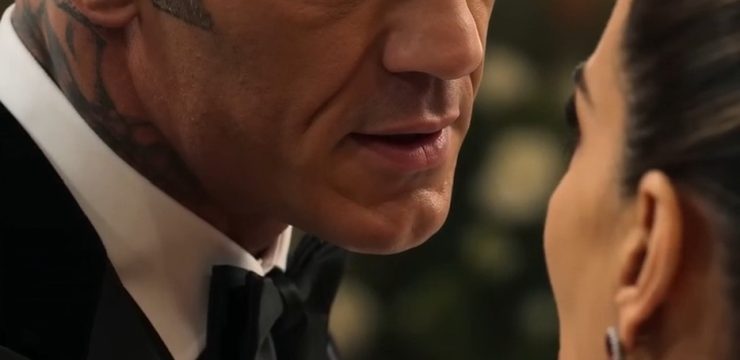
The restaurant kept breathing around them for a few seconds longer — glasses clinking softly in the background, low murmurs of laughter, a piano drifting from somewhere in the corner — until the silence at that particular table grew strange enough that people nearby instinctively stopped their own conversations and began to listen without meaning to.

“Who told you that?” the woman whispered.
The girl’s face tightened almost imperceptibly.
“My mother,” she said. “Before she died.”
The woman’s hand closed slowly over the ring on her finger, as if it had suddenly become too hot to keep wearing. Her knuckles whitened. Her breath caught somewhere between her chest and her throat.
Because no one alive was supposed to know about the church steps.
Many years before, on a stormy night that her family had since buried beneath layers of money and carefully constructed lies, she had met Isabel there in secret. Her younger sister had been frightened, desperate, and carrying a child she wasn’t supposed to have — desperate to leave the city with a man their father would never, under any circumstances, welcome into the family name. The two sisters had argued. Hard words. Cruel words. The kind of words you spend decades trying to take back. The older sister had begged Isabel to come home, to let the family handle it, to trust that everything could be quietly resolved if she would only cooperate.
Isabel refused.
Then the black cars arrived.
Men stepped out.
And in the chaos and panic that followed, Isabel was shoved, struck the stone railing along her side, and fell bleeding onto the wet church stairs below.
The older sister had screamed for help.
But her father’s men dragged her away before she could reach her sister’s side.
By morning, she was told that Isabel had fled the country alive. And because she was young, frightened, and had spent a lifetime learning to obey without asking too many questions, she allowed herself to believe the lie. She carried it the way you carry something that never quite fits inside your chest — always present, always uncomfortable, never fully yours to put down.
Now the flower girl stood before her like living proof that cowardice, left untended, can grow its own teeth over time.
“My mother didn’t die that night,” the girl continued, her voice soft and steady in a way that was almost worse than anger. “A woman from the convent found her and hid her away. She said the baby survived too.”
The woman’s eyes filled instantly with tears she hadn’t planned on shedding in public.
“The baby,” she whispered.
The girl held her gaze without blinking.
“That was me.”
The world narrowed all at once.
Not to the restaurant around them. Not to the ring still warm on her finger. Not even to the child standing close enough to touch.
Just to the single undeniable fact that Isabel had not disappeared alone into the dark. She had left behind a daughter. A daughter who had grown up without her family’s name, without their protection, without their wealth — selling roses from table to table while the very people who should have shielded her dined under chandeliers and told themselves the past was past.
The woman in black stood up so quickly that her chair scraped loudly across the floor.
“Where is she buried?” she asked.
The girl looked down at her hands.
“She isn’t,” she said quietly.
The woman went perfectly still.
“My mother died three days ago,” the girl whispered. “That’s why I’m here.”
Nothing before that moment had landed quite so hard.
Three days.
Three days too late to ask for forgiveness she had no idea she still owed. Too late to hear Isabel’s voice even once more. Too late to undo what a single night of fear had cost them both across a lifetime of separation and silence.
The woman reached for the girl’s hand, but the child stepped carefully back.
“My mother also told me something else,” she said.
The woman’s throat tightened. “What did she tell you?”
The girl looked directly into her eyes without hesitation.
“She said that if you cried when you saw me… then you probably weren’t the one who wanted us dead.”
The woman went cold from the inside out.
Because that meant there was still someone else out there. Someone Isabel had feared far more than simple betrayal. Someone with enough power and reach that even in her final days, even while dying, she had carefully separated guilt from something darker and more deliberate.
The girl reached slowly into the pocket of her sweater and pulled out a folded piece of paper. It was old. Worn soft at the creases. Clearly protected and preserved across many years with great intention.
She placed it quietly beside the wine glass.
“She said to give it only to the woman wearing the ring.”
The woman opened it with hands that would not stop trembling.
Inside was a single sentence written in Isabel’s unmistakable handwriting — the same careful, slanted letters she had known since childhood:
If our father is still alive, do not let him know she found you first.
The piano in the corner kept playing. Somewhere behind them, someone laughed at another table. A waiter passed without noticing.
And the woman who had spent decades learning to live with one unbearable secret suddenly understood she had been sitting, unknowingly, at the edge of a far deeper one all along — and that the little girl with the flowers had just handed her the only map that might lead her out of it, or deeper into it forever.