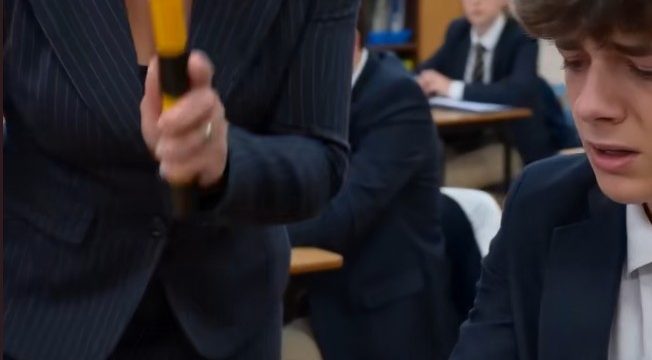
The camera went dark before the ruler struck. Twenty-one eighth-graders watched their teacher disconnect the surveillance camera, then turn toward them with a wooden ruler in her hand. Only one girl seemed to know what was coming.
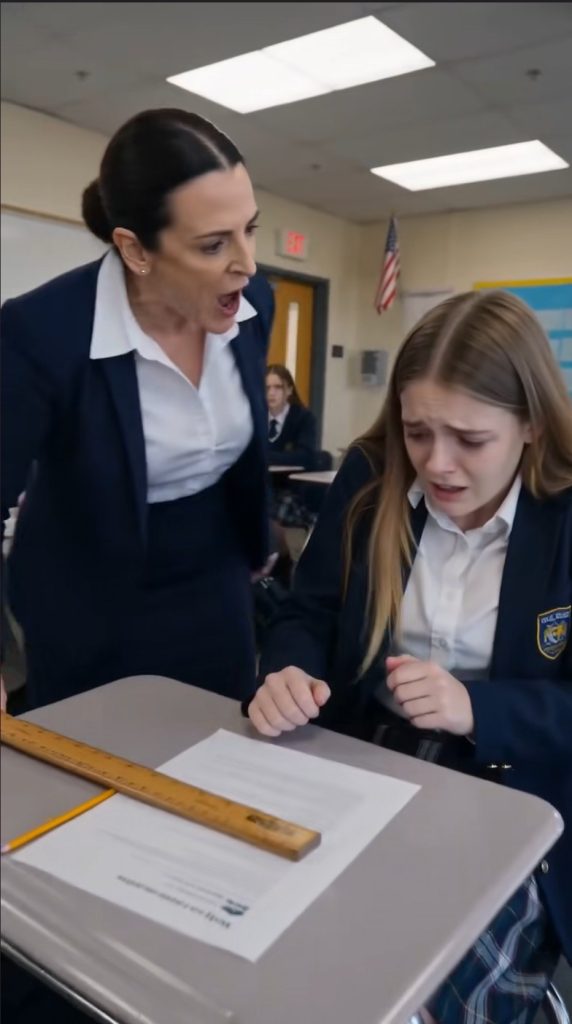
Mrs. Wells walked between the desks, her ruler tapping against her thigh. Brielle kept her eyes on her unfinished worksheet, but her stomach had already tightened. Every step brought the teacher closer.
That morning, during a history test, Mrs. Wells’s son, Caleb, had leaned over from two rows behind her. “Move your paper,” he whispered. Brielle covered her answers instead.
“Come on,” he insisted.
She shook her head. The humiliation in his face hardened into anger, and now his mother was standing over Brielle’s desk.
The ruler crashed against the desktop. Several children flinched.
“Why didn’t you let him copy your test?”
Brielle tried to speak. Nothing came out.
A chair scraped behind them. Connor stood, red-faced. “Because he’s your son! Does that mean we have to let him cheat?”
“Sit down,” Mrs. Wells snapped.
Connor hesitated, looking past her at the camera. Its green light was gone; the unplugged cable hung beneath it. When Mrs. Wells stepped toward him, he sat—but kept watching the wall.
Mrs. Wells faced Brielle again. “Your left hand. Out.”
Brielle looked up, confused at first, then frightened. “Mrs. Wells…”
“Now.”
She stretched her arm across the desk, palm down. Her fingers trembled. No one moved.
The ruler struck the back of her hand.
Brielle snatched it against her chest, the pain arriving a heartbeat after the shock. She held it with her other hand as tears slipped down her cheeks.
“I’m sorry,” she whispered.
“You should be.”
Connor glanced at the dead camera. He understood why she had unplugged it.
He stood again. “I need a tissue.”
“Sit down.”
But his desk was near the rear wall. He slipped between two chairs while Mrs. Wells leaned toward Brielle.
“Next time my son asks for help,” she said, “you help him.”
Connor reached the dangling cable and pushed it into the camera.
For a fraction of a second, nothing happened.
Then the indicator turned green.
Across town, Graham sat at his office desk, checking the school’s classroom-camera dashboard. He had authorized access through a parent safety pilot but rarely used it. Today he had opened it only because Brielle hadn’t replied to his message about dinner.
One classroom tile blinked back online: ROOM 214.
He clicked and saw his daughter hunched over her desk, crying, clutching her left hand. Beside her stood Mrs. Wells, still holding the ruler.
The microphone carried her voice into his office.
“You will not embarrass my son again.”
Graham leaned closer. He saw the terrified students, Brielle’s wet cheeks, the ruler. His palm hit the desk hard enough to startle his assistant outside.
On-screen, Mrs. Wells noticed the restored green light. The color drained from her face.
Then a notification appeared:
CAMERA OFFLINE PERIOD: 4 MINUTES 37 SECONDS.
Graham opened the device log. Manual disconnect. No outage, no technical failure. Someone had deliberately removed the only view into that room while his daughter was hurt.
His phone rang. The school.
“Mr. Graham? This is Assistant Principal Daniel Mercer. There’s been an incident involving Brielle.”
“I know. I’m watching her cry.”
“We’re gathering facts,” Mercer said carefully.
“Then explain why your teacher unplugged the camera.”
A long silence. “I’m sure there’s an explanation.”
Graham took his coat. “There’s a reason. And I’m coming to find out what it is.”
Before he could end the call, Connor turned toward the lens. He looked directly into it for a second, then pointed almost imperceptibly at the cable beneath it.
Graham stopped moving.
The boy had shown him where to look. But the most important four minutes were still missing.
Connor lowered his hand just as Mrs. Wells turned toward him.
For several seconds, neither spoke. The classroom clock ticked above the whiteboard, and the green camera indicator glowed steadily behind him.
“Did you touch that camera?” Mrs. Wells asked.
Connor swallowed. “I plugged it back in.”
“You had no permission.”
“You unplugged it first.”
A few students lifted their heads. Mrs. Wells gripped the ruler so tightly that her knuckles whitened.
“Everyone,” she said, her voice unnaturally calm, “remain seated. What happened here was a misunderstanding.”
Brielle stared at her swollen hand.
It hurt even when she held it perfectly still.
Mrs. Wells turned toward her. “Brielle, tell everyone you understand why I corrected your behavior.”
Brielle opened her mouth, but the familiar fear rose before any words could escape.
Then someone knocked.
Three sharp sounds.
The classroom door opened, and Assistant Principal Mercer stepped inside with the school nurse.
“Mrs. Wells,” he said, looking at the ruler, “please step away from the student.”
The teacher straightened.
“Daniel, this is unnecessary. Brielle became upset during a routine classroom correction.”
Mercer glanced toward the girl.
“Brielle, would you come with us?”
She hesitated, looking instinctively at Mrs. Wells for permission.
That small movement made Mercer’s expression change.
“You don’t need to ask her,” he said gently.
Brielle stood, cradling her injured hand.
Mrs. Wells moved toward the doorway.
“I expect my class to remain quiet until I return.”
“No,” Mercer said. “You’ll be accompanying me. Another teacher will supervise the students.”
Mrs. Wells stared at him.
“You cannot seriously be treating me like a criminal.”
“I’m treating this as a child-safety incident.”
Behind them, Caleb lowered his head.
For the first time, his mother seemed to notice him.
“Caleb,” she said sharply, “tell Mr. Mercer what actually happened.”
His lips parted.
Mrs. Wells waited.
But Caleb couldn’t look at her.
“Mom,” he whispered, “please stop.”
The room became painfully quiet.
Graham arrived twelve minutes later.
He found Brielle sitting in the nurse’s office beneath a fluorescent light, an ice pack wrapped in a towel against her hand.
The moment she saw him, she tried to stand.
“Dad?”
Graham crossed the room and knelt beside her.
He wanted to pull her into his arms, but he was afraid of touching the injury.
“Can I hug you?”
She nodded.
He held her carefully.
For several moments, neither spoke.
Then Brielle whispered something against his shoulder.
“I didn’t let him cheat.”
Graham closed his eyes.
“I know.”
“I wasn’t trying to make anybody mad.”
“I know, sweetheart.”
Her voice cracked.
“Then why did she hit me?”
Graham had spent the entire drive imagining what he would say to Mrs. Wells. He had rehearsed accusations, demanded explanations, even pictured the confrontation.
But he had no answer for his daughter.
So he held her a little closer.
“Because she made a terrible choice,” he said. “Not because you did anything wrong.”
Brielle began crying again.
This time, she didn’t apologize.
Outside the nurse’s office, Mercer waited with a folder.
“The nurse documented the swelling,” he told Graham. “We’ve contacted the district, and Mrs. Wells has been removed from classroom duties pending investigation.”
“Did you see what she did?”
“The camera was disconnected during the alleged strike.”
Graham’s expression hardened.
“Don’t call it alleged in front of my daughter.”
Mercer lowered his eyes.
“I’m sorry.”
Graham took out his phone.
“Your own system shows someone physically disconnected the camera. The restored recording shows her holding the ruler while my daughter cries. And twenty other children were sitting there.”
“Twenty-one students altogether,” Mercer corrected quietly. “We’ve begun collecting statements.”
Graham looked through the office window at Brielle.
He could release the footage online. By evening, thousands of strangers might know Mrs. Wells’s name.
But thousands of strangers would also watch his daughter cry.
He put his phone away.
“Preserve everything,” he said. “And protect the children who tell the truth.”
That evening, a doctor examined Brielle’s hand.
There was bruising and swelling, but no fracture. The doctor documented the injury and explained how to care for it.
Back home, Graham made the pasta he’d planned for dinner.
Brielle barely touched hers.
She kept looking toward her left hand, resting on a folded towel beside her plate.
“Will she come back?” she asked.
“Not to your classroom.”
“Are you sure?”
Graham pulled his chair closer.
“I’m going to make sure you’re safe.”
She studied his face.
Then she reached for his hand with her uninjured one.
The investigation began the next morning.
Connor gave his statement first.
He described the unplugged cable, the ruler, Brielle’s trembling fingers, and the moment Mrs. Wells struck her.
Three classmates independently confirmed what he had seen.
Then six more.
By the end of the day, investigators had matching accounts, the medical report, the camera logs, and the recording of Mrs. Wells warning Brielle not to embarrass her son again.
Mrs. Wells submitted a written explanation.
She claimed the ruler had accidentally made contact with Brielle’s hand while she was demonstrating classroom discipline.
She denied deliberately disconnecting the camera to conceal anything.
At a district meeting, Graham listened as her representative described the incident as an unfortunate misunderstanding.
Mrs. Wells sat across the room, hands folded neatly in her lap.
She looked composed.
Almost bored.
Then an investigator placed the camera log on the table.
“The device was physically disconnected,” he said. “It resumed recording only when a student reattached the cable.”
Mrs. Wells shifted in her chair.
“That proves nothing about my intentions.”
The investigator opened a second folder.
“Then perhaps you can explain why you instructed the children to describe the incident as a misunderstanding immediately after the camera came back online.”
The recorded audio played.
Mrs. Wells’s own voice filled the room.
Graham watched her face.
For the first time, she stopped looking at him.
But the most difficult testimony was still waiting.
Caleb had requested to speak to the investigators.
When Mrs. Wells learned this, she demanded to know what her son intended to say.
The district refused to discuss his statement with her.
He was interviewed separately, with a counselor present.
Caleb sat hunched over, rubbing his thumbs together.
“I asked Brielle to let me copy,” he admitted.
He paused.
“She said no.”
The investigator waited.
“I was embarrassed. I was mad at her.”
His eyes filled.
“But she didn’t deserve what happened.”
He described his mother’s anger, the disconnected camera, and the sound of the ruler hitting Brielle’s hand.
Then his voice dropped.
“My mom told her to help me next time.”
The investigator asked whether Brielle had threatened or provoked the teacher.
Caleb shook his head.
“No. She just wanted to do her own test.”
For several seconds, the only sound was the counselor gently moving a tissue box closer to him.
Caleb took one.
“I wish I’d said something sooner.”
His statement shattered the last defense Mrs. Wells had constructed.
She could dismiss Connor as disrespectful.
She could accuse Brielle of exaggerating.
She could question the memories of frightened children.
But she couldn’t easily explain why her own son had independently confirmed everything.
In the weeks that followed, Mrs. Wells lost her position permanently.
The district terminated her employment after completing its investigation. A criminal complaint followed, and the professional licensing process ultimately ended with the revocation of her teaching credential.
She could no longer stand before another classroom with the authority she had used against Brielle.
Graham received the final disciplinary notice on a rainy afternoon.
He read it twice.
Then he set it on the kitchen table.
Brielle looked up from her homework.
“Is it finished?”
“Yes.”
“She can’t teach anymore?”
“No.”
Brielle stared at the paper for a long time.
Graham expected relief.
Instead, she asked, “What happens to Caleb?”
He pulled out the chair beside her.
“He’s getting help from the school counselor. He’ll still be able to go to school.”
She nodded slowly.
“I don’t hate him,” she said. “I just don’t know how to talk to him.”
“You don’t have to figure that out today.”
Brielle looked down at her hand.
The bruise had faded.
Sometimes, though, she still moved it away when someone reached toward her unexpectedly.
Graham had learned not to mistake healing skin for a healed memory.
A week later, Connor came over for dinner.
He arrived carrying a small paper bag containing Brielle’s favorite chocolate cookies.
“My mom said I should bring something,” he explained awkwardly.
Brielle smiled for the first time that evening.
“You could’ve just come.”
They sat at the kitchen table, talking about school, teachers, and everything except Room 214.
Eventually, Connor glanced at her hand.
“Does it still hurt?”
“Not much.”
He nodded.
Then he stared at his plate.
“I was scared when I plugged the camera in.”
Brielle looked at him.
“You didn’t look scared.”
“I thought she was going to hit me next.”
The kitchen went quiet.
Brielle pushed the bag of cookies toward him.
“I’m glad you did it anyway.”
Connor took one, hiding a small smile.
Later that night, Graham received a message from Mercer.
There was something he believed Brielle and her father deserved to know.
He attached a copy of an earlier student message, shared with appropriate permission.
Graham opened it.
The timestamp made him stop breathing for a moment.
It had been sent during the camera’s missing four minutes.
Before Connor restored the feed.
Before Graham saw Brielle crying.
The sender was Caleb Wells.
The message read:
“My mom unplugged the camera. She’s mad at Brielle because I asked to copy her test. Please come to Room 214. I’m scared she’s going to hurt her.”
Graham sat motionless.
He had believed the school called because someone noticed the recording reconnect.
But Mercer had known something was wrong before the feed returned.
Because Caleb had warned him.
The boy who had asked Brielle to cheat had tried to save her from his own mother.
He hadn’t been brave enough to stand up in front of the class.
Instead, he had sent the message with trembling hands beneath his desk.
The warning hadn’t reached the classroom in time to prevent the blow.
But it had brought an adult toward the room.
Graham showed Brielle the message the following morning.
She read it silently.
Then again.
“Caleb sent this?”
“Yes.”
Her eyes filled.
“I thought he wanted her to punish me.”
Graham sat beside her.
“He was angry with you at first. But when he realized what she might do, he tried to get help.”
Brielle wiped her cheek.
“Can I tell him thank you?”
A few days later, with the counselor’s help, Brielle and Caleb met in a quiet room at school.
Caleb could barely look at her.
“I’m sorry I asked to copy,” he said. “And I’m sorry I didn’t stand up when she hurt you.”
Brielle sat opposite him.
Her hands rested loosely in her lap.
“I was scared too.”
Caleb nodded.
“I know.”
She hesitated.
“Thank you for sending that message.”
His face crumpled.
“I tried.”
“I know you did.”
They didn’t hug.
Neither offered a promise that everything would immediately feel normal.
But when they left the room, they walked into the hallway together.
And that was enough.
By spring, Brielle had stopped avoiding the corridor outside Room 214.
She had a new teacher who never raised her voice to frighten the class, and Connor still sat a few desks behind her.
Caleb was learning how to take responsibility for his own work.
Some friendships would need time.
Some memories would always remain difficult.
But Brielle was no longer afraid to say no.
One Friday evening, Graham found her at the kitchen table, working on a history assignment.
Her left hand rested beside the page.
No bandage.
No trembling.
Just her fingers holding the paper steady while she wrote.
“Dinner?” Graham asked.
She looked up.
“What are we having?”
“Pasta. Unless you have a better idea.”
Brielle laughed.
“You always make pasta.”
“I’m consistent.”
She closed her notebook and came around the table.
Then, without hesitation, she wrapped both arms around him.
Graham held her as the evening sun spread across the kitchen floor.
The house was quiet.
No ringing telephone.
No camera feed.
No frightened voices.
Only the soft ticking of the clock and the smell of dinner warming on the stove.
Brielle pulled back and reached for his hand.
“Come on, Dad. It’s getting cold.”
He followed her to the table.
And when she reached across it for the bread, Graham watched her open her left hand freely, without fear, beneath the warm kitchen light.