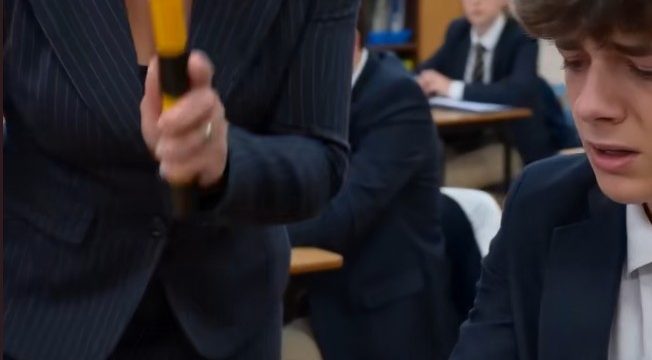
The pointer hovered above a child’s trembling hand, and twenty-two sixth graders sat too frightened to intervene. Behind their teacher, the American flag hung motionless; at the back of the classroom, someone was reaching for a phone.
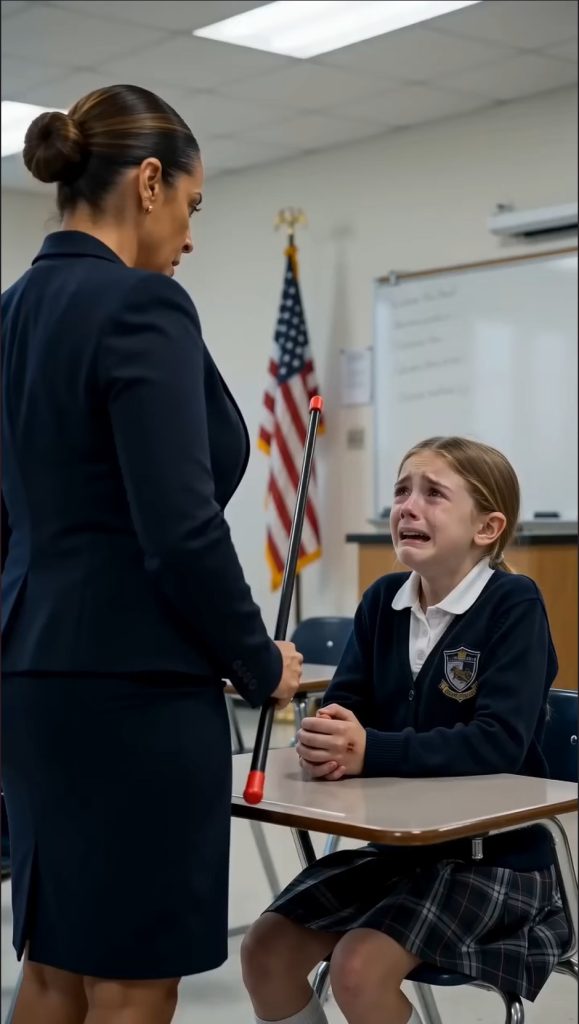
Violet stood beside her desk, left arm extended, palm down. Mrs. Reeves gripped the telescopic pointer in her right hand.
“Hold still.”
The first strike snapped across Violet’s hand. She recoiled, clutching it to her blazer as pain burned through her fingers, but Mrs. Reeves merely watched her struggle to breathe.
“Again.”
“Please, Mrs. Reeves—”
“Your hand.”
Tears gathered as Violet offered it a second time. Another crack, another gasp; around her, classmates shifted without daring to stand.
At the back, Harper lowered her textbook and began recording with her phone hidden behind its pages. She had missed the first blow. She would not miss another.
“One last time,” Mrs. Reeves said.
Violet looked around. Everyone knew the teacher controlled grades, recommendations, and discipline reports. Nobody wanted to become the next student she called difficult.
The third blow made Violet squeeze her eyes shut. She hugged her injured hand against her chest while Mrs. Reeves lowered the pointer.
“Now perhaps you’ll answer my question.”
“What question?” Violet whispered.
“Why haven’t you enrolled in my Leadership and Communication Lab?”
For a moment, confusion eclipsed fear.
“Because it’s optional. I chose Robotics Design.”
Mrs. Reeves stepped closer.
“Your father sends you to one of the best schools in the country, and you choose toys over my program?”
“They aren’t toys. I like robotics.”
The pointer lifted an inch. Violet instantly curled her injured hand against her blazer.
“If your name isn’t on my list next week, I’ll take points off your English grade.”
“That’s not fair,” Violet said. “My English grade shouldn’t depend on an elective.”
“Everything here depends on judgment,” Mrs. Reeves replied, tapping the pointer against her palm. “And yours is poor.”
Harper’s hand shook behind her book. Her recording held Violet’s frightened face, the blows, the threat. If caught with her phone, she could face punishment, but doing nothing felt worse.
She stopped recording and opened a message thread with Violet’s father, Adrian. She had his number because he’d arranged transportation for a science competition earlier that semester.
Harper attached the video.
What if this made things worse? What if Violet blamed her?
“You’ll stay after class,” Mrs. Reeves told Violet, “until you understand what loyalty to this school means.”
Harper pressed SEND.
Six thousand miles away, Adrian sat in an elegant private business lounge overseas, a newspaper open on his lap. Two professional bodyguards stood behind him when his phone vibrated.
He nearly ignored it.
Then he saw Harper’s name and opened the video.
His daughter extended her injured left hand. The pointer struck. Violet flinched.
It struck again.
Then Mrs. Reeves threatened to lower her grade for choosing a different elective.
Adrian stood so abruptly the newspaper slid to the floor. Both guards straightened as he replayed the footage, disbelief hardening into controlled rage.
“Book me a flight back to the States,” he said into his phone. “I need to leave right now.”
He called Violet.
No answer.
He tried again.
Nothing.
He had praised that school’s standards, its discipline, and demanding teachers. Now he could think only of his daughter standing alone while an entire classroom watched.
“Do you need the car, sir?” a bodyguard asked.
“Yes.”
Adrian seized his coat.
Before he reached the door, another message arrived from Harper.
Just seven words.
“She said this has happened before.”
He stopped.
His eyes remained fixed on the screen.
One teacher’s cruelty was horrifying enough. But those seven words suggested something much larger, something his daughter might have been enduring without ever telling him.
And the truth behind them was only beginning to surface. 👇
Adrian’s thumb pressed Harper’s number before he realized he was calling. She answered on the fourth ring, her voice almost too low to hear.
“Is Violet still with her?”
“I think so. The bell rang, but Mrs. Reeves shut the door.” A breath trembled through the receiver. “Violet told me she did it to a boy last month. He reported her. Then his grades started falling.”
Adrian stared at the departure board. “Harper, you did the right thing. Go to the office and stay there.”
He called the headmaster next. “My daughter is not to be left alone with Mrs. Reeves. Preserve every relevant record. Have someone stay with Violet until she can be taken home safely.”
Across the ocean, Violet sat with her sore hand beneath the desk. When the counselor appeared, Mrs. Reeves smiled.
“There’s been a misunderstanding,” she said.
The counselor looked past her. “Violet, bring your things.”
Violet’s chair scraped the floor as she stood. Only in the corridor did she begin to cry.
Adrian reached home the following evening. Violet sat at the kitchen table, turning a spoon in her right hand. The school nurse had bandaged her left.
He stopped at the doorway. Once, she would have raced to meet him. Tonight she didn’t move.
“May I sit?” he asked.
She nodded.
He sat beside her, leaving space between them. “I saw the video.”
“I know.” Her eyes remained on the spoon. “Everybody will know now.”
“Not unless you want them to. Harper sent it to me, not the internet.”
“She hurt another kid, Dad. He tried telling someone, and she made him look like a liar. I thought if I stayed quiet—”
“Look at me for a second.”
He struggled to hold her gaze. “I kept saying that school was good because it was strict. When you said it frightened you, I told you to work harder.”
“You were always traveling.”
“That didn’t make you less important.” He swallowed. “It made it my job to listen better.”
Violet placed her bandaged hand between them. He waited until she turned her palm toward him before touching it.
The next morning, they entered the headmaster’s conference room together. Harper waited outside with her mother. Other families had been invited after hearing privately about the recording.
Mrs. Reeves sat across the table in a dark jacket. The headmaster offered to move Violet to another English class and erase disciplinary notes.
“We would prefer to handle this without upsetting the children further,” he said.
Adrian glanced at his daughter. “What do you want?”
Violet stared at the polished table. Then she lifted her chin. “I want her to stop hurting people.”
Mrs. Reeves gave a small, incredulous laugh. “I have devoted twenty years to teaching discipline. I will not have my career destroyed over a child who refuses guidance.”
Adrian played the video. Nobody interrupted.
When the sound stopped, the headmaster folded his hands. “There have been no substantiated reports of previous incidents.”
“That’s not true.”
The voice came from the doorway.
A boy named Daniel stood there with his mother and the counselor. His face was pale, but he held a folded sheet of paper in both hands.
“I gave this to the office last month,” he said. “Mrs. Reeves hit me because I asked to switch out of her lab. They told me I must have misunderstood what happened.”
His mother laid the dated complaint on the table beside the school’s written response, which called the matter closed.
Silence spread through the room.
The counselor looked directly at the headmaster. “There is another complaint in my files. I forwarded it to your office in the spring.”
Mrs. Reeves’s chair scraped backward. “Those students are repeating each other’s stories.”
“No,” Violet said softly. “We were afraid of telling them.”
Adrian felt her hand searching for his beneath the table. He took it carefully.
The headmaster reached for the papers, but Daniel’s mother kept one finger on them. “We have already contacted an attorney and the proper child-protection authorities. Copies are outside this room.”
Mrs. Reeves looked toward the door, suddenly uncertain of her power.
The headmaster began to mention procedures. Adrian stopped him.
“Whatever you do next, do it in writing. And nobody retaliates against these children. Not for their grades. Not for their phones. Not for speaking.”
Mrs. Reeves offered no apology. The school removed her from teaching duties immediately, and an independent investigation began.
More students spoke. Records revealed grade reductions after complaints and elective transfer requests. The headmaster resigned when investigators uncovered dismissed warnings.
Months later, Mrs. Reeves was dismissed permanently and lost her teaching certification after a formal hearing. She pleaded guilty to assault charges. The courtroom was silent as the judge announced her sentence and ordered her to stay away from the children.
Violet had expected to feel triumphant. Instead, she sat outside the courtroom holding a paper cup of water with both hands, unable to drink.
“Is it really finished?” she asked.
“The case is,” Adrian said. “You don’t have to feel finished today.”
Daniel passed them in the hallway and gave Violet a shy nod. His mother had told Adrian that his grades were being independently reviewed and corrected. Harper, meanwhile, had received a letter confirming she would face no punishment for recording what happened.
On the drive home, Violet watched sunlight move across the dashboard. “I thought if I told you, you’d make me leave robotics.”
“Why?”
“Because you liked the school more than you liked hearing bad things about it.”
Adrian gripped the steering wheel. He could have defended himself. Instead he said, “I gave you a reason to think that. I’m sorry.”
“I still want to build things,” Violet whispered.
“Then we’ll find somewhere safe for you to do it.”
Her new school had a robotics workshop with scratched tables and mismatched parts. At first she stayed near the door. When projects failed, her teacher pulled up a chair and asked what she wanted to try next.
By winter, Harper joined her there on Saturdays. Daniel came too, preferring design sketches to motors. Gradually, they laughed together again.
At the next science showcase, Adrian arrived early and took a seat in the front row. Violet spotted him while checking the wiring of a small mechanical hand. She lifted her own left hand in greeting, its old marks finally faded.
After the demonstration, Harper approached Adrian holding a folded paper card.
“I kept this,” she said. “From the competition you organized transportation for.”
It was the emergency contact card he had given the team. On the back, in Violet’s unmistakable handwriting, were words Adrian had never seen.
“If you get scared and I can’t help, call my dad. He’ll listen.”
Adrian read the sentence twice. He had spent months wondering whether he could ever earn his daughter’s trust again. All that time, she had been carrying a faith in him he had nearly failed to deserve.
“Did you know she wrote this?” he asked Harper.
Harper nodded. “She told me grown-ups don’t always notice things. But she said you would, if somebody showed you.”
Across the workshop, Violet was trying to put a fallen screw back into its box. Adrian walked to her, crouched beside the table, and held out the card.
“You believed I’d come,” he said.
Violet looked at it, then at him. “I hoped you would.”
He opened his arms without moving closer. She stepped into them, the way she used to when she was younger, and held on.
Later, at home, the mechanical hand sat on the kitchen windowsill, gently opening and closing beneath the evening light. Violet worked beside her father at the table while he steadied a tiny screw for her.
Outside, the neighborhood settled into quiet. There was no pointer striking a desk, no phone lighting up with terrible news, and nowhere Adrian needed to fly.
When Violet reached for another tool, her father was already there to pass it to her.