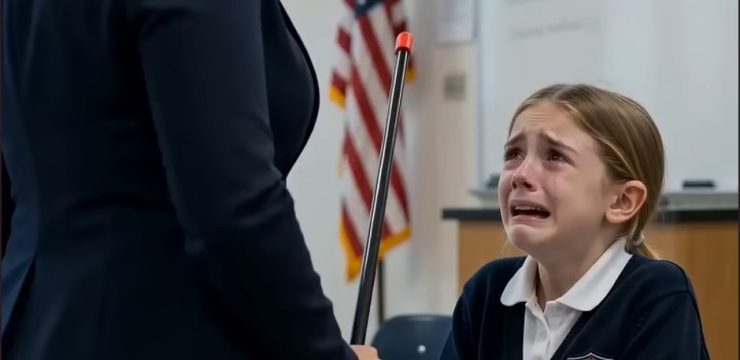
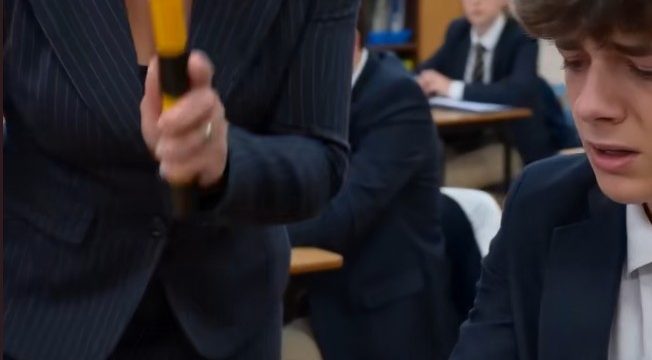
The ruler hovered above a child’s bandaged hand. Twenty-one seventh graders sat frozen while their teacher waited for the girl kneeling on the floor to obey. And someone outside the classroom was about to witness something no parent should ever have to see.
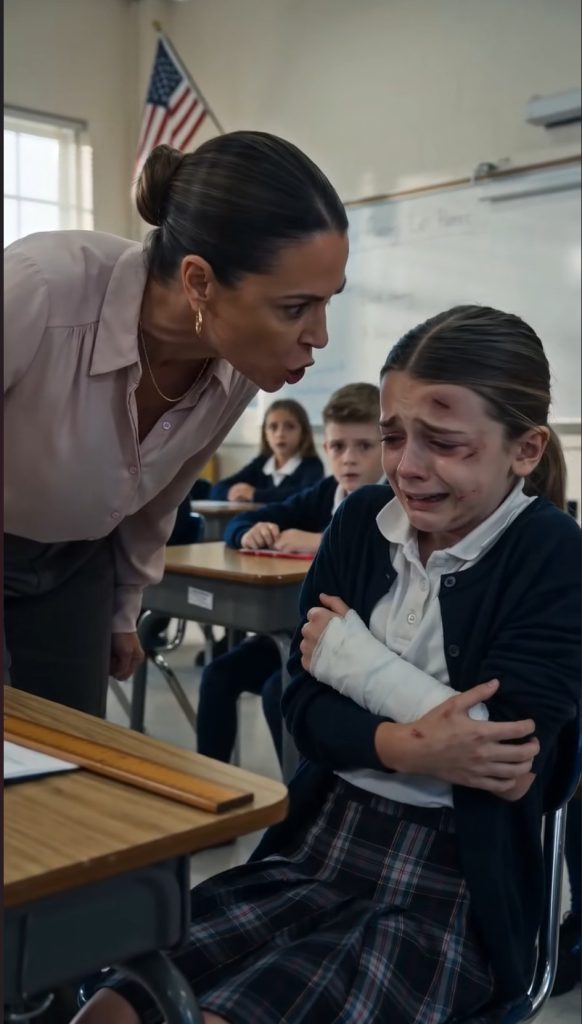
“Hand out,” Mrs. Carlson ordered.
Emily Parker pressed her injured right hand to her chest. Three days earlier, a fall at a skating rink had left her with a severe sprain and possible tendon irritation. The doctor had found no fracture, but had instructed her not to write and provided a school note.
Emily thought she would take the benchmark test later. Instead, on Monday, Mrs. Carlson insisted everyone finish before the class rankings closed.
Emily tried using her left hand. She completed barely six questions and scored twenty-three percent.
Now she was kneeling in front of her classmates, blamed for dropping their class from second place to fifth.
“You’re usually one of my best students,” Mrs. Carlson said, gripping the wooden ruler she normally used at the whiteboard. “Sorry doesn’t change numbers.”
“I couldn’t finish,” Emily whispered. “My hand hurt.”
The ruler slammed against the desk.
Emily jolted. So did several classmates. The ruler had not touched her, but its crack silenced the entire room.
“Next time, I won’t let the class down,” she managed.
“Next time?” Mrs. Carlson stepped closer. “You think there’s going to be a next time?”
She lifted the ruler higher.
Emily slowly extended her bandaged hand, fingers trembling, wrist aching. Behind her, Kayla Ortiz covered her mouth. No one dared speak.
Then a voice thundered from the doorway.
“WHAT THE HELL ARE YOU DOING?”
Mrs. Carlson froze with the ruler raised. The anger drained from her face before she even turned.
“Put the ruler down.”
Emily knew that voice.
Her mother, Rachel Parker, had come during her lunch break with an updated orthopedic note. A radiologist had reviewed Emily’s images again, and the clinic wanted her to avoid writing for the rest of the week. Rachel had expected to deliver the note to the nurse.
Instead, she had heard the shouting. The desk strike. The demand to hold out a hand.
Now she saw her daughter kneeling beneath the ruler.
“Put your hand down, sweetheart.”
Rachel crossed the room, crouched, and helped Emily stand. Her knees shook.
“This isn’t what it looks like,” Mrs. Carlson said.
“Then tell me why my injured child was on her knees.”
“Classroom discipline. Academic accountability.”
“For getting hurt?”
“For damaging our class ranking.”
Rachel glanced at Emily’s bandage. “She had a medical note.”
“I never received it.”
“Yes, you did. The nurse confirmed it was forwarded Monday morning.”
Mrs. Carlson fell silent.
Then Kayla spoke from the third row.
“She knew. Emily told her Monday.”
“Enough,” Mrs. Carlson snapped, pointing the ruler toward Kayla.
“Put it on the desk,” Rachel said.
The teacher obeyed. Rachel drew Emily close.
“We’re leaving.”
“You cannot remove her during instruction.”
“Watch me.”
The classroom phone rang.
Mrs. Carlson answered, listening in strained silence.
“She came in before I could finish.”
Rachel went cold.
“Who is that?”
“Assistant Principal Hayes.”
Into the receiver, Mrs. Carlson added, “No, the ruler never touched her.”
Not nothing happened. Just that the ruler had never made contact.
Rachel demanded the principal, but he was in a district meeting. Moments later, Assistant Principal Laura Hayes entered and glanced at Emily, Rachel, and the ruler lying on the desk.
Her first words were not a question about Emily’s safety.
“Before anyone says anything else, we need to keep this contained.”
Rachel held her daughter tighter.
Suddenly, the ruler was no longer the most troubling thing in that room. 👇
Laura Hayes reached behind her and eased the classroom door toward its frame. The latch clicked softly. In the stunned silence, it sounded deliberate.
“Open it,” Rachel said.
Hayes hesitated. “Mrs. Parker, these children don’t need to be involved in an adult dispute.”
“They’re already involved.” Rachel kept one arm around Emily. “Twenty-one of them watched what happened.”
Emily’s bandaged fingers curled into Rachel’s sleeve. From the third row, Kayla looked up, then quickly lowered her eyes when Mrs. Carlson turned.
Hayes drew a careful breath. “I think everyone would benefit from a private conversation.”
“Emily would benefit from a nurse. And I want the principal notified that there are witnesses.”
Mrs. Carlson shifted toward her desk. The ruler lay across a stack of worksheets, its dark markings suddenly ordinary again. Rachel took a photograph of it where it rested, keeping the children outside the frame.
“You can’t photograph my classroom,” Mrs. Carlson said.
“I’m photographing the ruler you held over my daughter.”
A small voice interrupted them.
“She told Emily to use her left hand on Monday,” Kayla said. “Emily kept saying it hurt. Mrs. Carlson said the rankings couldn’t wait.”
Mrs. Carlson opened her mouth, but Hayes raised a palm.
Rachel felt Emily lean more heavily against her. They walked into the corridor, where the fluorescent lights hummed over rows of lockers. Behind them, the classroom remained painfully quiet.
At the nurse’s office, Emily sat while her mother checked the bandage. Her skin above the wrapping was warm, and she flinched when Rachel lightly touched her forearm.
“Did she make you do that before?” Rachel asked.
Emily shook her head. “She hit the desk when people got answers wrong. I thought if I just did what she said, she’d stop being mad.”
Rachel could barely steady her voice. “You never have to hold out an injured hand for somebody to punish.”
“But I made everybody fifth.”
“No.” Rachel knelt in front of her. “A test score isn’t something you owe your classmates. And you didn’t choose to be hurt.”
Emily looked unconvinced. That hurt Rachel more than any argument with Mrs. Carlson could have.
The nurse arrived carrying the original email on her tablet. She had forwarded the medical note Monday morning, exactly as Rachel remembered. Mrs. Carlson was on the recipient line.
So was Assistant Principal Hayes.
Rachel stared at the screen. “She said she’d never seen it.”
The nurse scrolled to the reply beneath the forwarded message. It was from Hayes: Please ensure benchmark completion before the reporting window closes. Accommodations can be addressed afterward.
For a moment, even the hum of the lights seemed distant.
Hayes appeared at the doorway and stopped when she saw the tablet. Her gaze flicked from the message to Rachel’s face.
“You knew,” Rachel said.
Hayes pressed her lips together. “I was talking about the reporting deadline. I didn’t authorize anyone to threaten a student.”
“You told them to test my daughter first and protect her hand later.”
“I should have been clearer.”
Rachel looked toward Emily, who had gone very still. “You’re going to put that explanation in writing. So am I.”
The principal returned from his district meeting before the end of the school day. Rachel spoke to him with Emily seated beside her and the nurse present. When he asked if Emily wanted to tell him anything, she stared at the floor.
Rachel did not force her.
Then Emily whispered, “I thought she was going to hit my hand.”
The principal set down his pen.
That afternoon, Mrs. Carlson was removed from classroom duties while the district reviewed the incident. Hayes was relieved of responsibility for the inquiry. The students were interviewed separately, with their families informed. Rachel kept copies of the medical notes, the email chain, and every message the school sent.
For several nights, Emily woke at small noises. At the kitchen table, she instinctively hid her bandaged hand whenever she made a mistake with homework. Rachel stopped correcting the work and sat beside her instead.
One evening, Emily asked, “Did you think I was being bad when I got twenty-three percent?”
Rachel put down her mug. “I thought you were trying to take a test you should never have been asked to take.”
“Even if I’d gotten zero?”
“Even then.”
Emily watched her mother’s face for a long moment, searching for a condition attached to the answer. When none came, she leaned against her.
The investigation took two weeks. In the meeting that followed, the principal laid the findings on the table without asking Emily to relive them.
The report confirmed that Mrs. Carlson had received the medical restriction. She had insisted Emily complete the assessment, submitted the incomplete score, and ordered her to kneel in front of the class. Witnesses independently described the raised ruler and Emily’s extended hand.
Mrs. Carlson had argued that she never intended to strike the child. But the district found that intent did not erase intimidation, public humiliation, or the deliberate disregard of a medical restriction.
Her employment was terminated following the district’s disciplinary process. She would not return to Brookstone Middle School.
Hayes’s reply had also become impossible to explain away. She had known the accommodation conflicted with the testing deadline and failed to intervene before it was ignored. Her instruction to keep the confrontation “contained” further undermined the school’s response. She was removed from her position, and the district announced a separate review of its reporting practices.
Rachel read the findings twice. Her hands were steady. She had imagined this moment bringing satisfaction, but the chair beside her was empty. Emily had chosen to stay home rather than attend.
“What happens to her score?” Rachel asked.
The principal turned another page.
The benchmark dashboard, he explained, had displayed an unofficial classroom comparison. Emily’s test should have been coded incomplete pending her medical accommodation. Once corrected, it would not lower the class average.
Rachel felt her chest tighten. “So she didn’t take them from second to fifth?”
“No,” he answered. “That was never an official ranking.”
At home, Rachel told Emily everything except the details her daughter did not want to hear. Mrs. Carlson would not teach her again. Hayes would no longer be in charge. The school had admitted it failed her.
When Rachel explained the score, Emily stared at the edge of the couch.
“Then why did she say it?” she asked.
Rachel paused. “Because she cared more about a number on her screen than about what was happening to you.”
Emily’s eyes filled, but her voice was clear. “I thought everybody hated me.”
Rachel gathered her close. This time, Emily didn’t try to apologize.
Brookstone changed how medical accommodations were shared and confirmed. Staff received new procedures for assessment exceptions, and students were given a way to report intimidation without first approaching the adult involved.
Kayla’s family received assurances that she would face no retaliation for speaking up. When Emily saw her again, Kayla’s first words came out in a rush.
“I wanted to say something sooner. I was scared.”
“Me too,” Emily said.
They stood together by the lockers until Kayla reached for her uninjured hand.
Emily returned to class gradually, with permission to type while her wrist healed. She still tensed whenever a wooden ruler scraped against a desk. Her new teacher noticed and quietly put the ruler away, without making her explain.
Then, on her first full Friday back, Kayla handed her a plain envelope.
Inside were twenty-one small notes, one from each classmate who had sat in that room. Some were awkward, written in uneven pencil. One said, I looked down because I was afraid, not because you did something wrong. Another read, I should have spoken up. I’m glad your mom came.
At the bottom of Kayla’s note was a sentence Emily read three times: We weren’t worried about fifth place. We were worried about you.
Emily had remembered twenty-one silent faces as proof that she had disappointed everyone. All this time, those same classmates had remembered a frightened girl trying to protect her injured hand.
She carried the notes home pressed against her chest, not hidden there like the bandage, but held carefully, as something precious.
That evening, Rachel found her at the kitchen table arranging them into a little stack. Outside, the last sunlight rested on the windowsill. Emily’s bandage had been replaced by a smaller support, and she could turn the pages without wincing.
“Can I keep these forever?” she asked.
Rachel sat beside her. “Of course.”
Emily picked up a pencil in her left hand and wrote a reply on the back of Kayla’s note. She worked slowly, not because someone was timing her, but because she wanted every word to be right.
Thank you for seeing me.
When she finished, she placed the pencil down and rested her healing right hand, palm open, on the table. Rachel covered it lightly with her own, and neither of them pulled away.