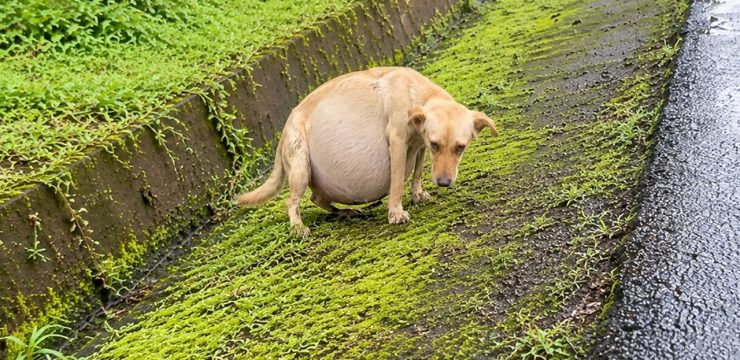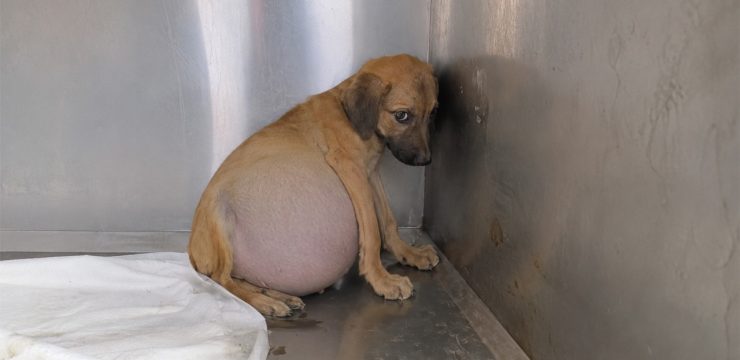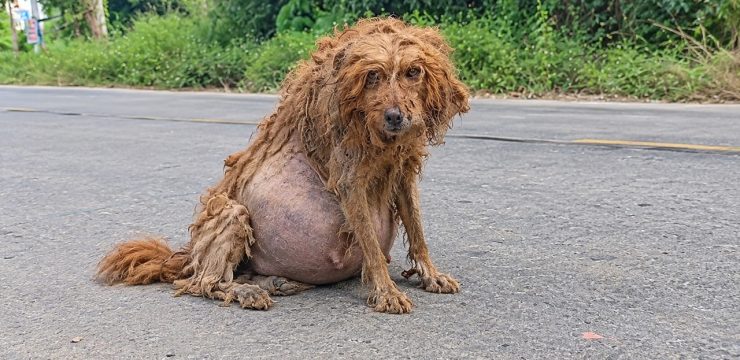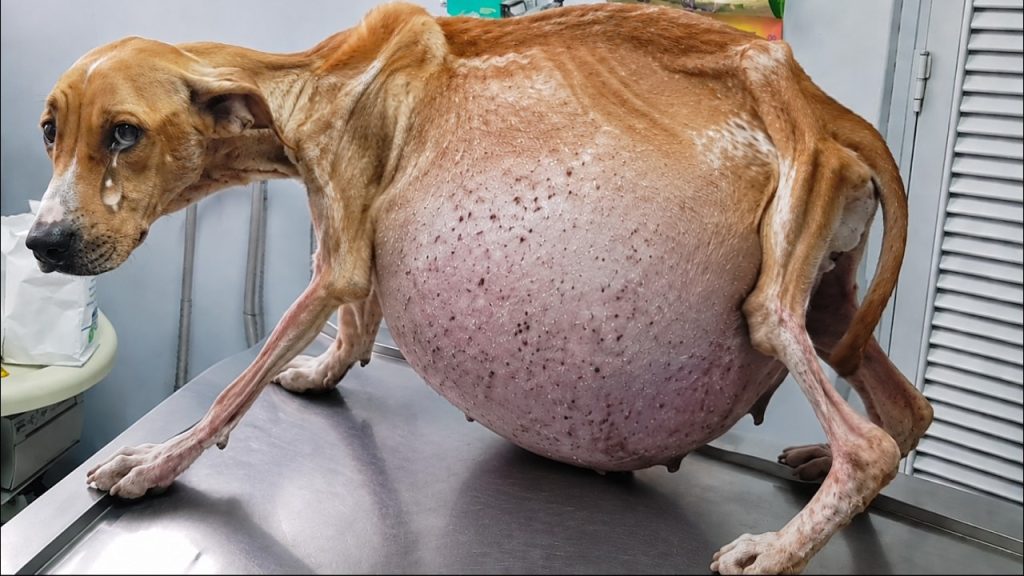
There was a cruel contrast in the way Victoria looked. Beneath the enormous swelling was a dog weakened by severe malnutrition, her body reduced almost to skin and bones. Fluid had collected not only in her abdomen but also in her legs. Even breathing, something a healthy dog does without effort, had become difficult.
The veterinarians discovered that serious liver disease was behind the buildup of fluid. But that was only part of Victoria’s medical burden. She also had an irregular heartbeat, anemia, ehrlichiosis, and a transmissible venereal tumor, known as TVT. Each condition complicated the work ahead. Together, they made her situation especially serious.
For anyone who has loved a dog, it is painful to imagine such a gentle animal carrying so many illnesses at once. Victoria could not simply be given a meal and sent somewhere comfortable. Her swollen abdomen was making it hard to breathe, and her weakened body needed careful treatment. The priority was relieving that pressure without creating another problem.
Removing all the fluid at once would have put her at risk of shock. Instead, the veterinary team drained her abdomen carefully over three consecutive days, taking only an amount considered safe each time. They also gave diuretic medication to help her body eliminate remaining fluid.
It was delicate work, guided by the need to help Victoria while protecting a body already under tremendous strain. The team could not rush simply because her need was urgent. Every treatment had to respect what she could safely tolerate.
And the difference mattered.
As the pressure eased, Victoria could finally breathe more comfortably. She was able to sleep better, too. To someone watching over a beloved pet, an easier breath and a restful sleep might seem like small victories. For a dog who had struggled just to draw air, they represented something precious: relief.
The improvements continued. Victoria began walking on her own, her breathing stabilized, and she showed encouraging signs of responding to medication. Her progress did not erase her other conditions, but it gave her caregivers a reason to keep moving forward with hope.
There is a special kind of joy in seeing an animal regain an ordinary ability that illness has stolen. A few steps may not look remarkable when a dog is healthy. After the ordeal Victoria had endured, being able to walk without assistance held a meaning far greater than distance.
But the greatest medical challenge was still ahead.
An ultrasound revealed that Victoria’s spleen had become enlarged because of a large tumor. It was another grave finding for a dog who had already required so much care. The veterinarians knew that surgery was necessary, yet they also had to consider how physically vulnerable she remained.
Victoria received a blood transfusion to help prepare her for the operation. The team faced a difficult reality: the surgery could no longer wait, even though enough money had not yet been raised to cover the cost. Her medical need came before the fundraising was complete.
That decision carried both urgency and responsibility. Victoria depended on the people treating her to make the best possible choices in a frightening situation. They could not promise an easy outcome. What they could do was give her the chance that treatment offered.
The veterinarians performed an emergency operation to remove her spleen along with the enormous tumor. It was a major procedure, especially after the illnesses Victoria had faced. The operation was successful.
Her second chance was no longer only a hope.
Recovery still mattered. Surgery could address the tumor, but Victoria had endured severe illness, malnutrition, and invasive treatment. Becoming well again meant more than surviving an operation. Her body needed the opportunity to regain strength, and she needed continued care as that happened.
What followed was a change grounded in simple, visible signs of health. Victoria’s appetite returned. She gradually gained weight. The energy that illness had taken from her began to return as well. The dog who had arrived barely able to breathe was now growing stronger.
These changes may sound ordinary to anyone whose dog eagerly approaches a meal or moves through daily life with ease. Yet ordinary things can become extraordinary when they have been absent for so long. Food, rest, movement, and comfort are not luxuries to an animal recovering from serious disease. They are part of a life worth protecting.
Throughout the difficult treatment, Victoria remained gentle, cooperative, and resilient. Her calm nature was especially moving in light of everything her body had been through. She did not need to understand the complicated names of her illnesses for her caregivers to recognize the simple truth: she deserved patient, attentive help.
Her story was never about one dramatic procedure alone. It was about careful fluid drainage when breathing was difficult, medication when her body needed support, a transfusion before a necessary operation, and the determination to proceed with surgery despite a funding shortfall. Each part mattered, and no single act could replace the others.
Eventually, Victoria made a full recovery. She was healthy, happy, and able to enjoy life again. Her ending was not defined by the swollen abdomen or the frightening list of diagnoses that had marked her arrival.
It was defined by the care she received and the strength she showed while healing. Victoria’s journey is a reminder that compassion does not always arrive as one grand gesture. Sometimes it takes the form of careful decisions, steady medical attention, and people who refuse to turn away when helping is difficult.
A gentle dog once struggled for every breath. Now Victoria has the chance to live in health and happiness, a chance every animal deserves.