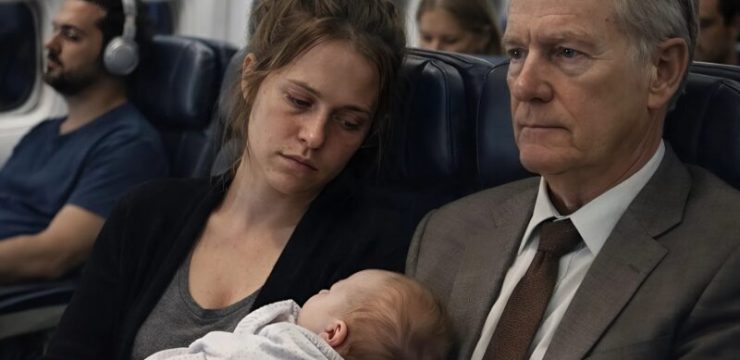
The father stared at the locket in the old woman’s trembling hand.
The mother stared at the old woman’s face — a face that seemed to carry the weight of decades, carved by grief and sleepless nights and prayers that went unanswered for far too long.
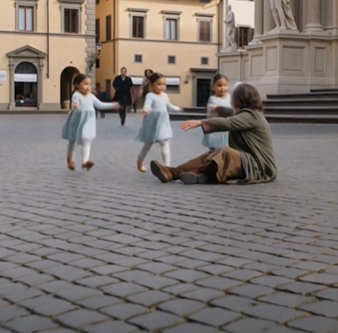
And the three little girls stayed pressed against her as if they belonged there. As if something ancient and invisible had already claimed them.
The mother’s lips trembled.
“What did you just say?” she whispered.
The homeless woman looked at her through tears that spilled freely, without shame.
“I buried it with your mother,” she said again, her voice barely above a breath. “The night they told me she was dead.”
The mother felt her knees weaken beneath her.
Because she had spent her entire life believing one story — the only story anyone had ever given her. That she had been found alone. That she had been taken into care, passed through the system, and eventually adopted after an accident no one could fully explain. No grandmother. No extended family. No roots. No past worth speaking of.
Only paperwork.
Always paperwork.
The father stepped forward carefully, placing himself between the old woman and his wife with the quiet protectiveness of a man who would do anything to shield the people he loved.
“How do you know her?” he asked, his voice steady but his eyes uncertain.
The old woman’s face crumpled like old parchment.
“She was my daughter.”
The mother covered her mouth with both hands.
The triplets clung tighter to the old woman — still calling her Nonna, still holding onto her coat as if letting go was unthinkable — as if some deeper part of them understood what the adults had not yet fully processed.
The father looked stunned. He shook his head slowly.
“That’s impossible,” he said. “Her records say she had no living relatives. They were thorough. We checked everything before—”
“Her records were bought,” the old woman whispered.
Silence fell over the square like a heavy curtain.
The wind moved lightly through the cobblestones, carrying with it the faint smell of old stone and something else — something that felt uncomfortably like truth.
The old woman looked at the mother with an expression of unbearable grief, the kind that doesn’t soften with time but simply becomes a permanent part of who you are.
“They took her after the fire,” she said slowly, carefully, as if each word cost her something. “A man came with official papers. He told me my daughter had died in the hospital and that the child — you — had already been placed elsewhere. I searched. For years, I searched. I spent everything I had. I lost everything trying to find you.”
The mother’s eyes filled with tears she could not hold back.
The old woman reached out with shaking fingers and gently touched the silver locket she still held in her palm.
“I kept this,” she said softly, “because it was the only thing they left me of her.”
The father frowned, his mind trying to find the logical thread.
“Then why are the girls calling you Nonna? They’ve never met you before today. How do they even know that word?”
At that question, the old woman went completely still.
Her eyes dropped slowly to the three toddlers pressed against her legs.
Then back up to the mother.
“They’re not just calling me that,” she whispered.
“They know the song.”
The mother froze.
Because at that exact moment, one of the little girls began to hum softly.
Then the second one joined in.
Then the third.
Together — without hesitation, without prompting — they hummed a lullaby.
Old. Italian. Fragile as spun glass.
The mother’s face broke open completely.
It was the lullaby from her very earliest memory. A melody she had carried in the back of her mind since childhood, something she had never been able to explain and had never once sung aloud in front of her daughters. Not once. Not ever.
“How?” she whispered. “How do they know that?”
The old woman wept openly now, without hiding it.
“My daughter used to sing that to you,” she said, her voice breaking on every word. “Before everything happened. Before they took you. And her mother — I — sang it to her first. It belonged to all of us.”
The father looked around the sunlit square as if the ground beneath him had quietly shifted in a direction he hadn’t expected.
But the most chilling moment had not yet come.
Because the old woman suddenly turned her head sharply toward the far edge of the piazza.
Her entire body went rigid.
The mother followed her gaze without thinking.
A man in a dark coat stood near a stone archway at the edge of the square. He wasn’t moving. He was simply watching. Too still. Too focused. His eyes were fixed on the small group with an expression that carried no warmth whatsoever.
The old woman’s voice dropped to a terrified whisper.
“That’s the man who took you.”
The mother went cold from the inside out.
The father stepped immediately in front of his family, his posture shifting into something fierce and protective without a word.
But the old woman seized his sleeve with a grip that was surprisingly strong for someone who looked so fragile.
“Don’t let him leave,” she said urgently, her eyes locked on the man across the square. “He knows what they did. He knows what happened to her real mother. He knows everything.”
The triplets began to cry all at once.
The man beneath the archway slowly turned his head.
He looked directly at them.
And then he began to walk — steadily, deliberately — into the crowd and toward the far end of the piazza, moving as if he had done this before. As if disappearing was something he was very good at.
The square erupted into motion, voices, pigeons scattering.
And just like that — he was gone.