Nobody in that funeral parlor expected what happened next. The flowers were arranged. The chairs were filled. The grief was real — at least for most of them. Evelyn lay still inside the white-lined coffin, dressed in the gown her mother had picked out the night before. Her husband Daniel stood near the front, accepting condolences with a solemn face and steady hands. Everything looked exactly the way it was supposed to look.
Except for the maid.
She had been standing near the back of the room, quiet, watching. Her name was Rosa, and she had worked in that household for nearly eleven years. She knew the sound of that house. She knew its routines, its rhythms, and its silences. And she knew Evelyn — not just as an employer, but as a woman she had watched slowly disappear over the past several months.
Rosa had noticed the changes long before anyone else was willing to say anything out loud. The way Evelyn moved through rooms like she was carrying something heavy no one else could see. The way she sometimes gripped the kitchen counter and stared out the window with eyes that had gone somewhere far away. The trembling. The exhaustion. The days she could barely make it down the stairs.
And the medicine.
Daniel had always been the one to handle Evelyn’s prescriptions. He said it was easier that way. He said he didn’t want her to worry about the details. He was so attentive, people often remarked on it. Such a devoted husband.
Rosa had never believed that.
She had found a pill once — just one — tucked beneath the edge of Evelyn’s bed frame. Small and white and ordinary-looking, except that it wasn’t the medication Evelyn had been prescribed. Rosa had kept it, folded carefully inside a tissue, and said nothing. Because saying something in that house meant saying it to Daniel. And Rosa had learned not to trust Daniel a long time ago.
Then Evelyn died in her sleep.
Or so Daniel said.
The doctor who signed the death certificate was Daniel’s younger brother. The funeral was arranged within two days. Everything moved so fast that most people didn’t have time to ask questions. Rosa had questions. Rosa had nothing but questions. But she was the maid. Who was going to listen to her?
She listened instead.
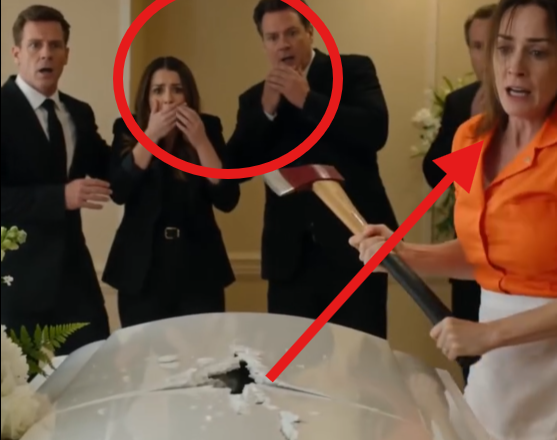
The morning of the funeral, before the guests arrived, Rosa walked slowly past the closed coffin. She stopped. She stood very still. And then she heard it — a sound so faint it barely existed. A soft, rhythmic knock from inside the wood. Barely there. Easy to dismiss as the settling of an old building or the trick of a grieving mind.
Rosa did not dismiss it.
She pressed her hand flat against the lid and felt it again. Then she did something that would have seemed unthinkable to everyone else in that room. She started to open it.
The chaos that followed happened fast. A man rushed toward her — not to help, but to stop her. Two mourners grabbed him before he reached her. Rosa screamed and pushed with both hands against the lid. The wood groaned and cracked. And when the coffin finally opened just enough, everyone in that room saw Evelyn — still breathing, still wearing her white funeral dress, her fingers trembling weakly against the satin lining, her lips faintly blue.
The cry that went through that room was something people who were there would carry with them for the rest of their lives.
Rosa reached inside and took Evelyn’s hand immediately. She whispered that she was there. That she had heard her. That she wasn’t going to let go. Evelyn’s eyes opened just barely — but they opened.
Then Rosa turned toward Daniel.
She pulled out the folded tissue with the pill inside. She held up Evelyn’s cracked phone, where one message was still visible on the screen. A message Evelyn had typed and apparently never sent — or maybe had sent and hoped someone would find.
If I don’t wake up, don’t let Daniel bury me.
The room went completely silent.
Evelyn’s mother made a sound that no parent should ever have to make. Daniel began shaking his head, repeating that Evelyn had been sick, that the doctor had confirmed it, that none of this was what it looked like. But then Rosa said, quietly, what everyone in that room heard perfectly clearly.
The doctor was his brother.
There are silences that feel like the air has been pulled out of a space entirely. That was the silence that followed.
Evelyn’s fingers tightened weakly around Rosa’s hand. Her lips moved. Rosa leaned in close, and the whole room leaned with her without realizing it. Evelyn’s voice came out in a broken whisper, barely more than breath.
He wanted the house.
Daniel moved toward the door. He didn’t make it.
The mourners who had come to grieve closed in around him as sirens began to sound faintly in the distance outside. Someone had already made a call. Rosa stayed where she was, half-inside the coffin, holding Evelyn’s face gently in both hands, crying the way people cry when relief and horror arrive at exactly the same moment.
“I heard you knocking from the hallway,” Rosa whispered. “I knew you weren’t gone.”
Evelyn’s eyes filled slowly with tears.
And as the room finally moved to help the woman they had all come to mourn, Evelyn lifted one trembling finger toward the man she had married — the man who had stood in that room accepting sympathy while she lay trapped inside a box — and whispered the sentence that told everyone exactly what kind of monster had been living behind that careful, grieving face.
He watched me wake up.
Some betrayals are so deep they don’t have words. This one didn’t need them.