The coffee cup slipped from her fingers and landed on the table with a dull, hollow crack.
She didn’t even look at it.
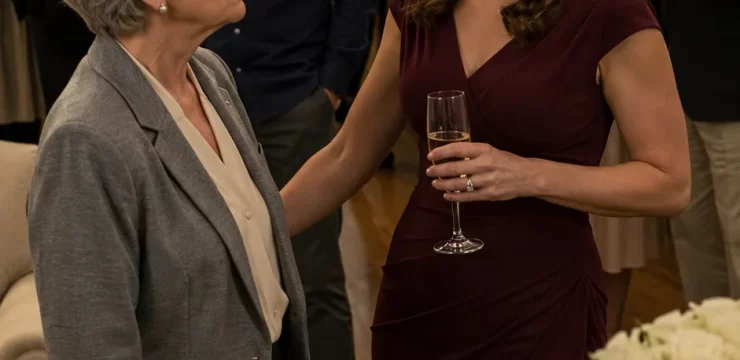
Every muscle in her body had locked into place the moment she saw the woman standing near the hedge. The world around her — the murmur of conversations, the soft clink of dishes, the warmth of the afternoon sun — all of it fell away in an instant. There was only that figure in beige, standing still as if she, too, had been struck by lightning.
“Lena…”
The name left her lips like something that had been sealed inside her chest for years, finally breaking free after a lifetime of silence.
The woman by the hedge didn’t answer right away. She simply stood there, her composed expression slowly unraveling, layer by layer, as the weight of being truly seen after so long became too great to bear. Her eyes stayed locked on the woman in black — but every few seconds, they drifted downward. To the boy. To the small, uncertain child standing beside her with dirt on his hands and questions written all over his face.
As if she still couldn’t quite believe he had actually found his way back to her.
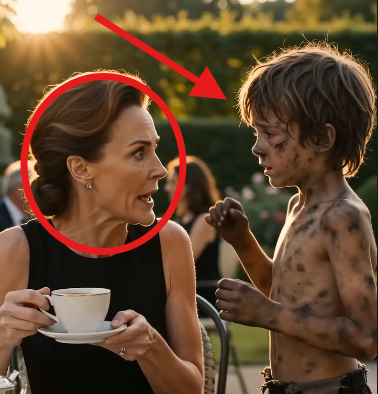
The boy sensed it immediately. That invisible current of emotion crackling between the two women. His small chest began to rise and fall too quickly, and he looked up at the woman beside him with wide, searching eyes.
“You know her?” he asked.
The woman in black rose from her chair so fast it scraped loudly against the stone beneath her. Her sunglasses slipped just slightly down the bridge of her nose, and for the first time, anyone watching could see what was happening to her face — the tears cutting silent paths down her cheeks, the trembling of her jaw, the way her entire composure had come undone in a matter of seconds.
She took one step forward. Then another. Slow. Careful. As though the slightest wrong movement might shatter everything.
“I watched you die,” she whispered.
The woman in beige finally moved toward her. When she spoke, her voice was raw and rough, roughened by years of swallowing down exactly this kind of grief.
“No. You watched them make you believe I did.”
The boy hadn’t moved. He was clutching something in his small, dirty fist — a jeweled hair clip, silver and delicate — squeezing it so tightly his knuckles had gone pale beneath the grime.
The woman in beige glanced at it, then back at the woman in black.
“I told him you’d know it the moment you saw it,” she said softly. “I told him you’d remember.”
The woman in black reached her. Stopped just short of touching her. As if she were terrified that the whole moment — this fragile, impossible reunion — would dissolve like smoke if she dared to make it real.
“What happened to you?” she asked, her voice barely above a breath.
The answer came out fractured, broken apart by years of carrying it alone.
“They took him from me. They told me you had abandoned us both. They said that if I ever tried to come near you again, they would make sure neither of us was ever found.”
The woman in black made a sound that had no name — something between a sob and a gasp, the kind of noise a person makes when the full weight of years of loss and deception lands on them all at once.
Her gaze fell to the boy.
She looked at him the way you look at something you have been searching for without ever knowing you were searching. His dark, messy hair. His wet eyes, blinking hard to keep from crying. The shape of his mouth. The way he planted his feet and tried to hold himself steady even while his whole body trembled.
Something shifted in her expression. A door opening that had been locked for years.
She was no longer looking at a stranger.
The boy’s lips quivered. He spoke quietly, with the kind of simple honesty that only children possess.
“My mom said you were beautiful,” he whispered. “She said you used to laugh with your whole face.”
That was the moment that broke her completely.
She dropped to her knees in front of him, right there on the cold stone, without a thought for her dress or her dignity or the people around them who had long since stopped pretending not to watch. Her hands hovered near his face, trembling, wanting to touch but not yet daring.
“What’s your name?” she asked, barely able to form the words.
The boy swallowed hard.
“Daniel.”
She closed her eyes. Just for one second. And when she opened them again, they held everything at once — love and grief, recognition and disbelief, sorrow and something that, against all odds, was beginning to feel like hope.
“That was the name we chose,” she whispered. “Before everything fell apart. That was always the name we had chosen for him.”
Behind her, the woman in beige pressed her hand over her mouth and wept without sound.
Daniel looked between the two women, still clutching the silver clip, his small face cycling through confusion and wonder and fear and something he didn’t yet have the words for. Slowly, he extended the clip toward the woman kneeling before him.
She took it gently, holding it like it was something sacred.
Then she looked straight into his eyes and told him the truth he had been unknowingly walking toward this entire time.
“I’m not just someone your mother knew,” she said, tears falling freely, without apology. “I’m your mother’s sister. I’m your family.”
Daniel’s face changed. Confusion gave way to shock. Shock gave way to something softer, something searching and new.
And then she pulled him into her arms — the way you hold someone you thought you had lost forever — and for a long moment, neither of them let go.
Some separations, no matter how deliberately engineered, cannot survive the truth forever. Some bonds run deeper than the lies built to break them. And sometimes, after years of silence and sorrow, the smallest thing — a silver clip, a child’s brave errand, a name spoken into the open air — is enough to bring what was torn apart back together again.