There are moments in life when the loudest person in the room believes he controls everything — the space, the energy, the fear. Victor Carter had lived inside that illusion for years, and inside those concrete walls, no one had ever dared to challenge it.
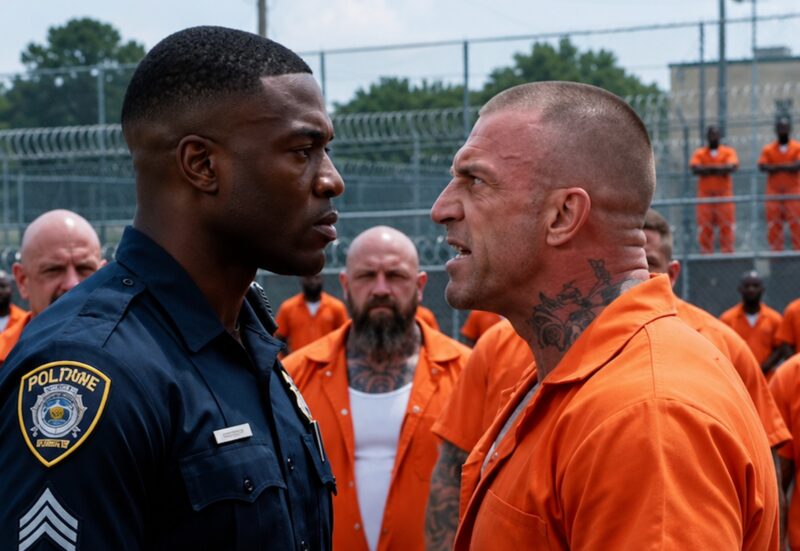
Victor was not just another difficult inmate. He was the kind of man that even seasoned corrections officers quietly stepped around. Veteran guards with decades of experience had learned through hard lessons that engaging Victor directly rarely ended well for anyone. The other prisoners watched him with a mixture of reverence and dread. Newcomers, both inmates and staff, were given the unspoken warning early on — do not make yourself a target, and whatever you do, do not show weakness in front of that man.
Then David arrived.
From his very first shift, it was clear that David was cut from entirely different cloth. He did not bark orders. He did not posture or put on a performance of authority. Instead, he walked those corridors with quiet steadiness, greeting people by name, making eye contact without aggression, and speaking to inmates the same way he would speak to anyone deserving of basic human dignity. If a man needed medical attention, David made sure he got it. If someone had a legitimate concern, David actually listened.
His colleagues warned him almost immediately. They told him, with genuine concern, that kindness in that environment would be misread. That men who had spent years surviving on dominance and distrust would see warmth as an opening, not a gesture. David heard them. He nodded. And he kept doing exactly what he believed was right.
It did not take long for the rumors to start spreading through the cellblocks. The new guard was soft. He had no edge. He would not last.
Victor heard those whispers, and he decided to put them to the test himself.
It happened during yard time, out in the open where everyone could see. Dozens of inmates were moving around the field, and several staff members were stationed nearby. Victor chose his moment carefully. He walked directly toward David with the slow, deliberate confidence of a man who had done this kind of thing before — a man who had never once faced real consequences for it.
He shoved David hard with his shoulder as he passed. Not an accident. Not a stumble. A deliberate, calculated act designed to spark a reaction.
David took one step back. Caught his balance. And looked at Victor with an expression that was neither angry nor afraid.
“Careful you don’t fall, boss,” Victor called out, his voice carrying across the yard. Laughter rippled through the crowd of onlookers.
But David said nothing.
That silence seemed to enrage Victor far more than any response could have. He moved closer, lowering his voice into something meant to cut deep. He told David that men like him did not survive long in a place like this. He called him a coward. He shoved him again, harder, and then again, each time waiting for the moment when the guard would finally snap — when the professionalism would crack and the human reaction would take over.
David stood still. He did not flinch. He did not raise his voice. He absorbed every provocation with a stillness that seemed almost unnatural to everyone watching.
Convinced he was looking at a man too frightened to fight back, Victor reached out and grabbed David by the front of his uniform.
What happened in the next few seconds changed the atmosphere of that entire facility.
In one fluid, controlled motion — the kind that comes not from anger but from years of deep, disciplined training — David broke free from the grip. He turned the larger man, disrupted his balance completely, and brought him face-down to the ground in a hold so precise and so professional that Victor had no window to resist, no leverage to fight back. There was no unnecessary force. There was no rage behind it. Just clean, practiced technique executed by someone who had done it countless times before.
The yard went absolutely silent.
Nobody had expected that. Not the inmates who had been quietly cheering Victor on. Not the other guards who had spent weeks wondering if David was really cut out for the job. Everyone had braced themselves for chaos. Instead, they witnessed something that looked almost graceful — a man completely in command of himself choosing restraint right up until the moment restraint was no longer an option.
When Victor was brought back to his feet and placed in handcuffs, David looked at him and said, quietly and without any trace of triumph in his voice:
“Respect can be earned through strength, but it can only be kept through discipline.”
Later, the staff learned what they had not known before. Prior to joining that facility, David had spent well over a decade as an instructor in a specialized law enforcement unit, training officers in advanced techniques for managing and detaining high-risk individuals. He had walked into that prison not as an inexperienced idealist, but as one of the most quietly prepared people in the building. Every moment of calmness, every refusal to rise to the bait, had been entirely intentional. He had hoped to resolve things without ever using those skills. Victor simply left him no choice.
Victor lost his privileges for several weeks as a result of the incident. More importantly, he never again approached David with anything other than a careful distance.
The rest of the prison caught on quickly. David’s stillness was not passivity. His patience was not weakness. His respect for others was not naivety.
It was the mark of a man who knew exactly who he was — and had absolutely nothing left to prove.