The shove came without warning.
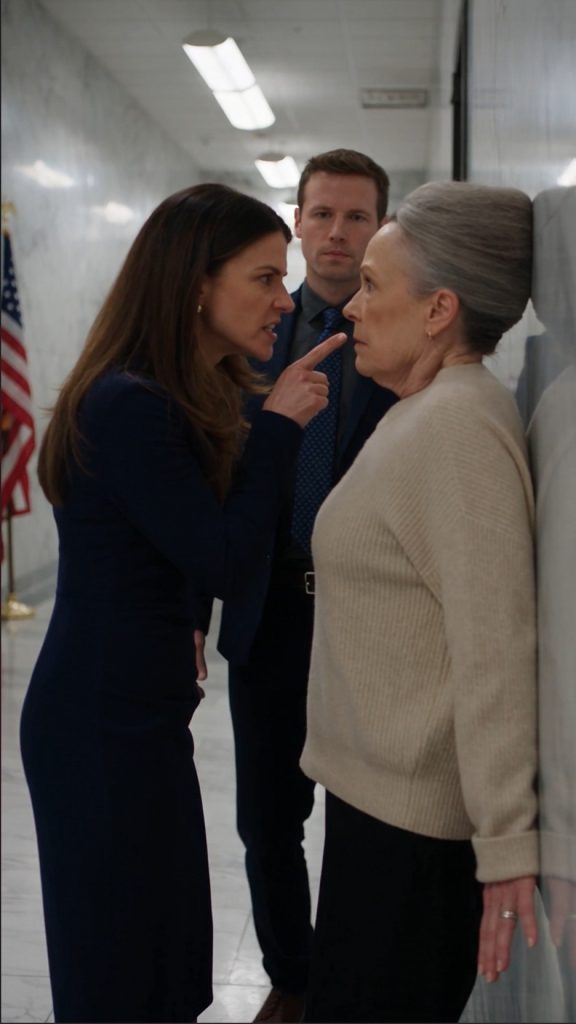
One second, I was standing beneath the courthouse lights. The next, my shoulder slammed into cold marble while my daughter-in-law leaned toward me and hissed, “You filthy old woman.”
My only son saw everything.
He did nothing.
I was seventy years old that morning, and the pain that shot down my back was sharp enough to steal my breath. The impact echoed through the corridor outside Courtroom 4B, loud enough that a security officer straightened and two passing attorneys turned.
A clerk stopped dead, clutching a stack of files against her chest.
Three steps away, David stared at the polished floor.
That was the part I couldn’t understand.
I had raised him alone.
When his father left, I worked double shifts and skipped meals without ever letting David know how frightened I was about money. I sat through every Saturday game, every school ceremony, every disappointment he thought would ruin his life.
Years later, after his first legal internship, he hugged me on the courthouse steps.
“I’m going to make you proud, Mom.”
I had believed him.
Now he couldn’t even meet my eyes.
Clara moved closer.
Her navy designer dress looked untouched by the chaos around her. Red lipstick. Perfect nails. Expensive perfume lingering in the sterile courthouse air.
And that flawless smile.
“You’re an embarrassment to this family,” she said softly.
I steadied one hand against the marble.
My gray hair was pinned into its usual bun with a small silver clip. My shoulder throbbed beneath my cardigan, but I refused to give Clara the satisfaction of seeing me crumble.
Then she noticed the people watching.
Her chin lifted.
“You should’ve stayed home,” she said. “This hearing has nothing to do with you.”
She turned toward David.
“Get her out of here. She’s humiliating us.”
Finally, my son opened his mouth.
For one foolish second, hope rose inside me.
Maybe he remembered the nights I had sat beside his bed when he was sick. Maybe he remembered the woman who had sacrificed everything so he could stand in courthouses like this one wearing an expensive suit.
Maybe he would finally say, “Enough, Clara.”
Instead, his voice came out barely above a whisper.
“Mom… maybe you should wait downstairs.”
The silence afterward hurt more than being thrown into the wall.
Several people looked away.
I swallowed.
Then I nodded once.
“Of course.”
Clara smiled.
She thought she had won.
I turned and walked toward the side corridor while David followed his wife through the doors of Courtroom 4B.
Neither of them looked back.
Neither of them noticed the security officer straighten as I passed him.
Or the way the clerk’s expression changed when she finally got a clear look at me.
At the far end of the corridor, a court officer met my eyes and gave me a quiet, respectful nod.
I stopped at an unmarked side door.
Then I opened it.
Inside was a private room I knew better than Clara could ever imagine.
I removed my cardigan and hung it carefully over the back of a chair. Facing the small mirror, I adjusted the silver pin in my hair and smoothed the front of my sweater.
Then I looked at what was waiting beside the desk.
Black wool.
Heavy shoulders.
A garment carrying the weight of every argument I had listened to, every carefully constructed lie I had watched collapse, and every person who had entered a courtroom believing the quiet woman before them could be underestimated.
My fingers moved slowly across the fabric.
Beyond the wall, chairs scraped against the courtroom floor.
An officer called everyone to order.
I slipped my arms into the black robe.
Then someone knocked sharply on the private door.
“Helen?”
It was the clerk.
Something in her voice made me turn immediately.
“You need to see this before you go in.”
She pushed an envelope through the narrow opening.
David’s name was written across the front.
In the corner was a case number.
I recognized it instantly.
My hand went still.
Because David wasn’t sitting inside Courtroom 4B simply to support Clara.
And whatever was inside that envelope, someone had gone to extraordinary lengths to keep it off my bench.
On the other side of the wall, the courtroom fell completely silent.
Then the handle of the private door began to turn.
Nobody in that room was prepared for what came next. 👇
The door opened only three inches before the clerk slipped inside and shut it behind her.
Her face had gone pale. “Judge Warren, he gave this to me himself at seven this morning.”
I looked down at David’s name.
“Who tried to stop it?”
She swallowed. “Mrs. Warren.”
Beyond the wall, chairs scraped across the courtroom floor. Clara’s heels clicked once, then stopped.
I broke the seal.
The first page was an affidavit signed by David.
For eight months, Clara had been moving money from client trust accounts through shell companies linked to her brother. When David discovered the transfers, she used his credentials and forged his electronic approval to make it appear he had authorized them.
There were bank records, copies of messages, and transcripts from recordings David had made after realizing Clara intended to blame him if the missing money was discovered.
Then I reached the last page.
Clara knew he had gathered evidence. She had threatened to destroy his career, accuse him of participating in the fraud, and publicly claim I had used my position to protect him.
The hearing in Courtroom 4B was not what she had told me it was.
David was not there as her loyal husband.
He was the cooperating witness who had brought the case down on her.
My knees nearly gave way.
Not from relief.
From the memory of him staring at the floor while her hand drove me into marble.
The clerk pointed to a small black device clipped beneath the affidavit.
“He was wearing this in the corridor.”
A recorder.
The insult. The shove. Clara ordering him to remove me.
Every word had been captured.
I closed the envelope. “Call the presiding judge.”
“You’re scheduled to take the bench.”
“Not anymore.”
When I entered Courtroom 4B in my robe, everyone rose.
Clara turned.
For the first time that morning, her perfect face emptied of certainty.
David looked at me.
His eyes were red.
I took the bench only long enough to make the record clear.
“This court has received information establishing that my son may be a material witness. I am recusing myself immediately. The evidence delivered to chambers will be preserved and transferred to the presiding judge.”
Clara’s chair scraped backward.
“That’s ridiculous. David isn’t a witness. He’s my husband.”
David flinched, then placed another envelope on the table.
“Not after today.”
The room went silent.
Clara stared at him.
“What did you do?”
His hands trembled.
“I told the truth.”
Her expression hardened.
“You pathetic coward.”
She stood, but her attorney caught her wrist.
David did not move.
“You said you’d ruin her,” he said, glancing at me. “You said if I went to investigators, you’d make everyone believe my mother fixed the case.”
Clara’s eyes jumped toward the side door.
The security officer who had watched her shove me stepped into the aisle.
She stopped.
Then the presiding judge entered.
What followed did not feel triumphant.
It felt exact.
The transfers.
The forged approvals.
The messages telling David to delete records.
Clara’s attempt to pressure the clerk into withholding his affidavit.
Then the recording from the corridor.
Her own voice filled the courtroom.
“You’re an embarrassment to this family.”
A second later came the hard sound of my body hitting marble.
No one moved.
Clara sat perfectly still as her cruelty played back to her.
David covered his mouth with one hand.
I left before anyone could see mine shaking.
He found me twenty minutes later on the courthouse steps.
Rain had begun to fall, light and cold.
“Mom.”
I did not turn.
“I’m sorry.”
When I finally looked at him, he seemed smaller than he had that morning.
“You watched her put her hands on me.”
His jaw tightened. “I know.”
“You watched.”
“I was wired. The investigators told me not to react unless you were in immediate danger. They needed her to believe I was still afraid of her.”
“And were you?”
“Yes.”
The answer came so quickly that it hurt.
David wiped rain from his face.
“I kept telling myself I was protecting you. That if I broke cover, she’d destroy the evidence and come after you next. But when she shoved you…” His voice cracked. “I should have stopped it. Whatever it cost.”
For years I had protected him from everything I could.
This was the first time I understood that love could not protect a grown man from his own fear.
So I did not forgive him on those steps.
“You don’t get your mother back because you finally did the right thing.”
He nodded.
“I know.”
“You earn trust slowly.”
Another nod.
“I’ll wait.”
Clara did not leave the courthouse freely that afternoon.
The fraud evidence, interference with the affidavit, and assault in the corridor gave authorities enough to act. By sunset, the woman who had entered wearing red lipstick and complete certainty was escorted out through a secured door.
She looked at David once.
He did not look back.
The case moved without me.
I testified only where required. David turned over everything and accepted the professional consequences of allowing Clara access to credentials he should have protected.
He did not ask me to rescue him.
That mattered.
The clerk received a formal commendation for refusing Clara’s pressure. The security officer’s report became part of the assault case. Recovered money began returning to the clients whose trust accounts had been drained.
Clara eventually pleaded guilty rather than face the full weight of the evidence at trial.
There was no dramatic speech.
Only a courtroom, a lowered head, and consequences that could no longer be negotiated away.
Months later, David stood on my porch holding a grocery bag.
“I brought the terrible coffee you like.”
“It is not terrible.”
“It tastes like burnt furniture.”
I almost smiled.
He noticed.
That was how we began again.
Not with forgiveness.
With coffee.
With small repairs.
He fixed the loose hinge on my kitchen cabinet. I asked about his new job at a legal aid office. Some evenings we spoke about Clara. Other evenings we did not.
Then one Sunday, while we were washing dishes, David placed something beside the sink.
My silver hair pin.
I touched my hair instinctively.
The pin I had worn the morning of the hearing had vanished after the courthouse. I assumed it had fallen somewhere near the wall.
“I found it that day,” he said.
My hand stopped.
“It was on the floor where she shoved you.”
He looked down.
“I picked it up before I went into the courtroom. I kept it because I thought if everything went wrong, I wanted one thing that reminded me who I was before I became afraid of her.”
The kitchen went still.
All that time, I had believed David stared at the floor because he was ashamed of me.
He had been looking at the pin.
I sat down.
He knelt beside my chair.
“I did fail you that morning,” he said. “I won’t pretend I didn’t. But I was trying to find my way back to you before you knew I was lost.”
My fingers closed around the silver.
Then, for the first time since Courtroom 4B, I reached for my son.
He folded into my arms the way he had as a boy.
No speeches.
No promises.
Just the quiet sound of both of us breathing.
A year later, on a bright Saturday morning, David drove me past the courthouse.
We did not stop.
We kept going to the old community field where he had played as a child.
Children ran across the grass beneath a pale blue sky. Parents shouted from folding chairs. Somewhere nearby, someone was burning hot dogs on a grill.
David handed me a paper cup of coffee.
I took one sip and frowned.
“This is terrible.”
He laughed.
It was the first time I had heard that sound from him without guilt hiding underneath it.
I wore the silver pin in my hair.
David noticed, but said nothing.
He only squeezed my hand once and turned back toward the field.
The morning sun warmed my face.
For the first time in years, I was no longer waiting for the next betrayal, the next accusation, or the next door to open.
The fight was over.
My son was beside me.
The pin was back where it belonged.
And, finally, so were we.