Her hand caught his wrist just as he reached for the clasp of her red clutch. Around the dining table, thirty-two guests went motionless. His fiancée looked terrified of what the bag might contain.
Fifteen minutes earlier, I had been only the maid sent upstairs for her engagement ring.
My name is Emma Reed. I was twenty-seven, eleven months into my job at Luca Moretti’s Gold Coast mansion, and I needed every paycheck. Vanessa Bellini, his fiancée, never let me forget I cleaned her bathrooms.
She’d ordered me to retrieve the ring from her dressing-table drawer. “And touch nothing else,” she’d added, champagne glass in hand.
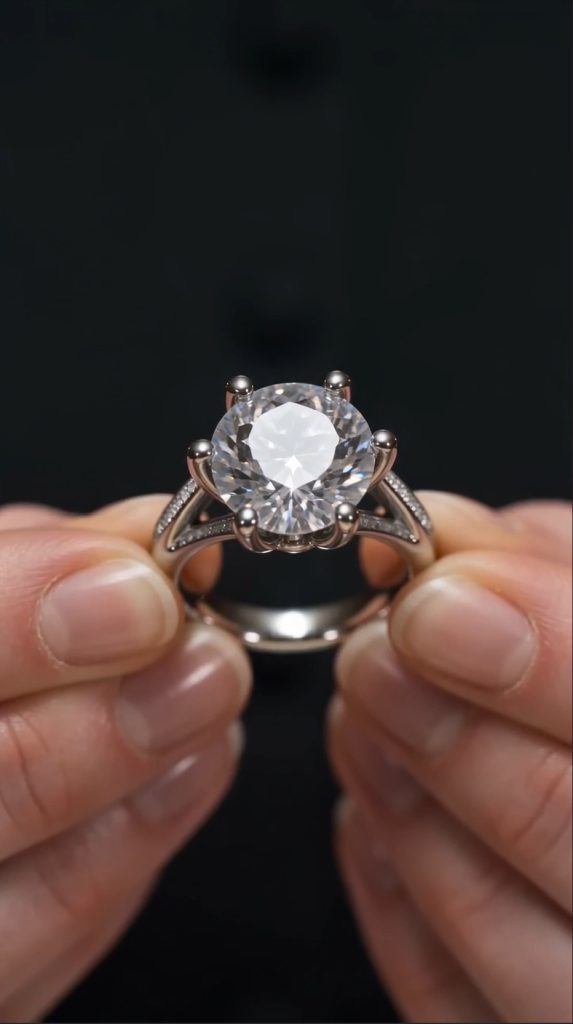
It lay in a red velvet tray, its emerald-cut center stone flanked by two smaller stones. Luca, Chicago’s mafia boss, had reportedly paid more for it than my parents’ house was worth. But when I lifted it, something was wrong.
Too light. Too bright. And missing the tiny nick Vanessa had made against the marble kitchen island at Christmas, when she’d made me search for a stone she thought had fallen out.
Inside the band was a stamp: 925.
My mother had spent twenty-three years behind a pawnshop jewelry counter. I’d grown up among wedding rings surrendered to pay bills, learning that 925 meant sterling silver—not platinum.
Vanessa appeared in the doorway. When I asked whether the ring had been replaced, she closed the door. I mentioned the stamp.
“I know what it says.” Her voice turned cold. “You clean toilets here. Don’t mistake access to expensive things for understanding them.”
I thought of my father’s rent, my younger brother’s community-college tuition, and the repair my mother’s old Buick still needed. Vanessa smiled as if she knew exactly what that silence cost me.
“Good girl. Bring it downstairs.”
But beneath the chandeliers, I couldn’t make myself return it. Vanessa held out her hand, called me a thieving little maid, and demanded the ring while every guest watched.
“Sir,” I asked Luca, “what metal did you buy?”
“Platinum.”
“Then this isn’t your ring.”
His expression barely changed. Vanessa laughed and announced it was merely a travel replica, a precaution wealthy women supposedly took.
Luca turned toward her. “How did you know what she was going to say?”
For the first time, Vanessa struggled to answer.
He took the ring from me, examined the stamp, and asked where the original was. “At Barlowe,” she said. “Being cleaned.”
I remembered serving breakfast Tuesday, when the real ring had clicked against her coffee cup as she complained about the florist. Vanessa insisted she’d taken it to the jeweler that afternoon.
“Show me the repair ticket,” Luca said.
She had no number, no receipt, no email she would produce. He calmly told Marco to call Barlowe.
I remembered the second tray upstairs: black velvet, empty except for a rectangular impression. Beside it lay a white cloth streaked gray with metal polish. I told Luca.
“You don’t normally polish a ring before sending it away to be cleaned,” I said.
“Enough!” Vanessa snapped.
“Sit down,” Luca replied.
Then, without anyone accusing her of selling anything, she blurted, “I didn’t sell the diamond.”
Luca looked up. “I didn’t ask whether you sold it.”
Marco returned. Barlowe had no repair recorded under either Vanessa’s name or Luca’s. She called it a mistake and reached, almost casually, for the red clutch beside her plate.
“Leave it,” Luca said.
I remembered the faint movement I’d heard inside that bag upstairs—the sound I suspected came from a ring box. When I said so, Vanessa went pale.
Luca drew the clutch toward him. Vanessa seized his wrist.
“Luca, don’t.”
He waited until she let go, then placed his thumb on the clasp.
“If my ring is at Barlowe,” he asked softly, “why are you afraid I’ll find it here?”
Nobody dared answer. Not yet. 👇
Vanessa’s fingers tightened around the edge of the table.
For a moment, I thought she might reach for the clutch again. Instead, she looked around at the guests, searching their faces for someone willing to rescue her.
Nobody moved.
The small metallic click of the clasp seemed impossibly loud.
Luca opened the bag.
Inside were a lipstick, a folded tissue, a car key, and a small black jewelry box.
Vanessa closed her eyes.
Luca lifted the box carefully, almost reluctantly, as though whatever it contained might weigh more than the ring itself.
“Please,” Vanessa whispered.
He opened it.
Nestled against the velvet was a diamond ring.
I recognized the emerald-cut center stone immediately. The two smaller stones were exactly where they belonged, and beneath the left side of the setting was the tiny nick I’d spent twenty minutes searching the kitchen floor over Christmas.
It was the real ring.
Luca stared at it without speaking.
Then he looked at Vanessa.
“You told me it was at Barlowe.”
She pressed her lips together.
“Why would you lie about something I gave you?”
A tear slipped down her cheek.
“I was going to explain.”
“When?”
Her mouth opened, then closed.
“When you found it?” he asked.
The room felt colder.
I stood near the doorway, my hands clasped so tightly that my fingernails were pressing crescents into my palms. Part of me wanted to leave before anyone remembered I was there.
But Luca turned toward me.
“Emma. Come here.”
My legs felt strangely heavy.
He placed both rings on the table, side by side.
“Tell me what you see.”
I examined the original first.
“The nick is still there. The weight feels right. The setting matches what I remember.”
“And the stone?”
“I can’t authenticate a diamond just by looking at it, sir.”
Luca nodded.
It was the first time that evening someone had seemed grateful for what I didn’t claim to know.
Then Vanessa laughed.
It was a broken, exhausted sound.
“Wonderful. Now my housekeeper is a jewelry expert.”
Luca didn’t look at her.
“Emma has given me more honest answers tonight than you have.”
Vanessa flinched.
Then something changed in her face.
The fear was still there, but underneath it was anger.
“You want honesty?” she asked. “Fine. I was going to sell it.”
Someone at the far end of the table lowered a glass.
Luca remained still.
“Why?”
Vanessa wiped her cheeks angrily.
“Because I needed money.”
“You have access to everything you need.”
“Not money that belongs to me.”
The sentence hung between them.
She looked toward the chandeliers, the enormous windows, the polished dining table.
“Everything in this house is yours, Luca. Your accounts. Your staff. Your rules. Even the engagement ring came with your name attached.”
“Then why agree to marry me?”
Her expression crumpled.
“Because I thought being loved by you would make me feel secure.”
For a few seconds, I almost felt sorry for her.
Then she looked at me.
“And I wasn’t going to let some little maid destroy the only good thing I had left.”
The sympathy disappeared.
Luca’s voice became quieter.
“Emma didn’t put that ring in your bag.”
Vanessa looked away.
“She didn’t invent the jeweler. She didn’t tell me you had sold anything. You did all of that yourself.”
Marco stepped closer.
“There’s something else.”
Luca turned.
Marco held out his phone.
“Barlowe’s manager returned my call. He checked their records. Vanessa visited last Thursday, but not for a cleaning.”
Vanessa’s face drained.
“She asked for an independent valuation,” Marco continued. “They recorded the appointment under her number.”
Luca’s jaw tightened.
“Anything else?”
“The manager said she asked whether the center stone could be sold separately.”
Vanessa pushed back her chair.
“Stop.”
But Marco hadn’t finished.
“She also asked about having a cheaper replacement made.”
Luca looked down at the silver ring.
The room had become so quiet that I could hear the faint hum of the heating system.
Vanessa began crying.
“I didn’t sell it,” she said. “You can see that. I couldn’t go through with it.”
Luca studied her for a long moment.
“Then why was the replica there?”
“I wanted time to decide.”
“Time to decide whether to sell my engagement ring?”
She lowered her head.
“No. Whether I wanted to marry you.”
The words seemed to strike him harder than anything else that evening.
He sat down slowly.
For the first time since I’d worked for him, Luca Moretti looked like a man who didn’t know what to say.
Vanessa covered her mouth.
“I was afraid to tell you.”
“Afraid of what?”
“Of losing everything.”
He looked around the dining room.
“Then you should have told me you were unhappy.”
She whispered, “Would you have listened?”
Luca didn’t answer immediately.
And in that silence, something more painful than anger entered the room.
Perhaps he wasn’t certain he would have.
Then Vanessa turned toward me.
“I never meant for you to get involved.”
I stared at her.
“You called me a thief.”
“I was panicking.”
“You threatened my job.”
She looked down.
“My family depends on that job,” I continued. “You knew that. And you still tried to make everyone believe I’d stolen from you.”
My voice shook on the final words.
I hated that it did.
But I didn’t take them back.
Vanessa looked at my hands, then at my face.
For once, she seemed unable to find a cruel answer.
Luca stood.
“Vanessa, the engagement is over.”
She went completely still.
“No.”
“I can’t marry someone who would sacrifice an innocent person’s reputation to protect a lie.”
She reached for him.
“Luca, please.”
He stepped away.
It was only a small movement, but everyone saw it.
“I’ll have Marco arrange for your belongings to be returned to your family tomorrow. You’ll have your own transportation, and no one will interfere with you leaving.”
Vanessa stared at the ring.
“What about us?”
Luca looked at the woman he’d planned to marry.
“There isn’t an us I can trust anymore.”
Her shoulders fell.
The diamonds on the table glittered beneath the chandeliers.
Neither of them reached for them.
Before Vanessa left, Luca asked Marco to document the jewelry, the calls, and the false accusation. He told the guests plainly that I had stolen nothing.
Vanessa stopped at the doorway.
She looked back at me.
“I’m sorry, Emma.”
I searched her face.
Perhaps she meant it. Perhaps she only understood what her actions had cost her.
“I hope one day you understand what you did,” I said.
She lowered her eyes and walked away.
Nobody applauded.
Nobody celebrated.
The guests departed quietly, leaving untouched desserts and half-empty glasses behind.
I began gathering the plates because I didn’t know what else to do.
“Emma.”
Luca stood at the end of the table.
“Leave those.”
I froze.
“Am I fired, sir?”
He looked genuinely startled.
“Fired?”
I swallowed.
“I embarrassed your fiancée in front of everyone.”
“No.” He shook his head. “She embarrassed herself.”
He looked toward the empty doorway.
“And I let her speak to you that way in my home.”
For a moment, he seemed to struggle with the words.
“I’m sorry.”
I had imagined plenty of things happening that night.
An apology from Luca Moretti hadn’t been among them.
He continued.
“Your job is safe. You’ll be paid for tonight, and tomorrow you can take the day off.”
“Thank you, sir.”
He paused.
“Emma, you don’t have to call me sir when you’re telling me I’m wrong.”
I almost smiled.
“That might take some practice.”
For the first time all evening, he smiled too.
The next morning, I called my mother.
She answered from the kitchen, with my father’s radio murmuring somewhere behind her.
“Emma? You’re calling early. Is everything all right?”
I tried to tell her calmly.
I managed about three sentences before my voice broke.
She listened without interrupting.
When I finished, she said, “Honey, are you safe?”
That question undid me.
Not whether I’d impressed a wealthy man.
Not whether I’d kept my job.
Just whether I was safe.
“Yes, Mom.”
“Good. Then come home for dinner.”
Two weeks later, Vanessa’s planned sale was confirmed through the jeweler’s appointment records and messages she voluntarily provided while collecting her belongings. The ring had never been sold. The replica remained with Luca’s attorney, and the accusation against me was formally withdrawn in writing.
Vanessa left Chicago to stay with relatives. No wedding took place.
Luca kept his promise about my job.
But he did something else I hadn’t expected.
He arranged a meeting with the household staff, apologized for allowing Vanessa’s treatment of us, and introduced written protections against retaliation and false accusations.
Then he asked me to stay afterward.
“I wanted to give you something.”
He pushed an envelope across his desk.
Inside was a generous bonus.
I stared at the number.
“Mr. Moretti, this is too much.”
“No,” he said. “It’s recognition for what you did. And it comes without conditions.”
I thought about my brother’s tuition.
My father’s rent.
The Buick sitting in my mother’s driveway.
For the first time in months, those worries no longer felt like stones in my chest.
“Thank you,” I whispered.
He nodded, but there was another envelope.
“This isn’t from me.”
I frowned.
“Then who?”
“Your mother.”
My breath caught.
Inside was a letter written in her familiar, sloping handwriting.
She had contacted Luca after I’d told her what happened.
She wanted him to understand something about the girl who had recognized a false ring.
When I was little, my mother wrote, I’d sometimes ask why people came into the pawnshop looking ashamed.
She told me that losing something valuable didn’t make someone less valuable.
And that the most important thing she could teach me about jewelry wasn’t how to recognize gold or diamonds.
It was how to recognize when someone was being treated as if they were worth less than either.
At the bottom, she’d written:
I’m proud that you remembered.
I pressed the letter against my chest.
Luca looked away, giving me room to cry.
That Sunday, I drove home.
My brother opened the door before I reached the porch.
“Apparently, my sister is now the family diamond detective.”
I laughed so hard I nearly dropped my bag.
My father hugged me longer than usual. My mother stood behind him, drying her hands on a dish towel, her eyes already wet.
Dinner was simple.
Roast chicken. Potatoes. The slightly overcooked carrots my father always insisted were perfect.
My brother talked about his classes.
My father told an unnecessarily long story about the Buick finally getting fixed.
And my mother kept reaching across the table to squeeze my hand.
Eventually, she asked, “Are you going back to work tomorrow?”
“Yes.”
“Are you afraid?”
I thought about Vanessa’s face, the silent dining room, and the terrible moment when I believed speaking the truth might cost my family everything.
“A little.”
Mom nodded.
“Courage doesn’t mean you stop being afraid.”
I looked at her.
“It means you remember what matters while you’re afraid.”
Outside, a light rain began tapping against the kitchen window.
My father turned down the radio.
My brother reached for another helping of potatoes.
And my mother slipped her hand into mine beneath the table.
For eleven months, I’d worked inside a mansion filled with things people called priceless.
That evening, sitting between the people I loved, I finally understood what the word meant.
The rain kept falling, dinner stretched into laughter, and nobody needed anything from me except to stay a little longer.
So I did.