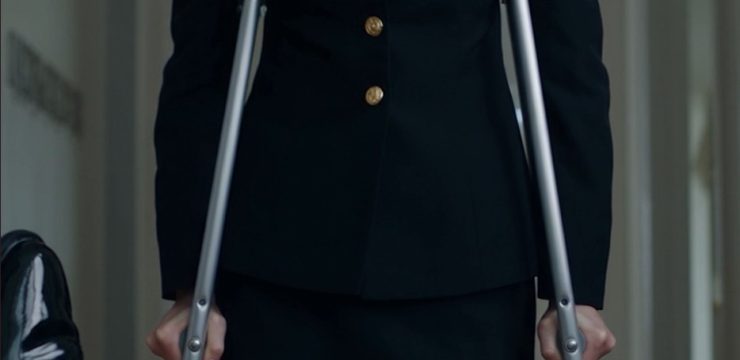
The laughter died the instant the glass shattered against the marble floor. From the shadows at the back of the ballroom, an older man stared at the uniform everyone had been mocking—and the color drained from his face.
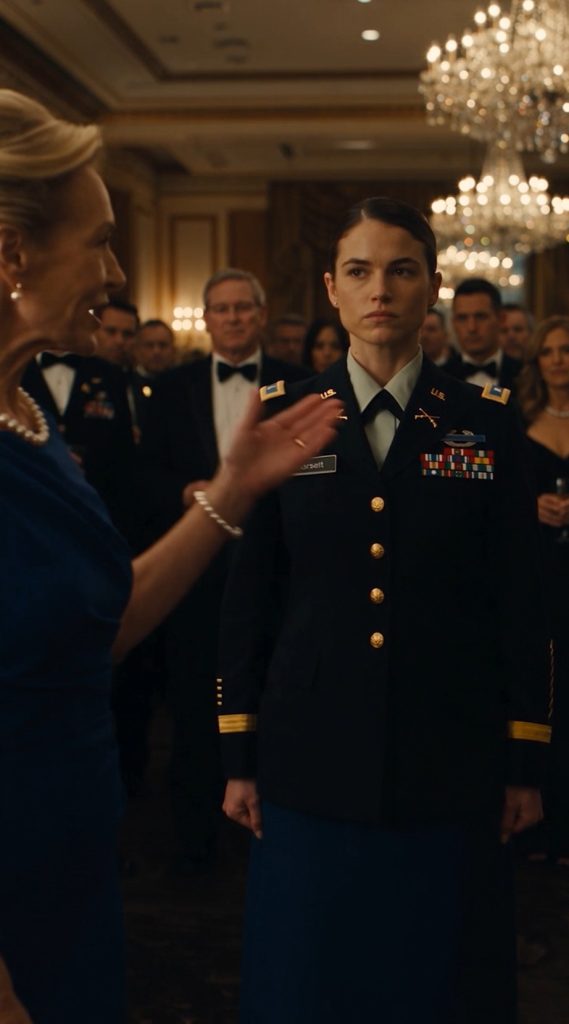
Only minutes earlier, forty-seven people had been laughing.
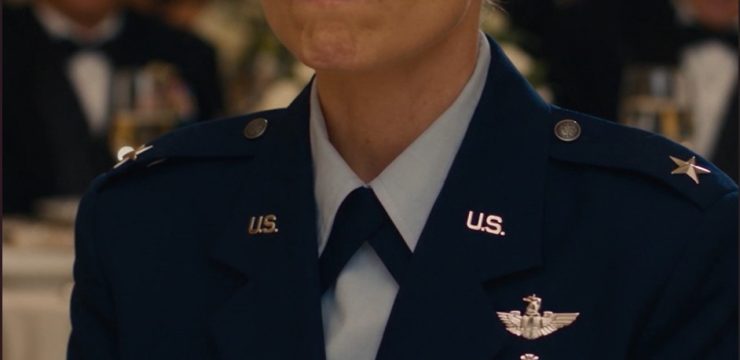
My mother’s red-painted fingernail tapped one of the ribbons on my chest as though she were testing a cheap imitation.
“Look at her,” she said, laughing hard enough to make the pearls around her neck tremble. “My daughter actually believes she’s a lieutenant colonel in the United States Army.”
Beneath the chandeliers of the Sterling Hotel ballroom, every face turned toward me.
I counted them automatically.
Forty-seven guests. Two private security guards. Three exits. One service corridor behind the bar. A grand staircase leading down to the lobby.
Old habit.
I always noticed the exits before I noticed the people.
Then came the faces.
Smirks. Raised eyebrows. A woman hiding her laughter behind one hand. A tuxedoed man murmuring, “Poor thing,” as though I were some confused stranger who had wandered into the wrong party.
My mother, Marjorie Hale, stood three feet away in a midnight-blue gown, her arm threaded possessively through Clive Westbrook’s.
Clive had the kind of money that demanded attention. Even his gold watch chain seemed designed to announce itself.
He had paid for the ballroom. The champagne. The string quartet.
And tonight, apparently, my humiliation.
Behind them stood my brother, Preston, carrying a leather folder beneath one arm.
I already knew what was inside.
Guardianship papers.
A legal surrender dressed up as family concern.
I kept my hands straight against the seams of my Army dress trousers. My shoes were polished almost perfectly, except for a faint crease in the left one from a field exercise years ago.
I had tried to buff it away.
Some marks stay.
“Evelyn, sweetheart,” my mother said, her voice suddenly soft enough for the room to hear, “there’s nothing shameful about admitting you need help.”
Laughter moved through the guests in delicate waves.
Polite laughter.
Cruel laughter.
The kind people use when they want to enjoy someone else’s destruction without admitting they helped cause it.
My throat tightened.
I had stood beneath skies turned brown with dust. Dragged injured men across broken pavement while gunfire snapped overhead. Pressed my hand against a general’s wounded shoulder and repeated, “Stay with me, sir,” until my voice went raw.
None of it had prepared me for this.
For hearing my own mother teach strangers how to laugh at me.
Clive lifted his champagne glass.
“Marjorie has endured so much,” he announced. “She’s been trying to save a daughter who refuses to accept reality.”
Sympathy moved toward her almost instantly.
Preston opened the folder.
My mother smiled.
And suddenly I was nineteen again, standing beside the fireplace in the Hale mansion while my Yale acceptance letter curled black at the edges.
She had worn that same expression then.
Not sadness.
Not anger.
Possession.
As though I had damaged something that belonged to her.
Twenty years later, I understood what I hadn’t understood then.
Some people do not tell the truth because they feel guilty.
They tell it only when lying stops working.
Preston stepped closer.
“Sign the papers,” he whispered. “Don’t make this uglier than it needs to be.”
I looked into eyes that reminded me of our father, though Preston had inherited none of his restraint.
“You gave them my records.”
His jaw tightened.
No denial.
Just one tiny crack.
“You should have stayed gone,” he muttered.
Then my mother turned back toward the room.
“My daughter has struggled with delusions for years,” she announced. “She buys uniforms. Invents missions. Tells people she saved lives.”
A glass hit the marble.
The sound cut through the ballroom like a gunshot.
Every laugh stopped.
An elderly man stepped out from the dim edge of the room. His posture was rigid, but his hands were trembling.
Then several guests seemed to recognize the four stars associated with his name.
He stared at me.
Not at my mother.
Not at Preston.
At me.
His eyes filled before he managed to speak.
“S-she…”
The entire ballroom held its breath.
“She carried me out alive.”
And nobody in that room was prepared for what came next. 👇
The general’s hand rose slowly toward his chest, stopping halfway as though even now the old wound resisted the movement. He looked at the ribbons my mother had touched, then at my face, and something inside his expression broke open.
“You were there,” he said.
My mouth went dry.
He took another step. “Outside Kandar Province. Convoy Three. The second vehicle took the blast.”
The room seemed to shrink around us.
Clive lowered his champagne glass.
My mother’s smile remained on her face for one second too long.
Then it vanished.
The general’s voice steadied. “Lieutenant Colonel Evelyn Hale was a captain then. She crossed open ground under fire after I went down. She ignored my order to leave me. She dragged me behind the remains of a wall and kept pressure on my shoulder until the evacuation team reached us.”
No one moved.
Even the quartet had stopped playing.
I could hear the faint electrical hum of the chandeliers.
The general looked toward my mother.
“I spent six months learning to use this arm again,” he said quietly. “Your daughter is the reason I had an arm left to rehabilitate.”
My mother opened her mouth.
Nothing came out.
Preston’s fingers tightened around the leather folder until the edges bent.
Clive recovered first.
“This is touching,” he said, forcing a laugh that died almost immediately. “But surely one old battlefield story doesn’t address Marjorie’s concerns about Evelyn’s current mental state.”
The general turned his head.
The look he gave Clive was almost gentle.
That made it worse.
“You should choose your next sentence carefully.”
Clive’s face hardened.
I looked at Preston.
“Give me the folder.”
He held it against his chest.
“Evelyn—”
“Give it to me.”
My voice never rose.
It did not need to.
Something changed in his face then. The arrogance was still there, but underneath it was fear. Not fear of me.
Fear of what I already knew.
My mother stepped between us.
“No. We are not turning this into some military spectacle.”
I looked at her.
“You already turned it into a spectacle.”
Her shoulders flinched.
For the first time that evening, she looked less like the woman controlling the room and more like someone who had suddenly realized the doors might lock from the outside.
I reached for the folder.
Preston pulled it back.
That was his mistake.
Several loose pages slipped free and scattered across the marble.
One landed near the general’s shoe.
Another slid beneath a table.
A third stopped faceup beside Clive.
I saw his expression change before I saw the page.
“Pick that up,” he snapped.
Nobody moved.
The general bent carefully, retrieved the paper, and read the first few lines.
His jaw tightened.
“What is this?”
Preston went pale.
My mother whispered his name.
I stepped forward and took the page.
It was the medical declaration they intended to attach to the guardianship petition.
My name.
My date of birth.
A diagnosis I had never received.
And beneath it, the signature of a physician I had never met.
I looked at Preston.
“You forged a competency evaluation?”
“No.”
Too fast.
Clive stepped toward me. “That document was prepared by counsel.”
“Then counsel can explain it.”
“Evelyn,” my mother said, her voice suddenly small, “we were trying to protect you.”
“From what?”
She stared at me.
I waited.
Her eyes dropped.
That silence answered more than anything she could have said.
Preston sank into a chair.
Clive turned on him immediately.
“You idiot.”
There it was.
Not concern.
Not confusion.
Recognition.
Forty-seven guests heard it.
Preston looked up slowly.
Something in him changed.
Perhaps it was realizing Clive would sacrifice him without hesitation. Perhaps it was finally hearing, in front of witnesses, how little his loyalty had purchased.
He placed the folder on the table.
“There are emails,” he said.
My mother closed her eyes.
Clive went absolutely still.
Preston swallowed. “He needed Marjorie to control Evelyn’s share of the family trust. His development company is overleveraged. The banks wouldn’t extend the loans without additional collateral.”
A woman near the bar whispered, “Oh my God.”
Clive’s face became gray.
Preston continued, each word seeming to cost him something.
“He said if Evelyn was declared incompetent, Mom could become guardian and petition for control of the distributions.”
My mother gripped the back of a chair.
“You told me it was temporary.”
Clive stared at her with naked contempt.
“And you believed what you needed to believe.”
The words struck harder than a shout.
My mother’s fingers slipped from the chair.
For one terrible second, nobody looked at me.
They looked at her.
The woman who had spent the evening teaching everyone how to pity her was suddenly standing inside the truth she had helped build.
Preston pushed the folder toward me.
“The emails are behind the petition. All of them.”
I did not touch it.
My hands had begun trembling.
That surprised me.
I had imagined this confrontation in a dozen ways since learning about the petition. In none of them had I imagined my body betraying me with something as ordinary as shaking hands.
The general noticed.
He did not touch me.
He simply moved beside me.
Close enough that I was no longer standing alone.
Clive glanced toward the exits.
Old habit.
I noticed.
So did the two security guards.
“Don’t,” I said.
He looked at me.
I took out my phone.
“My attorney has copies of the petition Preston sent me yesterday. She also has my service verification, my current medical evaluation, and the messages threatening to file this if I refused to sign over financial authority.”
Preston’s head snapped up.
“You already knew?”
“I knew enough.”
Clive took one step backward.
The general’s voice was cold. “And now she has witnesses.”
The power left Clive’s face slowly.
Not dramatically.
That was the strange part.
A man who had filled an entire ballroom with his money seemed to become smaller by inches.
The security guards moved toward him, not because I ordered them to, but because the hotel manager had appeared in the doorway and was quietly speaking into a phone.
My mother looked at me.
“Evelyn.”
I had waited twenty years to hear my name in that tone.
Not as a correction.
Not as an accusation.
As a plea.
I wanted to feel victorious.
Instead, I felt tired.
“You knew I served,” I said.
Her lips parted.
“You knew.”
“I knew you joined.”
“You received my commissioning photograph.”
She looked down.
“I sent you deployment addresses.”
Her breathing became uneven.
“I sent Preston copies of promotion orders because neither of you ever answered.”
Preston covered his mouth with one hand.
My mother whispered, “I thought you were punishing me.”
“No. I was living.”
That was the sentence that broke her.
She sat down hard.
The pearls at her throat shifted crookedly.
For once, she did not fix them.
Clive tried to leave.
The hotel manager blocked his path.
What followed was quieter than his downfall deserved.
Phones came out. Guests moved away from him. The people who had spent years laughing at his jokes suddenly found other places to stand.
Preston handed the complete folder to my attorney when she arrived from the lobby.
Clive’s own documents did the rest.
The forged declaration, the emails, the financial pressure, the instructions about my trust—all of it had been preserved by the very people who believed paperwork could turn theft into respectability.
By morning, the guardianship petition was withdrawn.
Within weeks, investigators opened inquiries into the forged medical statement and the attempted financial fraud. Clive’s lenders discovered what else he had hidden from them.
His empire did not explode.
It collapsed the way badly built things usually do.
Floor by floor.
My mother moved out of his house before the month ended.
Preston cooperated with the investigation.
It did not erase what he had done.
I made sure he understood that.
One evening, he came to my apartment carrying a small fireproof box.
He set it on the table between us.
“I found this years ago,” he said.
I did not open it.
“Where?”
“Dad’s things.”
My breathing stopped for half a beat.
Preston lifted the lid.
Inside lay a scorched piece of heavy paper.
Cream-colored.
Blackened along one edge.
I knew it before he touched it.
My Yale acceptance letter.
Or what remained of it.
I stared at him.
“I burned that.”
“I know.”
He turned the fragment over.
There was handwriting on the back.
Our father’s.
Three lines.
She chose her own road.
Let her walk it.
Home should still be here when she returns.
I read the words twice.
Then a third time.
The room blurred.
Preston looked away, giving me the privacy of not being watched while I broke.
“He pulled it from the fireplace after you left,” he said. “Mom thought he threw it away.”
I pressed my thumb against the scorched edge.
For twenty years, I had remembered that fire as proof that leaving meant losing everything.
But someone had reached into the ashes.
Someone had saved what remained.
The realization hurt in a completely different way.
Preston’s voice cracked.
“I should’ve given it to you sooner.”
“Yes.”
He nodded.
No excuse.
No demand for forgiveness.
Just yes.
That mattered.
Months passed.
The case against Clive moved forward. Preston accepted the consequences of his part in it and began the slow, humiliating work of becoming someone who did not expect his last name to rescue him.
My mother and I spoke rarely at first.
Then carefully.
She apologized without using the word but.
The first time she tried to explain herself, I stopped her.
The second time, she did not explain.
She simply said, “I chose control over knowing you.”
I looked at her across a small kitchen table.
No chandeliers.
No champagne.
No audience.
“Yes,” I said.
She cried quietly.
I did not rush to comfort her.
Some wounds need truth before tenderness.
But I stayed.
That was what I could give.
The general remained in my life too.
Once, over coffee, he admitted he had almost skipped Clive’s gala.
“I hate those things,” he said.
I smiled. “So do I.”
He flexed the shoulder I had once held together with both hands.
“Best bad decision I made all year.”
For the first time, we laughed about that night.
Not because it was funny.
Because it was over.
Nearly a year later, I stood outside the Hale house beneath a pale autumn sky.
My mother had sold it.
Too large, she said.
Too full of rooms where everyone had spent years pretending.
Before handing over the keys, she asked me to come one last time.
The fireplace was cold.
I stood before it with the scorched Yale letter in my hand.
My mother stopped several feet behind me.
“I remember that night,” she whispered.
“So do I.”
“I thought if I made leaving painful enough, you would stay.”
I turned.
She looked older without the armor of pearls and perfect makeup.
“I know.”
Her eyes settled on the letter.
“Your father was better at loving you than I was.”
I folded the fragment carefully.
“He was quieter about it.”
She gave a broken little smile.
“Yes.”
Then she opened her hand.
Inside was a small brass key.
The key to the front door.
I stared at it.
“The buyers changed the locks this morning,” she said. “It doesn’t open anything anymore.”
I almost laughed.
“Then why keep it?”
“I thought you might want to be the one who throws it away.”
I looked at the key.
Then at the empty hallway behind her.
For years, that house had been the place I measured escape from.
That morning, it was only wood, stone, dust, and sunlight.
I closed her fingers around the key.
“Keep it.”
Her eyes lifted to mine.
“You may need the reminder more than I do.”
She nodded slowly.
Outside, Preston waited beside his car.
The general had sent me a ridiculous retirement gift even though I was not retiring—an engraved shoe brush with a note telling me some creases were evidence, not flaws.
I had laughed until I cried.
My mother walked me to the porch.
At the bottom step, I stopped.
She did not ask whether I would come back.
That, more than anything, told me she had finally learned something.
I reached for her hand.
Only for a moment.
Her fingers closed around mine carefully, as though holding something she had once gripped too tightly and had finally understood could only stay by being free.
Then I let go.
The afternoon light caught the faint crease in my left shoe as I walked toward Preston’s car.
This time, I did not look back to count the exits.
There was nothing behind me I needed to escape.
And for the first time in a very long while, home was not a place someone else had chosen for me.
It was wherever I could walk through the door as myself—and know I was wanted there.